Get Full Government Meeting Transcripts, Videos, & Alerts Forever!
Get email alerts on the Agritourism topic
No spam. Unsubscribe anytime.
House bill would allow wedding and event venues on agricultural land; township association urges caution
Summary
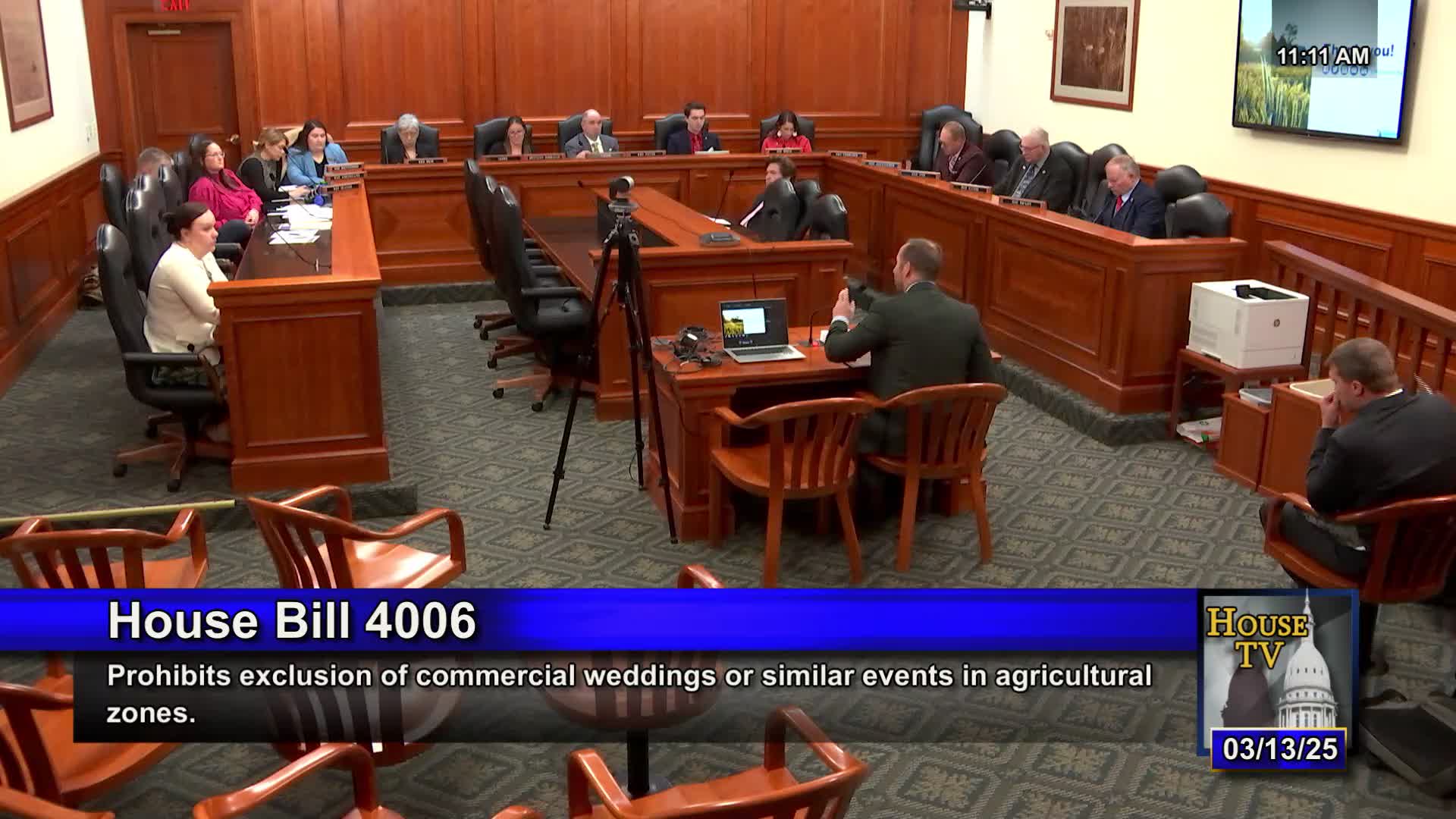
Representative Beerline introduced House Bill 4,006 to amend the Michigan Zoning Enabling Act so barns and farm facilities on agriculturally zoned land may be used as commercial event venues. Townships warn the bill’s current language would force local units to allow such uses in all cases and could increase litigation.
Representative Beerline introduced House Bill 4,006, which would amend the Michigan Zoning Enabling Act to allow barns and other facilities on agriculturally zoned land to operate as commercial venues for weddings and similar events. Beerline said the change would provide another revenue source for family farms adapting to economic pressures.
Beerline told the committee, “Michigan's agricultural heritage is a cornerstone of our state's identity and economy,” and described the bill as a way to protect property rights while allowing local regulation of hours, noise and traffic.
Nut graf: The bill drew detailed questions from members about tax treatment, inspections, local control and potential unintended consequences. The Michigan Townships Association testified that, as written, the bill could force local units to allow event venues on small or marginal parcels and could increase litigation.
In testimony, Judy Allen, director of government relations for the Michigan Townships Association, said the bill’s current language “says that we must allow. We cannot prohibit under any scenario.” Allen warned the language does not account for parcel size, adjacency to residences, or other site-specific conditions and could leave towns unable to prevent incompatible uses. She said the association is working with the sponsor but has concerns about the scope of the bill and its potential to prompt litigation.
Committee members asked practical questions. Representative Pice asked whether tax treatment would change; Representative Alexander replied that property-tax assessment is determined by local assessors and depends on how the assessor classifies the property. On inspections and food-service regulation, Beerline said venues with on-site food would have to meet the same health-department requirements as other commercial food operations. The sponsor said the bill would not eliminate local authority to regulate noise, hours or other conditions but would remove the need for a special land-use permit where those permits currently apply.
Several members sought clarity about terms and limits. Representative Wirtz asked what “similar events” includes; Beerline said it would cover other commercial rentals such as birthday parties or comparable gatherings. Members also asked whether using a parcel for events would end agricultural tax treatment; the sponsor and other members said the assessor decides that, so the effect on property taxes is “not specified” in the bill text. Judy Allen told the committee multiple counties and townships have experience with event venues and that the number of such facilities is already in the triple digits in parts of the state.
Ending: The committee heard multiple viewpoints and offered continued work between the sponsor and stakeholders. No vote on HB 4,006 was recorded at the meeting; committee members said they were working on amendments and continuing discussions with the Michigan Townships Association.