Get Full Government Meeting Transcripts, Videos, & Alerts Forever!
Get email alerts on the Federal Match Grants Fte topic
No spam. Unsubscribe anytime.
LEO explains enhancement-grants process and staffing counts to appropriations subcommittee
Summary
LEO officials told the House appropriations subcommittee how legislatively sponsored enhancement grants are executed via work projects, the department's federal-match mechanics, and provided corrected staffing totals: 2,180 authorized FTEs with 2,067 filled and approximately 113 vacancies.
The Department of Labor and Economic Opportunity told the House Appropriations Subcommittee on Labor and Economic Opportunity how legislatively sponsored enhancement grants are managed, how federal-match requirements are met and how the department accounts for FTEs.
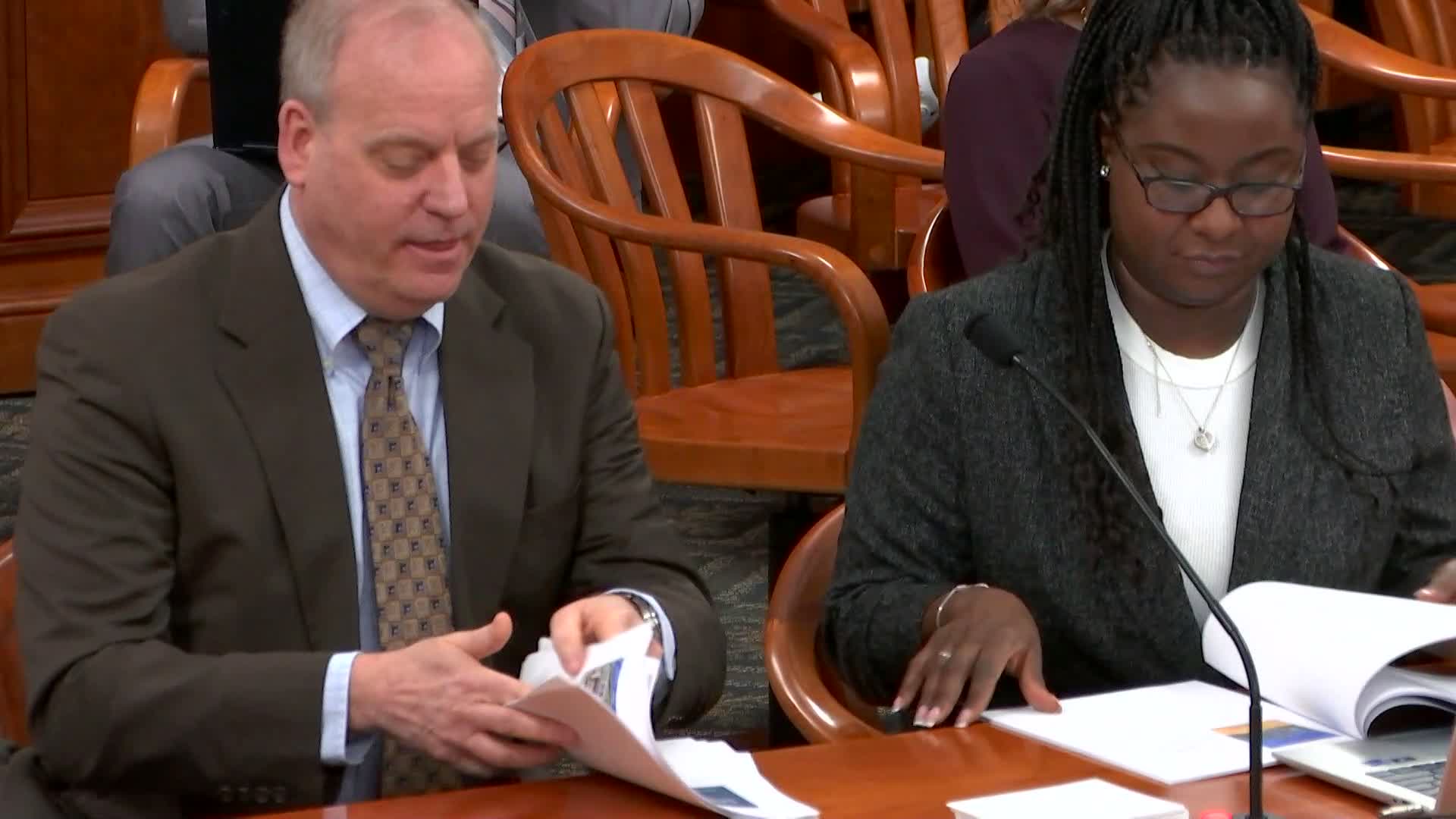
Gregory Rivett, LEO chief administrative officer, said enhancement grants (one-time, legislatively sponsored grants) are placed into work projects when grantees need additional time to execute multiyear activities. He said LEO placed more than 151 one-time grants into a work project in FY 2024 (100% fully executed; 28% of funds dispersed) and that in FY 2025 the department received 207 one-time grants with about 48% fully executed and 86% of legislative sponsor packets received. Rivett said LEO posts a March legislative report and additional reports in June and September and plans a public dashboard showing geographic distribution of enhancement grants and grant-level details.
On federal funding, Rivett said about 65% of LEO’s FY 2025 budget comes from federal sources, delivered through more than two dozen federal projects and distributed across multiple bureaus. He said many federal discretionary grants require supplemental state authorization before LEO can spend the funds and that the agency typically uses the work-project mechanism to carry federal awards forward when spending extends beyond a single fiscal year. Rivett described matching rules and said LEO seeks state match dollars so the department can draw down federal vocational rehabilitation and other funds.
Rivett also addressed FTE accounting. He corrected the report snapshot for the committee: "LEO as an organization has a total authorized FTE count of 2,180 FTEs. We currently have 2,067 FTEs filled as of the last (Feb. 15) reports," he said, explaining the difference represents roughly 113 vacancies. Rivett explained that new hires are initially coded to administrative lines by default and that limited-term employees hired on grant awards are authorized in boilerplate and may not appear on the same appropriation authorization lines. He said LEO does not exceed its total authorized FTE count and that the department is working to improve reporting so allocations appear in the appropriate program lines sooner.
Committee members asked for follow-up information on how long vacancies have been open and for clearer reporting; Rivett said he would provide that information after the meeting. Members also asked about an apparent negative balance on a Michigan infrastructure grants line; Rivett said that item was a coding adjustment and not an unapproved overspend.
Rivett described controls LEO uses to ensure accountability: detailed expenditure monitoring, reimbursement-based payment review, an internal compliance unit that performs invoice and program reviews, and audits by the state Auditor General and federal auditors. He said LEO implements corrective actions from audit recommendations.
Representative Robinson and other members asked for data on long-term vacancies and employer interest in MSHDA’s employer-assisted housing pilot; staff said they would follow up with more specific information.