Get Full Government Meeting Transcripts, Videos, & Alerts Forever!
Get email alerts on the Business Perspective Workforce topic
No spam. Unsubscribe anytime.
Michigan Chamber urges more state support for childcare, housing and Going Pro funding
Summary
The Michigan Chamber of Commerce told the House Appropriations Subcommittee on Labor and Economic Opportunity that employers face structural barriers to hiring, urged more funding and refinement for the Going Pro Talent Fund and Tri-Share childcare pilot, and recommended zoning and transit reforms to expand the worker pool.
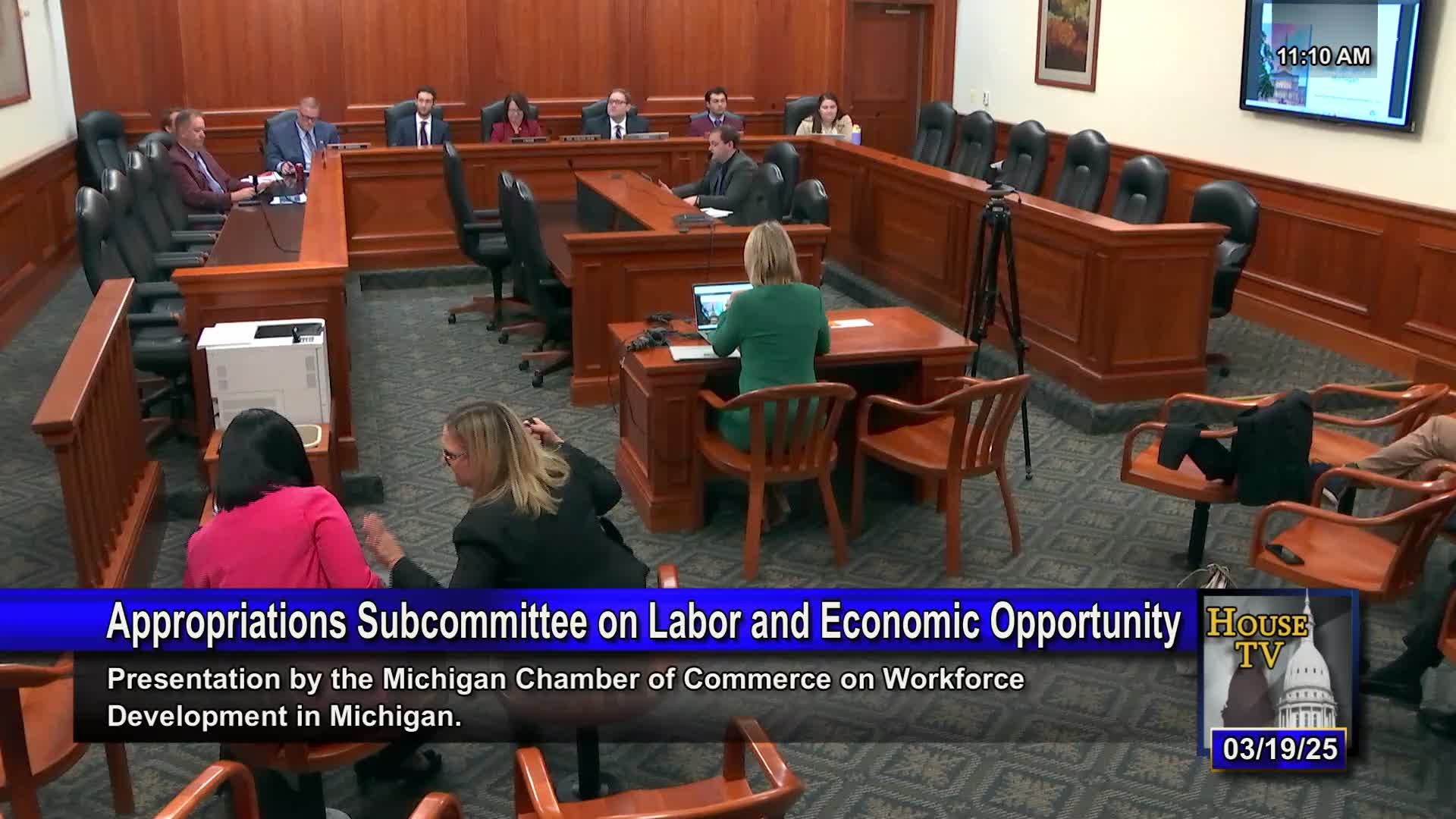
LANSING, Mich. — Wendy Block, senior vice president of business advocacy for the Michigan Chamber of Commerce, told the House Appropriations Subcommittee on Labor and Economic Opportunity on March 19 that employers across Michigan continue to face hiring challenges tied to demographics, childcare, housing and transportation.
"Workforce issues continue to be kind of at the top of the list in terms of things that businesses are voicing concern about in Michigan," said Wendy Block, introducing herself and the chamber's statewide membership during her presentation.
Block cited demographic trends and labor-force data the chamber tracks: Michigan's population is aging and the state ranks 32nd nationally for labor force participation, she said in the presentation, and those structural trends have left employers with fewer available workers and a mismatch between available worker skills and employer needs.
Block said the Going Pro Talent Fund has been the most effective state tool for employers seeking to upskill workers. She told committee members that the program—egan in 2014, has issued thousands of awards and helps employers reimburse training costs tied to industry-recognized credentials. Block said demand for Going Pro historically exceeded available funding and urged the subcommittee to examine whether the program's annual appropriations should be increased.
The Michigan Chamber also urged continued support and refinement for the Tri-Share childcare pilot, a public-private model in which employers, employees and the state each cover portions of childcare costs. Block called Tri-Share a "national model" that needs refinements to expand participation and scalability, including adjustments to eligibility and stronger employer engagement in creating childcare hubs.
On housing and transportation, Block recommended zoning and permitting reforms to speed construction of workforce-attainable housing and urged the committee to explore incentives for employers to cooperate on transit solutions across jurisdictional lines.
Block also encouraged the committee to demand stronger, publicly available data on return on investment for state workforce programs so lawmakers can evaluate whether state funds are producing measurable outcomes.
Why it matters: Block framed the issues as barriers that reduce employers' ability to hire and retain workers, and she urged state lawmakers to use a mix of incentives, regulatory reform and targeted funding to expand labor supply and make training investments more accessible to employers.
Provenance: Block's testimony began when she introduced herself to the committee and concluded when she ended her prepared remarks and opened for questions; transcript segments for both are attached below.