Get Full Government Meeting Transcripts, Videos, & Alerts Forever!
Get email alerts on the Housing Msdha topic
No spam. Unsubscribe anytime.
MSHDA describes housing grants, launches $10 million employer-assisted housing pilot
Summary
Michigan State Housing Development Authority executive director Amy Hovey told the House Appropriations Subcommittee that state appropriations for FY 2023 and FY 2024 are fully obligated, described regional programs and said a $10 million Employer Assisted Housing Fund pilot has already attracted demand.
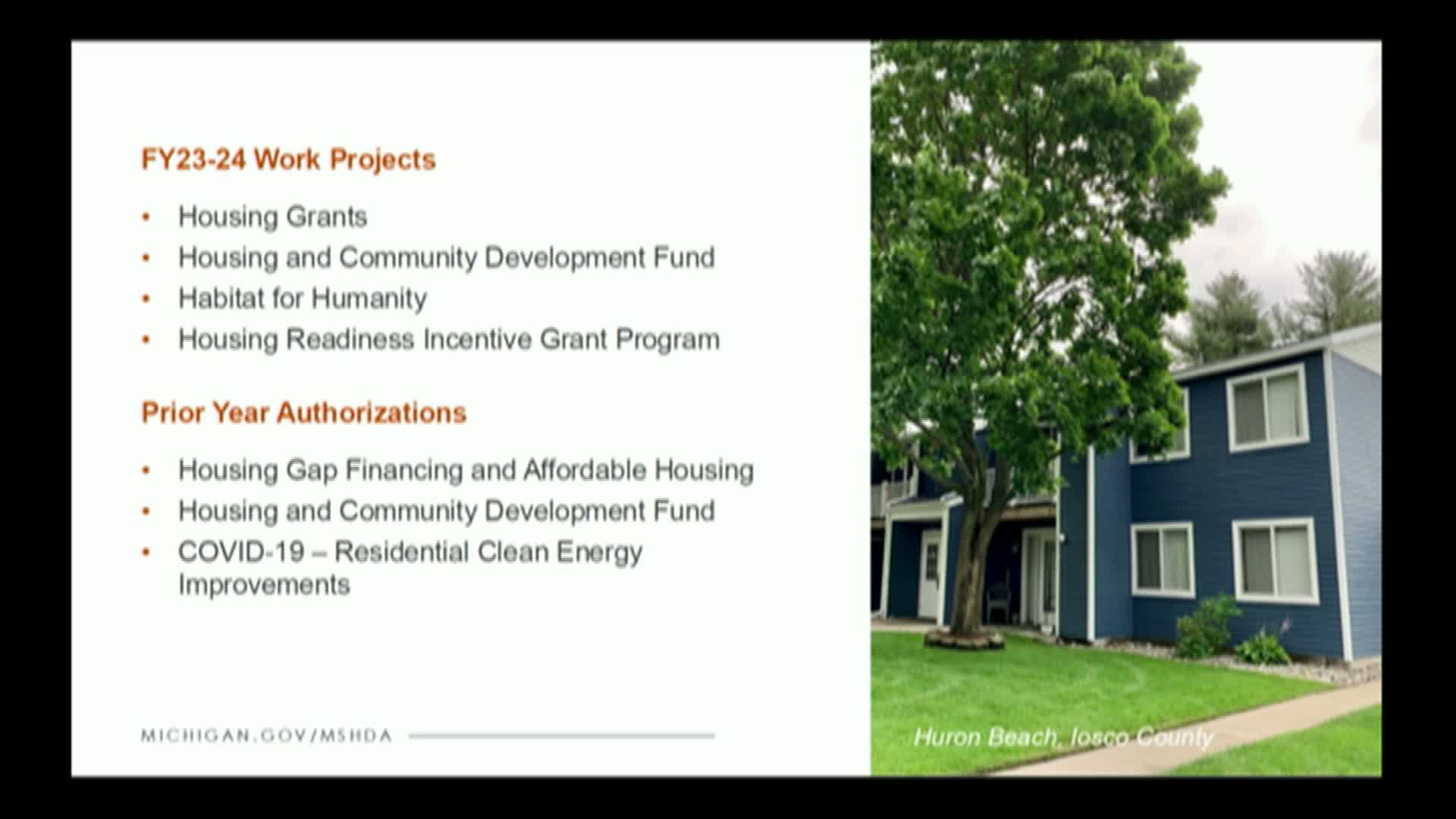
Amy Hovey, executive director of the Michigan State Housing Development Authority, told the House Appropriations Subcommittee on Labor and Economic Opportunity that 100% of the FY 2023 and FY 2024 state housing appropriations to MSHDA have been obligated to projects across the state.
Hovey said a large portion of the state funds flow through the Housing Community Development Fund to support homeless services and the My Neighborhood program, which implements regional housing plans developed by 15 regional housing partnerships. “We use the funds the state appropriates to the housing community development funds to fund the My Neighborhood program, which funds the implementation of those regional plans,” Hovey said.
She described the Housing Readiness Incentive Grant program, which awarded $50,000 planning grants to townships, counties and cities to modernize land-use policies and accelerate housing development. Hovey said those funds are fully obligated and have been useful in creating municipal readiness for development.
MSHDA recently launched a $10,000,000 Employer Assisted Housing Fund pilot using FY 2025 state-appropriated funds. Hovey said the program requires a dollar-for-dollar match from employers and is meant to encourage employers to contribute funding or donated land to expand housing supply near job centers. She said the agency has already committed $6,500,000 of the $10,000,000 and that the governor’s recommended budget proposes $25,000,000 for the program.
On how employers participate, Hovey said most employer partners are not acting as project developers or owners; instead they provide funding or donate land and partner with developers. If an employer-owned rental unit receives state investment, MSHDA requires that occupants not be displaced if their employment ends, Hovey said, describing a compliance restriction meant to avoid housing instability.
Hovey acknowledged challenges in bringing housing investment to some rural communities, saying MSHDA is partnering with the nonprofit Great Lakes Housing Services to provide free consulting to local governments and nonprofits and is drafting a “housing-ready” checklist for municipalities. The agency is also compiling a developer contact list that municipalities can use to find developers willing to work in underserved areas. Hovey said those tools are in draft form and expected to roll out within 30 days.
Committee members asked about permitting reform and funding uncertainty. Hovey said uncertainty at the federal level and inconsistent funding streams are significant concerns for maintaining a steady development pipeline; she also said zoning and permitting remain key local barriers that state programs try to address.
Hovey thanked the committee for recent appropriations to housing programs and said MSHDA is working to leverage state funds with federal and private financing to maximize production.