Get Full Government Meeting Transcripts, Videos, & Alerts Forever!
Get email alerts on the Economic Development topic
No spam. Unsubscribe anytime.
MEDC presents 'Make It in Michigan' results and FY26 requests for talent teams, site readiness and Pure Michigan funding
Summary
Quentin Messer, MEDC chief economic competitiveness officer, summarized FY24 results and outlined FY26 one‑time and ongoing requests for talent action teams, small business support hubs, site readiness, Pure Michigan marketing and targeted sector funding.
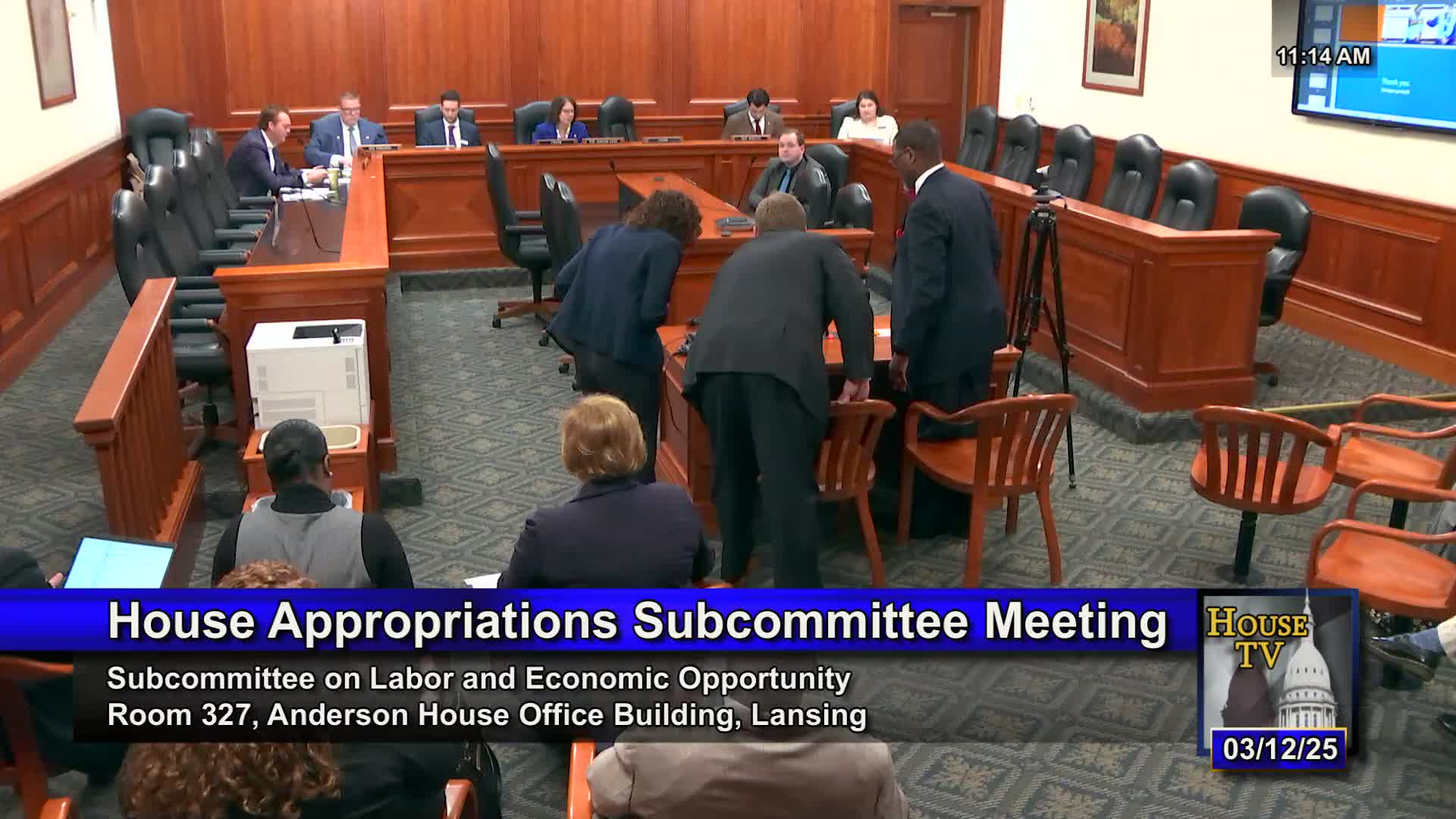
Quentin Messer, chief executive and economic competitiveness officer at the Michigan Economic Development Corporation, told the House Appropriations Subcommittee the MEDC is executing the administration’s Make It in Michigan strategy across people, places and projects and asked the committee to support ongoing and one‑time investments in talent action teams, site readiness and marketing.
Messer said MEDC’s FY24 work included supporting nearly 14,000 small businesses, placing more than 1,100 interns, training and hiring over 3,000 people, and leveraging public dollars to attract roughly $11.1 billion in private investment to the state. "Economic development matters because people matter," Messer said, summarizing the agency’s emphasis on attracting and retaining residents and private capital.
MEDC proposed one‑time FY26 requests including $10 million for talent action teams (sector‑focused teams that coordinate industry, training providers and Michigan Works), and $10 million to support competitive small business support hubs that provide mentoring, technical assistance and market access. Messer described talent action teams already working with mobility and semiconductor employers and said the teams help match future industry needs with training providers.
Messer described ongoing requests the agency views as core to business attraction and community revitalization: continued funding for a $100 million business attraction and community revitalization line (the "workhorse" program that supports business attraction, community projects and small business assistance); continuation of a $16 million Pure Michigan marketing allocation (with the potential of up to $10 million in matching funds when available); and targeted ongoing requests such as $9.8 million for the Michigan Arts and Culture Council, $15.65 million for entrepreneurship and innovation, and $5.5 million for the Michigan Office of Defense and Aerospace Innovation.
Messer highlighted MEDC regional structure and partnerships with the Michigan State Housing Development Authority, Michigan Works agencies and local economic development organizations to coordinate projects and housing goals. He cited examples of local projects and named companies that received MEDC support, including a $900,000 grant tied to an $8.0 million private investment and other community revitalization grants for small businesses.
Members asked about the governor’s international trade and outreach trips and whether those trips delivered direct foreign investment. Messer said state outreach has produced direct investments, citing Nel Hydrogen as an example from a prior trip and noting other companies that cited the governor’s presence as a factor in choosing Michigan. On a question about a large potential investment in Genesee County, Messer said the state remains engaged with federal partners and private investors and defended the quality of the Advanced Manufacturing District site, while urging patience as federal decisions and administrative staffing are completed.
Ending: Messer said MEDC would continue follow‑up with committee members and that agency staff — including subject matter experts on small business, talent and places — are available for additional questions; MEDC will appear before the committee again in coming weeks.