Get Full Government Meeting Transcripts, Videos, & Alerts Forever!
Get email alerts on the Workforce Development topic
No spam. Unsubscribe anytime.
LEO Director outlines workforce investments, apprenticeship growth and digital access plan in FY26 budget pitch
Summary
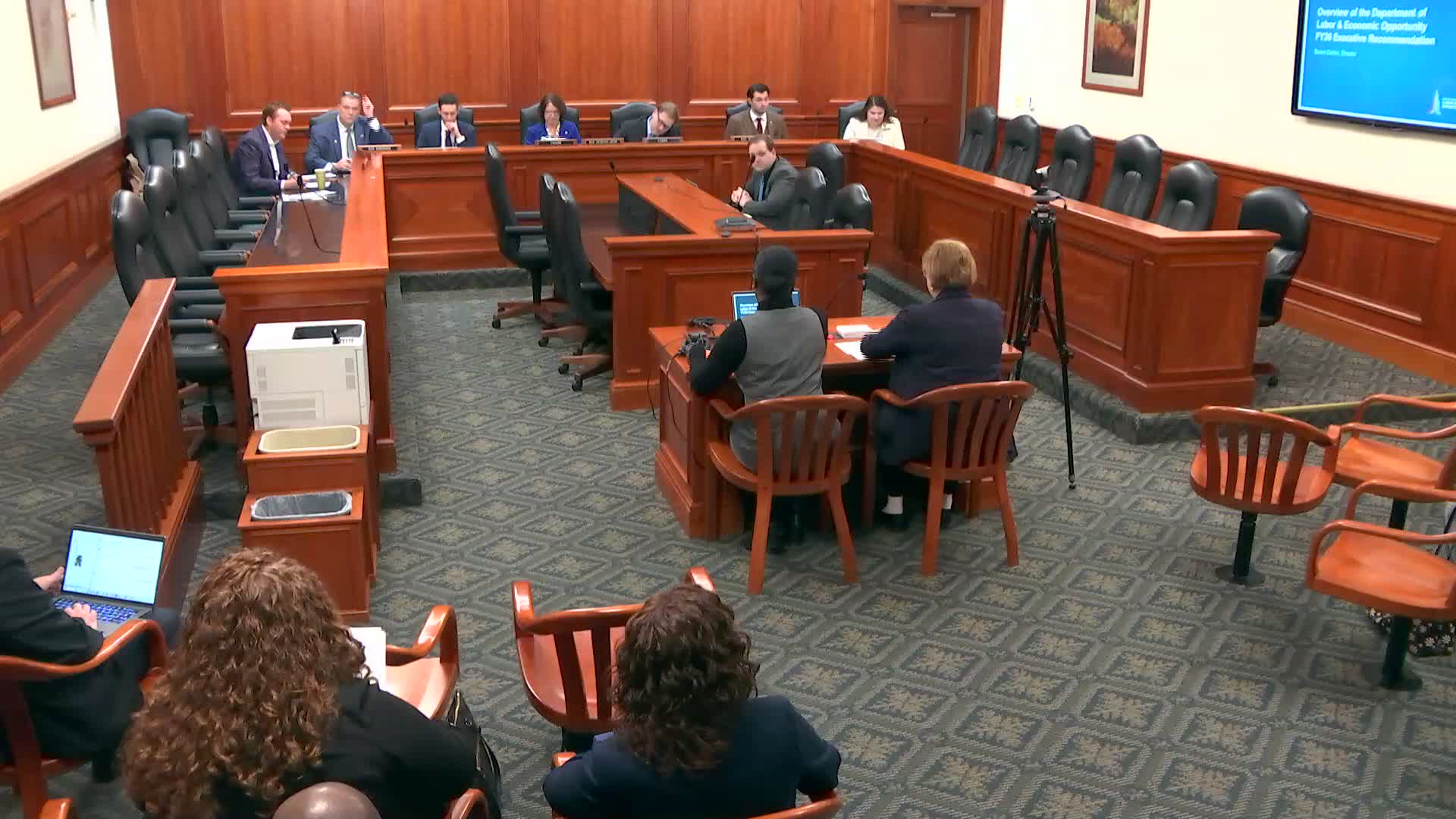
Susan Corbin, director of the Department of Labor and Economic Opportunity, told the House Appropriations subcommittee the governor’s FY26 proposal centers on workforce training, barrier‑removal services, apprenticeship expansion and internet access, and described specific budget requests and program outcomes.
The Department of Labor and Economic Opportunity’s director, Susan Corbin, told the House Appropriations Subcommittee on Labor and Economic Opportunity that Governor Whitmer’s proposed fiscal‑year 2026 budget would invest in workforce training, barrier removal and internet access to expand economic opportunity across Michigan.
Corbin said the governor’s recommended budget for LEO for fiscal years 2026‑27 includes $1.8 billion in ongoing funding, of which $239.5 million comes from the state’s general fund, and an $83.5 million one‑time general fund appropriation for FY2026. "The Department of Labor and Economic Opportunity was created to make Michigan a place where all people, businesses, and communities have the economic means and personal freedoms to ... reach their full potential," Corbin said.
Corbin framed LEO as the state’s lead talent and workforce agency and described programs intended to connect residents with credentials, degrees and jobs. She said LEO passes federal Workforce Innovation and Opportunity Act funds to local Michigan Works agencies and other local training providers, and that Michigan’s statewide workforce plan — adopted by the Michigan Workforce Development Board — has three pillars: supporting business growth through talent solutions, growing good‑paying jobs, and increasing educational attainment.
Corbin highlighted several program outcomes and requests. She said Michigan ranks highly in credential attainment and in helping adults find employment, and noted recent apprenticeship growth: Michigan has "more than 22,000 apprentices," added 8,600 new apprentices last year, and Michigan ranks among the top states for active apprentices and completers. "One year after completing training, registered apprentices in Michigan earn a median salary of over $80,700 with 94 percent retaining employment," she said.
On barrier removal, Corbin described the Barrier Removal and Employment Success program (BREEZE) as supporting transportation, child care, legal services and other needs that keep low‑income and working‑poor Michiganders from participating in the workforce. She said additional funding would support at least 2,500 unemployed workers and members of the ALICE population. Corbin told the committee the governor proposes an $8.4 million general fund investment to provide the state match needed to access about $32 million in federal vocational rehabilitation dollars for pre‑employment transition services for students with disabilities.
Corbin also described operational priorities: a $1.5 million investment to improve employer and worker education for wage and hour compliance and to increase staffing for wage and hour investigators (she said the current investigator to worker ratio is about 1 to 290,000 and the proposed change would move it toward 1 to 175,000); a $2.5 million ongoing increase to the First Responders Presumed Coverage Fund to assist first responders during cancer treatment; and a $20 million supplemental request to continue modernization of the Unemployment Insurance Agency (UIA) information technology project (myUI) to replace a decades‑old legacy system.
Corbin described UIA improvements launched in 2024, including a claimant roadmap that had 837,000 views, online coaching sessions, Community Connect events held across 78 counties and 180 municipalities, and a public UIA economic dashboard. She also noted local office renovations in Sterling Heights, Lansing, Grand Rapids and Saginaw, and work on the Detroit office.
Corbin said LEO’s Office of Rural Prosperity and the Rural Readiness Network provide planning grants (up to $50,000 to tax‑exempt rural partners) and technical support to rural communities; she cited an ongoing $700,000 appropriation that helped secure $850,000 in additional grant funding for rural communities. On broadband, Corbin said the Michigan High Speed Internet Office (MiHI) aims, with federal and state funds, to reach nearly 72,000 homes and businesses by the end of 2026 and, through BEAD funding, to bring service to an additional roughly 240,000 households and businesses with an anticipated $1.6 billion investment.
Committee members asked how LEO evaluates third‑party nonprofit partners and whether the department tracks return on investment; Corbin said federal reporting requirements apply to the federal dollars passed through LEO and that the department is hiring an outside consultant to support evaluation of grant outcomes. Members also asked about FTE counts versus authorized positions; Corbin said differences can reflect recruitment and timing while the department balances staffing needs against available funding.
LEO materials and Corbin’s presentation listed program funding breakdowns, workforce performance metrics and targeted uses for both one‑time and ongoing investments. The director said LEO will follow up with line‑item FTE data and a list of long‑unfilled positions at the committee’s request.
Corbin’s presentation and the committee’s questions were limited to clarifying program scope, outcomes and budget requests; there were no formal votes on appropriation amounts during the hearing.
Ending: Corbin said the department would provide additional requested material (detailed FTE and program appropriation breakdowns) and Deputy Director Stephanie Beckhorn was scheduled to present to the committee at a later date.