Get Full Government Meeting Transcripts, Videos, & Alerts Forever!
Get email alerts on the Public Defense topic
No spam. Unsubscribe anytime.
Michigan Indigent Defense Commission outlines standards, grants and staffing needs
Summary
Kristen Stanley Staley, executive director of the Michigan Indigent Defense Commission, told the House Appropriations subcommittee the agency has used state grants since 2019 to build public defense capacity, has implemented minimum statewide standards and seeks four additional full‑time staff to sustain compliance and training work.
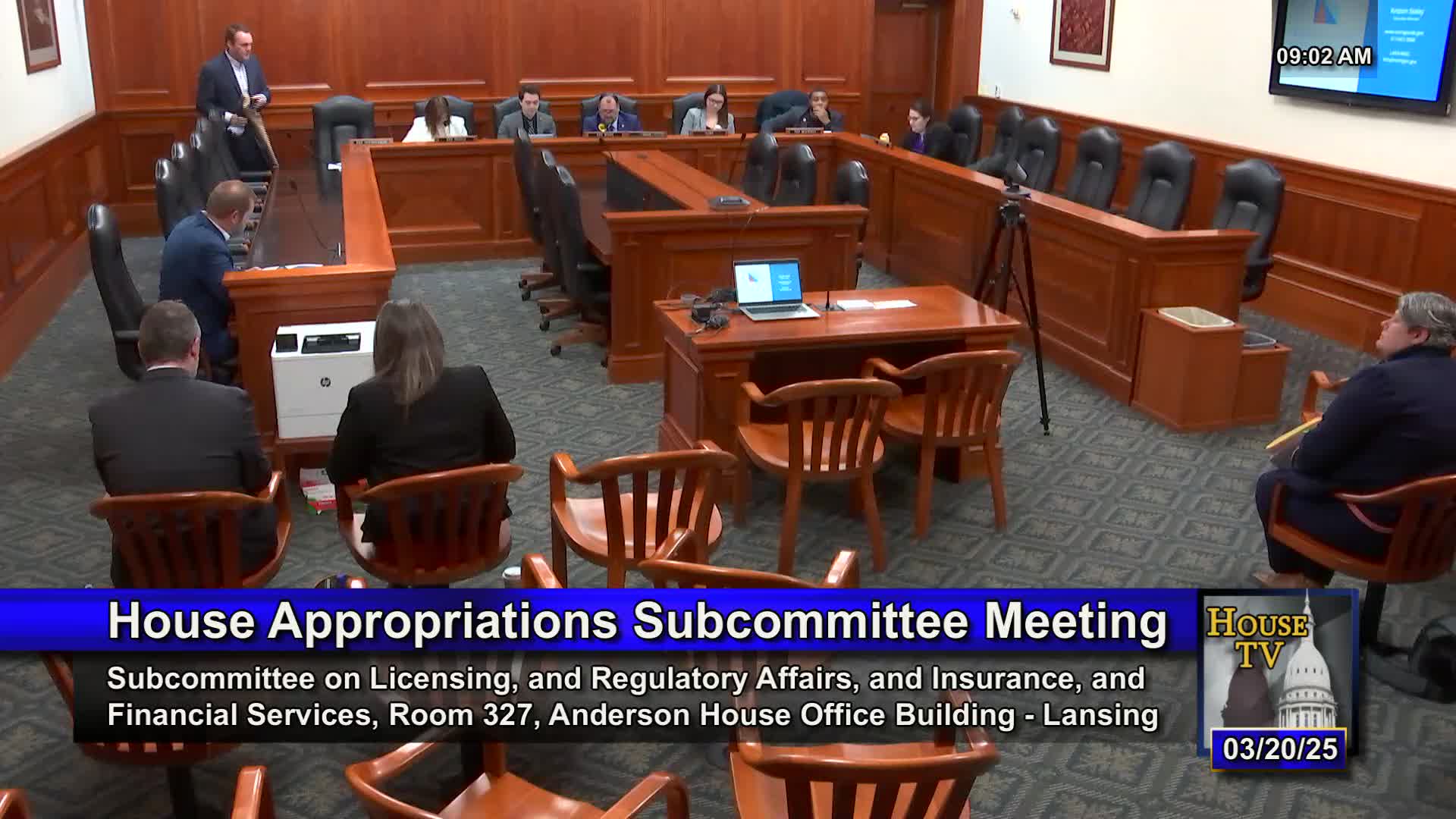
Michigan Indigent Defense Commission Executive Director Kristen Stanley Staley told the House Appropriations Subcommittee on Licensing and Regulatory Affairs and Insurance and Financial Services that the agency has used statute‑mandated standards and state grant funding to expand and professionalize public defense across Michigan.
Staley said the MIDC’s statutory mandate is to “develop and oversee the implementation of minimum standards on the delivery of indigent defense at the trial level” and to administer grants so local systems can meet those standards. She told the committee the commission enforces standards that include annual training for attorneys, timely attorney‑client contact, case caps, access to investigative and expert services, and an independent public‑defense structure.
The commission, created by the MIDC Act, is a 19‑member body that meets publicly and operates under Michigan’s Open Meetings Act, Staley said. She described the agency as a small staff — currently funded for 18 full‑time equivalents with authorization for up to 21 — that provides compliance monitoring, regional field staff, grant oversight, training and research.
Staley told lawmakers the MIDC directs most of its grant dollars to local operations. She said local shares for trial‑level funding are statutorily required and that for fiscal 2025 local shares were about $38,800,000. She said state grants from the general fund in fiscal 2025 totaled $258.3 million and that systems also collect an estimated $300,000 a year in attorney fee reimbursements from some jurisdictions.
The presentation summarized measured outcomes MIDC attributes to its work: Staley said the commission’s policies helped expand counsel at first appearance so that last year “over 295,000 people” received counsel at arraignment — roughly 86% of arraignments statewide — and that national research shows counsel at first appearance is associated with reduced pretrial incarceration, reduced bail amounts and higher appearance rates in court.
Staley described other changes supported by MIDC grants: creation of 35 public defender offices covering 40 counties, growth in investigator and social‑work positions embedded with defense teams, and a 41% increase in use of experts and investigative resources compared with the prior year. She said the commission supports training partnerships with the state’s law schools and has created a holistic defense fellowship in partnership with Wayne State University.
Questions from subcommittee members focused on pay parity with prosecutors, the use of leftover grant balances (work projects) and how the MIDC would handle expanded responsibilities such as youth defense. Staley said the commission’s attorney‑compensation standard ties minimum pay guidelines to comparable state civil service pay bands (for example, the attorney general’s assistant attorneys) and noted retained criminal defense rates are often higher; she said the standard aims to reduce the disincentive to take public defense work.
On unexpended local grant balances, Staley said some funds reflect hiring delays, start‑up time for new offices, and pandemic‑era case backlogs; she noted some funds are set aside to pay for large retrials and resentencings, including cases affected by Michigan Supreme Court rulings about juvenile life without parole.
Staley closed by asking the subcommittee to consider an increase of four FTEs to support financial and compliance oversight, training, and continued technical assistance to local systems.
Votes at the meeting included approval of the March 13, 2025 subcommittee minutes and a motion to excuse absent members (see separate item).