Get Full Government Meeting Transcripts, Videos, & Alerts Forever!
Get email alerts on the Board Of Water And Light topic
No spam. Unsubscribe anytime.
Lansing commission advances charter changes for Board of Water and Light after hours of public comment
Summary
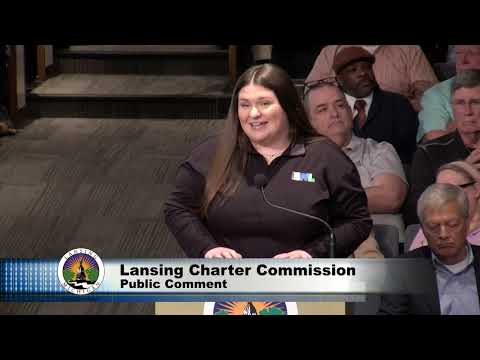
The Lansing Charter Commission on March 18 advanced a package of charter amendments that update governance and oversight for the Lansing Board of Water and Light, after more than two hours of public comment from customers, BWL employees and labor representatives.
The Lansing Charter Commission on March 18 advanced a series of charter amendments that update governance and oversight of the Lansing Board of Water and Light (BWL), following more than two hours of public comment from both BWL employees and customers who said they are struggling with bills.
The commission approved multiple changes to Article 5 — the BWL sections of the city charter — including renaming the board’s chief officer from “director” to “general manager,” updating the board’s stated powers to include chilled and thermal energy, and adjusting how certain property sales must be approved by city council. Commissioners also approved language formalizing current practice on how BWL funds are held and disbursed and retained the board’s authority to select its external auditor while clarifying the board’s internal audit role.
Why it matters: The amendments clarify how BWL operates and codify practices that affect rate-setting, audits, property transactions and customer protections. Opponents at the meeting said parts of the charter make it hard for residents to influence rate decisions, while BWL supporters argued the utility’s local, not-for-profit structure and community programs justify retaining the current board model.
Public comment opened the meeting. Dozens of speakers, including current and former BWL employees, labor representatives and customers, delivered competing accounts of the utility’s performance. Derek Quinney, introduced himself as a lifelong Lansing resident and said he supported the current governance model: “I support them in that regard as well,” he told commissioners, praising the utility’s community programs.
Jan Simpson, identified herself as a 27-year BWL retiree and asked the commission not to change the appointed-board model: “The BWL Board of Commissioners does not need to be changed,” she said, describing the board as a vetted, volunteer body accountable to the mayor and city council.
Several speakers urged more oversight and relief for customers who say bills have become unaffordable. Linda Keith, a customer who called attention to large bills, highlighted a written testimony she submitted alleging problems with smart meters and payment processing and said, “electricity is a basic need, not a hot commodity.” Tammy Arend and other customers described hardships tied to peak-hour pricing and fees.
In response, BWL General Manager Phefley addressed accuracy and the opt-out policy for smart meters. “The module only allows the meter to communicate with the Board of Water and Light system. It can’t adjust the meter or do anything,” he said, and added that the utility’s meters are NC-certified for accuracy. Phefley and other BWL officials said the utility operates an opt-out program (111 opt-outs reported) among roughly 57,000 electronic meters and that the utility offers payment assistance and community resource fairs to distribute available funds.
Commission debate focused on several technical but consequential points: - Audit oversight and authority: Commissioners and members of the public questioned whether internal-auditor functions and external-auditor selection give sufficient transparency. The commission retained language letting the board run its internal audit function while noting that the city can require audits by existing city processes. Commissioners discussed whether the city’s internal auditor should be allowed to audit BWL directly; the commission did not change that prohibition in this session. - Property sale threshold: The commission considered and ultimately approved an amendment raising the city-council approval threshold for sale of certain BWL property to two-thirds of council members (a roll-call vote recorded 8–1 on the amendment to require two-thirds; Commissioner Washington voted no). Commissioners and staff noted that City Charter Article 8 already requires two-thirds for some city property sales and discussed consistency between sections. - Rate-setting and public notice: Commissioners discussed extending the period and outreach for public hearings when BWL proposes rate changes. Several commissioners proposed stronger public-notice language, additional hearings and quarterly stakeholder meetings with the general manager to increase transparency.
Formal actions recorded at the meeting included multiple motions to adopt the proposed text of individual charter sections covering BWL responsibilities, powers, property, audits, budgets and pension language; most were approved by voice vote. The commission also approved language updating withdrawal-of-fund rules to reflect a 1988 city ordinance that already allows BWL to manage its own operating accounts. Commissioners asked staff to draft optional charter language to require a negotiated “reasonable return” for the city’s ownership interest and to propose language requiring regular public engagement by the general manager.
The meeting produced frequent procedural votes on line-by-line edits. The most notable roll-call vote was on an amendment to require a two-thirds city-council approval for certain BWL property dispositions; the clerk recorded yes votes from Commissioners Anderson, Bauer, Boyd, Dowd, Jeffries, Lopez, Cui and Adam Simon and a no from Commissioner Washington.
Commissioners also discussed council governance changes unrelated to BWL: possible limits on how many standing committees a council member can serve on, and whether to tie attendance to compensation. No final charter change on per-diem compensation was approved; commissioners asked staff to return with council rules, attendance records and possible policy options.
What’s next: The commission recessed and announced it will continue the charter review in subsequent meetings, beginning with Article 4 and returning to boards-and-commissions language. Commissioners said they will receive drafted language on increased public-notice timelines for rate hearings and on a possible charter provision that would require regular public meetings between the general manager and community stakeholders.
Votes at a glance - Amendment to require two-thirds City Council approval for sale of certain BWL real property: Passed (roll-call vote recorded 8 yes, 1 no; outcome: approved). - Series of line-by-line charter amendments affecting sections 5-201 through 5-207 (powers, titles, internal auditing language, pension/budget procedural updates, and withdrawal-of-funds language to reflect current ordinance): Each separate section motion was approved by the commission (voice votes recorded as passes or unanimous where indicated; outcome: approved).
The commission closed the meeting after additional public comment and scheduled follow-up sessions to complete the charter review.