Get Full Government Meeting Transcripts, Videos, & Alerts Forever!
Get email alerts on the Housing Infill topic
No spam. Unsubscribe anytime.
Pontiac approves sale of multiple city lots to private builders for infill housing after public hearings
Summary
The Pontiac City Council approved the sale of multiple city-owned vacant lots for infill housing following three public hearings in which residents voiced both support for getting vacant lots developed and concerns about investor purchases and lot size.
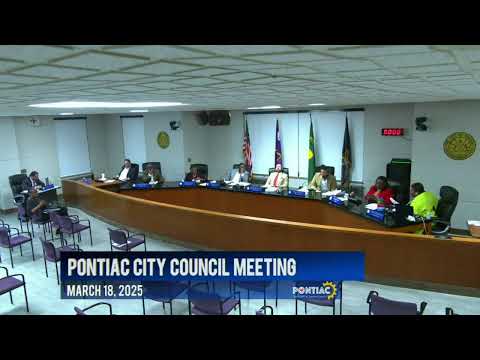
The Pontiac City Council approved option contracts and the sale of multiple city-owned vacant lots for infill housing during the March 18 meeting, clearing the way for private and nonprofit developers to construct new single-family and multifamily units.
What council approved: By roll-call votes the council adopted separate resolutions to sell groups of vacant parcels to developers who proposed new housing. The first package — four lots at 476 California, 586 California, 530 Luther and 182 Rockwell — passed 5–2 (Parker, Rutherford, Goodman, James and McGinnis voting yes; Carrington and Jones voting no). The second and third batches — a pair of narrow strips behind Auburn Avenue (140 Clifford and an adjacent unaddressed strip) and four parcels on Luther Avenue (including 387 and 383 Luther) — were each approved by roll-call vote (unanimous where recorded). The council also concurred with Oakland County Brownfield plans for Presbyterian Villages (two separate Brownfield concurrence resolutions were adopted unanimously).
Conditions and safeguards: Sale resolutions include development agreements and standard city protections. The city requires a two-year reverter clause that returns the lots to city ownership if the buyer does not complete development within the agreed timeline. Several sales included price terms (many lots sold for nominal amounts such as $1,100–$1,895 or at half SEV as authorized by city policy) and language that the buyer would pay combination, transfer and tax costs. The administration said where projects received MSHDA subsidies they could be offered as affordable housing; for example, two recently completed houses were sold at a subsidized price of $190,000 with MSHDA subsidizing the difference to reach construction cost levels reported by administration.
Public comment: Dozens of residents spoke during three back-to-back public hearings. Supporters told council that converting city-owned vacant lots to occupied, owner-occupied housing would raise neighborhood stability, reduce blight and add taxpayers. Other speakers — including long-term residents — urged more engagement with neighbors, stronger safeguards to prevent speculative investor flipping, workforce development linkages so local construction-trained residents could obtain work, and assurances about house size and quality. Multiple commenters asked the city to pair lot sales with down-payment assistance and workforce programs; staff said a city down-payment assistance program was in preparation and that banks already offer layered assistance in partnership with MSHDA.
Developer commitments: Builders who presented to council pledged to limit heights, improve buffers where lots abut single-family houses, and, for the Luther Avenue project, to cap building height at four stories and limit the number of units (example: a proposal limited to no more than 90 units and to access only from South Johnson). The administration noted some parcels will require planning commission review and possible variances because several lots are small and require specific design approvals.
Why it matters: Pontiac owns hundreds of scattered vacant parcels that currently are tax-exempt and costly to maintain. The administration and several council members argued that conveying underused lots to builders who will construct owner-occupied homes or subsidized rentals advances neighborhood stabilization and increases the tax base. Critics asked the city to prioritize owner-occupancy for local residents, strengthen neighborhood engagement, and use public tools — neighborhood enterprise zones, home repair grants, and down-payment assistance — to ensure long-term benefits to residents.
Follow-up: The council directed the administration to finalize option contracts and development agreements; staff will return with required lot combinations, site plans, and any required planning commission reviews. The council reiterated the two-year reverter clause as the city’s principal enforcement tool if buyers fail to develop.