Get Full Government Meeting Transcripts, Videos, & Alerts Forever!
Get email alerts on the Invasive Species topic
No spam. Unsubscribe anytime.
Lake County approves $25,000 for golden mussel prevention at Clear Lake
Summary
The Lake County Board of Supervisors approved up to $25,000 in general funds to support ramp monitoring, canine detection teams and other immediate prevention measures against golden mussels at Clear Lake; staff warned state grants currently exclude golden mussel activities and additional funding will be needed.
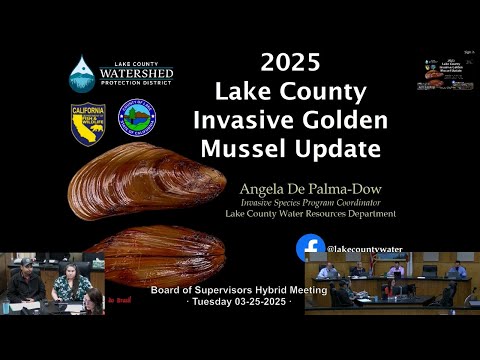
The Lake County Board of Supervisors voted to approve up to $25,000 in general-fund support for Golden Mussel prevention activities at Clear Lake, following a presentation from county staff on rising detection risk elsewhere in California and increased inspection needs.
Angela DePalma Dow, invasive species program coordinator for Lake County Water Resources, told the board the county has strengthened its quagga, zebra and golden mussel (QZGM) prevention program and is facing larger inspection and decontamination workloads because of detections in the Sacramento–San Joaquin Delta and related boat traffic. "They are the reason why we don't have mussels and other invasives in Clear Lake," DePalma Dow said of the ramp monitors who perform boat inspections and decontaminations.
The board’s action provides bridge funding for the remainder of fiscal year 2024–25 to pay for short-term needs including canine detection teams, additional ramp-monitor staffing or contracted staff, and outreach. DePalma Dow said the county has already used District 1 discretionary funds and state and federal grant dollars; the $25,000 is intended to maintain operations while the department pursues larger funding sources.
Why it matters: Golden mussels (genus Limnoperna) were detected in parts of California beginning in October, and state monitoring indicates a growing distribution in the Delta and some downstream movement through water-project infrastructure. DePalma Dow said the species can tolerate higher salinities than quagga/zebra mussels, expanding where they might establish. Because the state’s current QZ grant guidance excludes activities that explicitly mention golden mussels in the 2025 grant cycle, the county cannot rely on that state grant for golden-mussel–specific work and is seeking local and other funding sources now.
Key details from the presentation and board discussion: - Detection and monitoring: DePalma Dow reviewed state maps showing concentrated detections in the Delta and noted weekly additions to those detections. Lake County staff conduct early-detection monitoring at shoreline substrates, buoy lines, docks, artificial substrates and with plankton tows; they send samples to the Bodega Marine Laboratory for microscopic analysis. - Ramp monitors and staffing limits: Ramp monitors are part-time seasonal staff who have traditionally worked roughly 900 hours per year; DePalma Dow warned the program could run out of monitor hours by May unless staffing or contract help is secured. The department said it is interviewing candidates but lacks permanent budget authority to hire more part-time staff. - Canine detection teams and mobile decon: The county has expanded use of certified canine teams and reported adding 12 canine days so far in 2025 compared with previous years. DePalma Dow described canine teams and contracted mobile decontamination units as costly but effective, and said the county is using them during high-traffic periods and pre-tournament inspections. - Permanent decontamination station concept: Staff discussed planning for a permanent decontamination facility (a dip/dry/hot-water station) at the John Kloss Park gateway site near Highway 20 as a future capital project; the board was told that engineering design and planning would be a next-phase cost if funded. - Ordinance and plan updates: County staff, with County Counsel (Nicole and Lloyd) and other staff help (Joanna), updated the county ordinance (Chapter 15.52) and planned revisions to include golden mussels and to clarify county authority for inspection, quarantine and decontamination. The ordinance was scheduled to go on notice and be returned for board review and potential approval on April 8. DePalma Dow also recommended updating the county prevention and containment response plans after a change in the program coordinator position. - Funding landscape: DePalma Dow said the state’s QZ grant program guidance for 2025 currently disqualifies applications that discuss golden mussels; she identified Prop 4 funds and the Blue Ribbon Committee as possible larger funding sources and noted the county may request larger general-fund amounts for FY 2025–26 (presentations referenced estimates of $245,000 and up to $270,000 for broader program support). She encouraged pursuing Blue Ribbon and Prop 4 opportunities while using the approved $25,000 to sustain near-term operations.
Board members pressed staff on uncontrolled access points (private docks, short-term rentals) that ramp monitors cannot inspect, the economic effects of tournament reductions and schedule changes, and whether enforcement of the sticker program can be strengthened. Supervisor Pysco said ramp monitors "have been doing a fantastic job," while also warning the county has "many leaks" where boats can access the lake outside monitored public ramps. One supervisor noted tournament permitting was reduced from three to two events per day to ease inspection burden, and staff confirmed this change.
Action and vote: A motion to approve the funding request for up to $25,000 for fiscal year 2024–25 Golden Mussel prevention activities passed on a 4–0 vote.
Next steps and context: DePalma Dow, who said she will leave the department later that week, urged continued outreach to municipal advisory councils and noted the department will seek updated grant guidance and pursue Blue Ribbon/Prop 4 options. County staff said they may return to the board for larger, multi-year funding to create a permanent decontamination solution and support staff augmentation.
The county provided a website (www.nomuscles.com) and a public contact number for reporting suspected mussels; DePalma Dow recommended that boaters keep inspection stickers current and follow clean, drain, dry practices.