Get Full Government Meeting Transcripts, Videos, & Alerts Forever!
Get email alerts on the State Education Policy topic
No spam. Unsubscribe anytime.
Board weighs positions on WASB resolutions ahead of state convention
Summary
Board members reviewed and debated proposed Wisconsin Association of School Boards resolutions that will shape the association’s legislative priorities, signaling support for funding reform, licensure pathways and accountability for voucher schools while asking for clarifying language on workforce and truancy proposals.
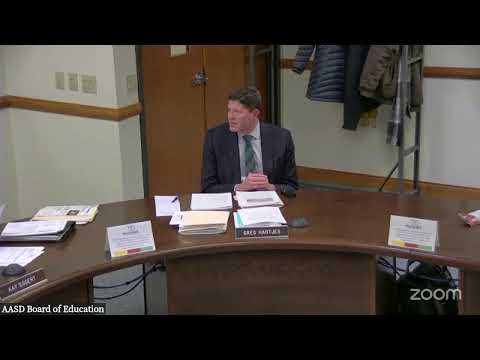
Board members reviewed a set of Wisconsin Association of School Boards (WASB) resolutions the district’s delegate will consider at the state convention. The resolutions guide WASB’s legislative priorities; they do not change law but steer the association’s advocacy.
Context: Board member Nick (identified in the meeting as the delegate) led the discussion and said the WASB delegate assembly votes instruct WASB’s lobbying on education issues. Administration offered perspectives on particular items and the board discussed potential amendments and priorities.
Resolutions discussed (high-level summary of board position during the meeting): - Blue Ribbon Commission on Funding (amendment to encourage action on the commission’s recommendations): Board members generally supported urging the legislature to consider the Blue Ribbon Commission recommendations, including changes to weighted funding for student populations. - Pathway to licensure for paraprofessionals (amend proposed language to permit alternate pathways when teacher shortages exist): Board members expressed conditional support and asked for clearer definitions of "reasonable efforts" and "rigorous training." Administration noted Appleton has internal "grow‑your‑own" pathways and supports controlled pilot pathways. - Early literacy assessments for English learners: Administration supported the resolution that would encourage the state to provide assessment materials in languages other than English so literacy is measured in a child’s home language rather than being conflated with English‑language skill. - Decoupling public and private (voucher) school funding from the school‑aid formula: Board and administration supported greater transparency; discussion centered on potential unintended consequences if funding streams were separated without safeguards. - Consistent standards and accountability for publicly funded private schools receiving vouchers: Members favored keeping transparency and reporting requirements consistent across publicly funded institutions. - Early childhood funding and public–private partnerships (support for universal state‑funded 3‑K and full‑day 4‑K): Members expressed support for expanded state funding and collaboration with community providers. - Staff mental-health funding and retention supports: Board members supported the concept but sought clarity on structure, funding source and implementation. - School accountability and report card standards (proposed change to calculate overall scores from achievement only): Several board members opposed removing growth and target-group measures, arguing that those metrics matter for historically marginalized students and for measuring schools’ growth. - Truancy: The board discussed proposed language that replaces punitive phrasing with strengths‑based approaches focused on families, schools and community partners. Administration warned that some districts rely on court enforcement as a final lever and recommended careful language to preserve options where local enforcement mechanisms exist; the board signaled broad support for strength‑based approaches but asked for conditional language. - Funding for school meal debt and cybersecurity: Members were cautious about an open, unfunded mandate for school meal debt and requested clarity on the proposed mechanism; members strongly supported cybersecurity funding given the district’s investments and threats.
Next steps: The board’s delegate will carry the board’s positions to the WASB delegate assembly; members asked administration to prepare suggested amendments or clarifying language for a few resolutions (notably the paraprofessional licensure pathway and truancy language) and to summarize fiscal implications for any resolution that could create an unfunded mandate.
Ending: Board members emphasized the resolutions process is intended to build statewide consensus; members urged careful attention to language and potential financial impacts before a final position is taken at the WASB convention.