Get Full Government Meeting Transcripts, Videos, & Alerts Forever!
Get email alerts on the School Referendum topic
No spam. Unsubscribe anytime.
Racine Unified superintendent seeks $190 million, five-year referendum to shore up budgets and preserve programs
Summary
Superintendent Lauren Gajewski told a district town hall the nonrecurring $190 million referendum on the April 1 ballot would cover projected shortfalls, keep safety systems and early‑literacy efforts intact, and aim to hold the tax impact to about $35 per $100,000 of property value.
Racine Unified School District Superintendent Lauren Gajewski told a district town hall that the district is asking voters to approve a $190,000,000 nonrecurring referendum on the April 1 ballot to cover projected budget shortfalls and preserve current programs, including early‑literacy initiatives and school safety systems.
Gajewski said the measure would run for five years and is intended to maintain — not expand — existing staffing and services. "This is a non reoccurring referendum," she said, and later summarized the homeowner impact: "The impact would be approximately $35 increase on your property taxes per $100,000 of your property value."
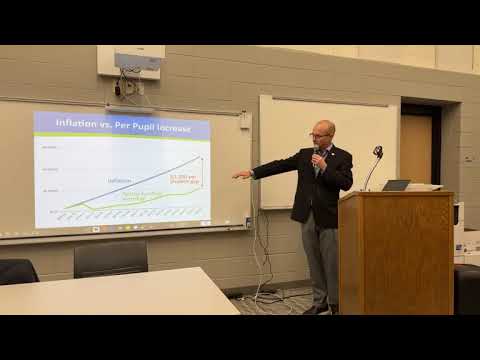
The nut graf: district leaders say persistent gaps between state funding and inflation have created recurring deficits that they cannot close without local support. Gajewski told attendees that a 2009 change in how the state ties school funding to inflation has left many Wisconsin districts facing accumulated revenue losses and that Racine Unified has experienced what she described as roughly $50,000,000 in lost purchasing power over time.
More detail: Gajewski said the district faces an immediate projected deficit of about $24,000,000 for the coming year and forecast rising shortfalls in subsequent years (she presented a five‑year deficit series roughly described as $24M, $30M, $35M, $42M and $45M). The proposed referendum totals $190 million over five years; the district structured the annual levy amounts so the average homeowner increase would remain approximately flat from year to year rather than jump after the first year.
District leaders tied the request to several operational priorities. They said the funding would preserve early‑literacy work targeted at 4K through grade 3 — including the district's earlier adoption of the "science of reading" curriculum and related teacher training — and keep supports for dual‑credit and youth‑apprenticeship pathways that help some students earn college credits or industry certifications before graduation. Gajewski also emphasized school safety work, saying the district uses an "Evolve" screening system and staff whose roles include re‑regulating students and heading off major safety incidents; she said there are ongoing costs for equipment purchase and upkeep.
Gajewski walked through steps the district took after inheriting a prior shortfall, including a $34,000,000 deficit the previous year: roughly $10,000,000 in staff reductions, school consolidations tied to the district's facilities plan, benefit changes, limited use of one‑time ESSER pandemic funds and about $4,000,000 of vacancy savings driven by market difficulty hiring teachers. She said those vacancy savings represented positions the district could not fill, not an intended cost‑cutting benefit.
Parent leaders and students also spoke. Kim Anderson, representing the district's Parent Leadership Network, told attendees, "This referendum is very important to us here at Racine Unified," and urged community support for maintaining current programs. Student ambassador Jayden George of Racine Case High School described hands‑on learning and youth apprenticeship experiences and said of a student‑run manufacturing project, "I'm the CEO of that company." Jordan Tran, a senior at Case, described dual‑credit opportunities and worksite visits as part of the district's pathways.
A local campaign group, Vote Yes for Our Kids, is organizing outreach for the ballot question. Campaign director Andrew Ellison said the committee has "been out walking the last couple months, setting up, getting out in the community," and invited volunteers for door‑knocking, phone banks and distribution of yard signs; Gajewski and others said yard signs are available at the district headquarters at 1201 West Boulevard.
What the referendum does not do: speakers repeatedly said the dollar amount was chosen to preserve the district's current level of services rather than to add major new programs. Gajewski noted that a prior legally binding facilities referendum limits how that earlier money may be used and cannot be redirected into operating expenses.
Questions from the audience addressed alternatives and consequences. Gajewski said public school revenue largely depends on state and local tax dollars and that there are no other reliable large income sources to replace the gap. She said state legislation sometimes mandates new requirements with limited funding; she gave Act 20, a state initiative tied to science‑of‑reading implementation, as an example and said the district has not received all the state funds connected to that effort. On staffing, she warned that failing to pass the referendum would likely mean higher class sizes, program reductions and further difficulty retaining teachers to compete with neighboring districts that pass referenda.
The town hall concluded with a brief campaign introduction, a question‑and‑answer period and a building tour. The referendum will appear on the April 1 ballot; the town hall presentation and campaign materials specified the request as a five‑year, nonrecurring levy meant to hold the tax increase at about $35 per $100,000 of property value while preserving the district's current programs and staffing levels.