Get Full Government Meeting Transcripts, Videos, & Alerts Forever!
Get email alerts on the Graduation Requirements topic
No spam. Unsubscribe anytime.
State mandate for personal financial literacy prompts board debate over economics requirement
Summary
Staff told the board Wisconsin will require personal financial literacy as a graduation requirement for the class of 2028; the proposal would place that credit within current scheduling constraints and prompted several board members to urge keeping economics as a required course.
District staff told the board that the state of Wisconsin now requires personal financial literacy as a graduation requirement and that the district must include the requirement for the class of 2028 (current freshmen).
Staff said this presentation is an initial step and that the district is considering substituting personal financial literacy for economics within the current 24-credit framework. The presenter outlined options: rewrite the existing economics course to remove overlap with personal financial literacy, adopt a course from a local partner such as Gateway Technical College, or design a Racine Unified personal financial literacy course. Staff noted licensing and staffing implications: if the district adopts a Gateway course for college credit it would typically require a business teacher to deliver it, whereas a locally created personal financial literacy course could be taught by a social studies teacher, a business teacher or other appropriately licensed staff depending on staffing and scheduling.
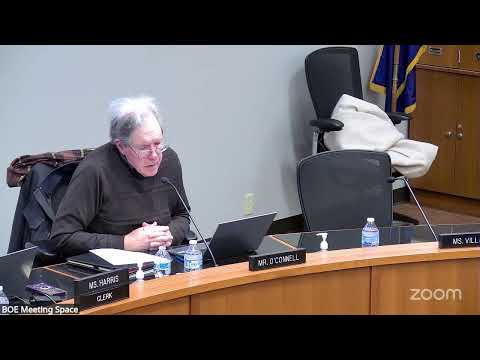
Multiple board members voiced concern about removing economics as a required course. Board member Mister Coe argued economics and personal finance are not the same, urged retaining economics for its macro- and microeconomic concepts and said eliminating economics would reduce rigor. Miss Allen and Miss Walker Cleveland echoed worries about losing economics as a requirement. Board member Mister O'Connell described the change as legislative intervention into curriculum and noted staff capacity constraints in implementing new mandates.
Staff emphasized this is step one of a longer process and said they will return to the board with scheduling options and a proposed administrative regulation. No policy change was adopted at the work session; staff said the district will put proposals out to public comment as the administrative process proceeds.