Get Full Government Meeting Transcripts, Videos, & Alerts Forever!
Get email alerts on the Parks And Recreation topic
No spam. Unsubscribe anytime.
Portsmouth council advances $250,000 Market Square splash pad; debate centers on process and priorities
Summary
Portsmouth City Council on Feb. 10 advanced an ordinance that would authorize up to $250,000 to help install splash-pad equipment at Market Square Park, moving the measure to a second reading after an extended public-comment period and council debate.
Portsmouth City Council on Feb. 10 advanced an ordinance that would authorize up to $250,000 to help install splash-pad equipment at Market Square Park, moving the measure to a second reading after an extended public-comment period and council debate.
The ordinance as read on the record authorizes “not more than $250,000,” with $125,000 designated as a loan from the general fund (account 101, recreation equipment/grounds line 101.1180.5374) and a $125,000 credit from the city’s public utilities department for water service; the water credit is listed in the ordinance as “to have no cash value.” The splash pad must be available to the public for free for not less than 10 years, according to the ordinance language presented at the meeting.
Why it matters: supporters say the splash pad is part of a downtown economic-development strategy to attract visitors and support local businesses. Opponents and some residents argued the city should prioritize urgent needs such as housing and raised questions about using public funds at a privately owned site.
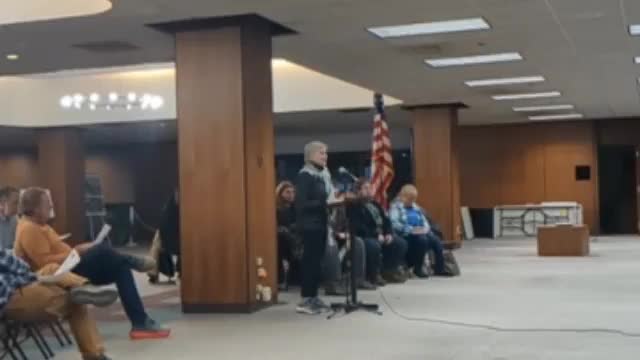
Public testimony: several residents and local stakeholders spoke both for and against the proposal. Laurie Swain, of 1717 Poplar Street, said she was not opposed to a splash pad but opposed using public funds while urgent needs go unmet: “I am opposed to the splash pad… the city awarding the equivalent of urgent needs in our city that are not being supported.” Swain told council she expected proposals for housing to include supporting documentation and studies that this splash-pad ordinance lacked.
Michael Reyes, who identified himself as affiliated with the Burnside Grandcamp Park at Market Square project, described a revised funding arrangement he said emerged from meetings with two council members, the city manager and the auditor: “A hundred and $25,000 loan… and a $125,000 water bill credit to be used as necessary until depleted,” he said, adding that the combination matches the original $250,000 request but spreads it across different mechanisms.
Attorney Jared Brankamp, describing a consultant analysis, said the Montrose Group’s modeling showed economic impact from such investments: “For every $1 invested … there’s an additional 44¢ of economic impact to this local community,” he told council, citing the firm’s county-level demographic modeling.
Supporters also included downtown business owners and residents. Craig D’Atley, whose office is downtown, said amenities support residential growth and “creates a third place” for people who live and work downtown. Jeff Hamilton read a letter from Gerald Kondogan, athletic director at Shawnee State University, urging council to support the park as a community hub and economic draw.
Council debate and concerns: council members expressed differing views about process and priorities. One council member said they were not opposed to splash pads as a concept but objected to using city funds to support a facility located on privately owned property and said that procedural concerns would lead them to vote no on the measure as presented. Other council members emphasized the potential for the splash pad to boost downtown activity and said the project did not preclude continued work on homelessness and other needs.
A councilor asked staff to clarify between readings that the proposed water-credit would be dedicated only to the public portion of the project and not to any private portions; that clarification was requested to be provided before final action.
Votes at a glance: the council voted to move the splash-pad ordinance to a second reading. Vice President Lavette Mosley moved that the ordinance constitute a second reading; the roll call vote recorded Sean Dunn (aye), Charlotte Gordon (aye), Andy Cole (aye), Lavette Mosley (aye), Joey Sandlin (aye) and Dennis Packard (aye). The motion to constitute a second reading passed.
Other legislation on the agenda: the council passed a third-reading ordinance authorizing construction of a platform and curb modification for the Southern Ohio Museum (motion moved by Vice President Mosley; roll call recorded ayes). The council also advanced an amendment to the salary ordinance to reflect a 3.85% wage increase for nonunion employees and wage adjustments per several union contracts to a second reading; that motion also passed by roll call.
What’s next: the splash-pad ordinance was advanced to a second reading; the council did not take final passage on the splash pad at the Feb. 10 meeting. Council asked for additional clarification on how the water credit would be applied and for confirmation that public access conditions in the ordinance will be enforceable before final passage.