Get Full Government Meeting Transcripts, Videos, & Alerts Forever!
Get email alerts on the Abandoned Foreclosed Properties Ordinance topic
No spam. Unsubscribe anytime.
Salem councilors debate higher fees, contact rules in proposed abandoned/foreclosed property ordinance
Summary
The Salem City Council committee reviewed proposed changes to the city’s abandoned and foreclosed property ordinance, including graduated registration fees, a required posted 24-hour contact, fines that run with the land, and an administrative appeal process; councilors asked for more data and sent the measure back to committee.
Salem City Council committee members on Monday discussed proposed changes to the city’s abandoned and foreclosed property ordinance that would raise registration fees, require a visible 24-hour contact on vacant properties and allow fines to run with the land.
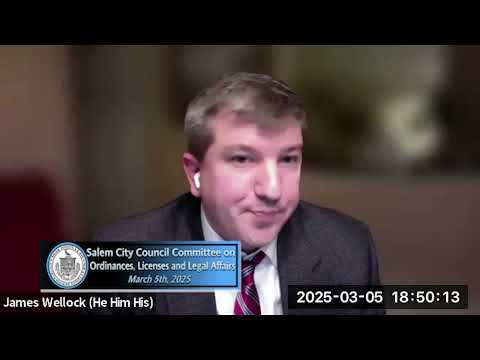
Assistant City Solicitor James Wheelock, who helped draft the revisions, said the city already maintains a registry of vacant and abandoned properties but needs stronger contact and enforcement rules. "We should be able to charge fines for mortgage lenders or foreclosing mortgage lenders that aren't keeping their contact information for particular properties up to date," Wheelock said. He added the proposal would require property owners or their agents to post a 24-hour contact name, address and phone number on the property and allow the city to issue a $300 fine per violation if contact information is not kept current.
The proposal would replace the existing single annual registration fee with a graduated schedule: $500 for properties less than one year vacant, $1,000 for one to two years, $2,000 for two to three years, and $3,000 for properties vacant more than three years. Wheelock also told councilors that after the city adopted an enabling state provision last year—referred to in the discussion as "40 U"—unpaid fines can run with the land, letting the city collect costs tied to monitoring and enforcement.
Why it matters: Councilors said vacant and neglected properties draw repeated municipal responses (inspectional services, fire, health, police) and can create public-safety and quality-of-life problems for neighbors. Several councilors urged caution about charging fees that could end up affecting families still living in homes undergoing foreclosure, and asked staff for clearer data before final action.
During the discussion, Councilor Cohen said she supported the approach but raised a technical point about capitalization and a procedural question about who the ordinance’s defined "director" refers to. "I do want to just say that the $300 day is actually $300 per day, if it continues, and that a lien can be put on the property," Cohen said, adding she expects liens and fines to help the city recoup monitoring costs.
Committee members pressed staff for more information on several points before a vote: how the proposed fees relate to actual staff and software costs; how many properties on the city list are truly vacant versus occupied by owners or tenants; whether city-owned properties would be treated similarly; and a breakdown of single-family versus multi-family addresses on the registry. Councilors also asked for a listing of recorded complaints, violations and department responses tied to properties on the list.
Wheelock told the committee the ordinance already defines "director" as the director of the Inspectional Services Department and that the draft adds an administrative appeal: an owner assessed a registration fee could appeal to the municipal hearing officer. He also said the ordinance includes criteria for abandonment and that a building inspector’s findings about evidence of vacancy and lack of good-faith efforts to maintain the property would be the basis for enforcement; he estimated some timelines used by staff are shorter than the two-year general-law example discussed by councilors.
After extended questions and requests for more data from councilors including Musil, Varela, Marceau, Jerslow and others, Councilor Barrera moved that the measure remain in committee for further review; Councilor Marceau seconded the motion and the committee carried it. The committee asked staff to return with a breakdown of what the fees would pay for, the ordinance’s abandonment language (Section 12-67/12-68), the number of properties that are actually vacant versus occupied, complaint and violation records, whether city-owned properties are included and a single- vs. multi-family breakdown.
The committee did not adopt the ordinance during the meeting. The measure will return to committee after staff compiles the requested data.
The committee hearing included multiple councilors and city staff; no final passage or numeric roll-call on the ordinance was recorded in the meeting transcript.