Get Full Government Meeting Transcripts, Videos, & Alerts Forever!
Get email alerts on the Oem Staffing Eoc topic
No spam. Unsubscribe anytime.
Council hears OEM reliance on federal grants, calls for plan to move staff to city payroll and upgrade emergency operations center
Summary
At a March 27 hearing councilors probed the Office of Emergency Management about heavy federal grant reliance for staff salaries and the need for an improved emergency operations center. OEM staff described current grant dependencies, contingency planning and an upcoming hazard mitigation grant the council will be asked to accept.
City councilors asked the Office of Emergency Management (OEM) on March 27 to explain how much of its operating capacity depends on federal grants and what contingency steps the administration would take if that funding decreased.
Councilor Ed Flynn and other members emphasized that OEM carries out functions critical to city‑wide public safety and regional coordination and said they want more positions shifted onto the city’s operating budget to reduce reliance on federal awards.
OEM staffing and grant reliance
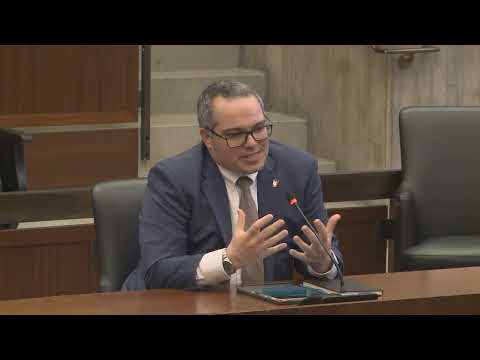
Assistant Deputy Chief Andrew Balaniars (Office of Emergency Management) told the committee OEM has about 25 staff. "We have about 25 staff people. I think approximately 5 of them are fully on the operating budget. The remaining 20 are, then there's probably 16 that are 90% federal grant funded, 10% operating funded," Balaniars said. He added that about 16 OEM staff are funded from UASI and three staff are funded from the Regional Catastrophic Preparedness Grant Program; a few staff have roughly 50/50 funding mixes.
Balaniars and others told councilors that OEM and BRIC staff funded by federal grants are at risk if federal funding declines and the city is working on contingency planning. He said the department and the administration have advocated for more operating‑budget support, noting the tradeoffs between funding staff payroll, a new emergency operations center (EOC) and other capital or technology needs.
Facility needs and hazard mitigation grant
Councilors pressed OEM about the condition and location of the city’s EOC. Balaniars acknowledged the current EOC "leaves a lot to be desired" and said the department has advocated for a state‑of‑the‑art facility but that capital investment depends on city budget priorities and real‑estate challenges. He said some federal funding could be used for a new EOC but stressed regional coordination would influence how funds are allocated.
Balaniars notified the committee that a hazard mitigation plan update grant from MEMA will be coming to the council for acceptance and asked the committee to expect that item in the coming weeks so the city can maintain eligibility for other federal hazard‑mitigation program funding.
Why it matters
Councilors said OEM performs core planning and coordination work—regional planning, large‑event coordination, summer cooling and heat‑response logistics, and equipment procurement for emergencies—and that losing staff would reduce the city’s ability to mount those operations. Councilor Flynn and others asked the administration to prioritize moving more OEM positions to the city payroll over time and to provide a clearer operating‑budget plan so councilors can consider both staffing and capital proposals.
What the hearing did not decide
Witnesses did not request an immediate vote on transferring positions to operating funds. Instead, OEM committed to continued advocacy for operating support and to providing the council with more detailed budget and contingency information. There were no formal votes during the hearing.