Get Full Government Meeting Transcripts, Videos, & Alerts Forever!
Get email alerts on the Uasi Bric Surveillance topic
No spam. Unsubscribe anytime.
Council hearing highlights community concerns over UASI funding, BRIC data sharing and surveillance
Summary
The Boston City Council Committee on Public Safety and Criminal Justice held a hearing March 27 on docket 0413 to review federal grants administered by the Office of Emergency Management, focusing on the Urban Area Security Initiative (UASI) and how the Boston Regional Intelligence Center (BRIC) uses grant funds and shares information.
The Boston City Council Committee on Public Safety and Criminal Justice held a hearing March 27 on docket 0413 to review federal grants administered by the Office of Emergency Management, focusing on the Urban Area Security Initiative (UASI) and how the Boston Regional Intelligence Center (BRIC) uses grant funds and shares information.
City and police officials described how BRIC uses UASI money for personnel, training and analytic technology; community groups and civil‑liberties organizations warned that BRIC-funded analysis and information sharing risked enabling federal immigration enforcement and expanded surveillance of lawful protest activity.
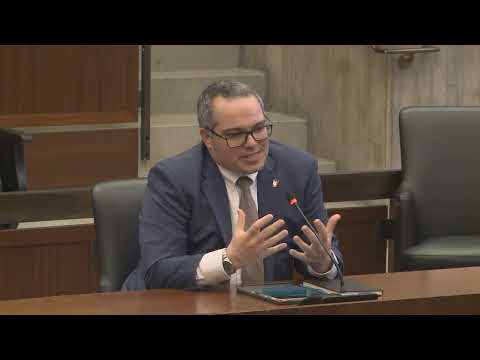
Council Chair Henry Santana convened the hearing, saying the committee would examine "all City of Boston grants administered by the Office of Emergency Management, including the Urban Area Security Initiative grant and emergency management performance grant." (Henry Santana, March 27). The BRIC’s director told the committee the center received roughly $2,000,000 from last year’s UASI award and that personnel accounted for most of that funding. Ryan Walsh, director of the BRIC, said, "Approximately 3 quarters of this money went towards personnel, funding a total of 12 full and part and 1 part time position" and described the funds as supporting analysts, a privacy officer and technology projects.
Why it matters: community groups and civil‑liberties advocates told the council that, under the current federal enforcement climate, information generated or shared by BRIC could be repurposed by federal agencies to detain or deport noncitizens even where local policy forbids routine immigration enforcement. Fatima Ahmed of Muslim Justice League called UASI "essentially a Trojan horse," arguing the grant steers local resources toward policing and fusion‑center activity rather than public‑health or community resilience projects.
What officials said about access and privacy
Ryan Walsh and Boston Police Captain Timothy Conley described BRIC as an analytic center that collects and assesses threat information from local and federal partners. Walsh said BRIC has a full‑time privacy officer funded by the UASI award and that BRIC limits direct access to sensitive systems: "The basically, the only users of the database are Boston Police Officers, under very strict controls. We don't allow printing or things like that from the database." (Ryan Walsh, March 27).
On federal access, Captain Conley said there is no "direct access for any federal law enforcement or other federal employees" to the gang database, and that BRIC generally responds to requests from federal partners only when those partners provide a case or investigation number and demonstrate an ongoing criminal investigation. He said external requests are reviewed by a BRIC supervisor and the office consults with its privacy officer when concerns arise.
What community witnesses said
Representatives of Muslim Justice League, the ACLU of Massachusetts, Massachusetts Law Reform Institute and Kairos Action urged the council to reconsider relying on UASI money. They presented three linked concerns: (1) UASI’s federal rules and local practice channel large shares of grant money toward "law enforcement terrorism prevention activities" (LEPPA) and fusion‑center staffing; (2) BRIC products have in the past surveilled political gatherings and circulated reports that list local demonstrations; and (3) under the current federal administration information compiled by BRIC could be used by federal immigration authorities.
Kate Crockford of the ACLU said UASI operates "as a Trojan horse" that steers city spending toward policing and surveillance. Fatima Ahmed said BRIC reports on local Palestine‑related activity were distributed twice daily and that the BRIC user list leaked in 2020 included federal agencies, and likely ICE among other law‑enforcement users.
Officials and advocates disagreed on the public‑safety tradeoffs. Director Walsh and Captain Conley described analytic products that supported homicide, burglary and missing‑person responses and said BRIC's work supports regional coordination. Community witnesses said the same systems and reports can chill protected speech and may be used in civil immigration enforcement.
Policies and documents cited
Witnesses pointed to BPD internal rules and city and state law as governing information handling. Captain Conley cited BPD Rule 3.35 as the rule governing the gang database process. Community witnesses referenced the Boston Trust Act and asked for copies of memoranda of understanding (MOUs) between BRIC/BPD and federal partners, which officials said exist (including an MOU with DHS Office of Intelligence and Analysis) and could be provided.
What the hearing did not decide
No formal vote or grant acceptance occurred during the hearing. Councilors and staff requested more detailed, written materials: (a) a line‑item breakdown of how past UASI and related federal grant dollars have been spent across the Metro Boston Homeland Security Region; (b) copies of MOUs and written procedures for external requests to BRIC; and (c) the list of BRIC registered users or a redacted summary of private and public entities authorized to receive BRIC products.
Close and next steps
Councilors and witnesses agreed the item requires further review. Chair Santana said the committee will hold follow‑up hearings and urged the Office of Emergency Management and BRIC to provide the requested documentation; community groups said they will press for limits on information sharing and for alternatives to UASI‑tied spending.
Acknowledgment: The reporting above summarizes testimony from Boston City Council committee members, Office of Emergency Management staff, Boston Police Department BRIC officials and community witnesses at the March 27, 2025 hearing on docket 0413. Direct quotes are cited to the speaker and date when provided during the hearing.