Get Full Government Meeting Transcripts, Videos, & Alerts Forever!
Get email alerts on the Drought Resiliency Plan topic
No spam. Unsubscribe anytime.
Lake County outlines advisory committee for drought resiliency plan; board hears concerns but takes no action
Summary
Staff presented a proposed ad hoc advisory committee and a roughly one‑year schedule to draft a Drought and Low Water Resiliency Plan required by SB 552; supervisors and a public commenter raised concerns about membership, transparency and local representation.
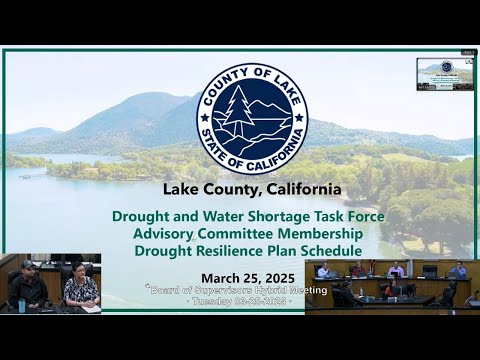
Lake County staff on Friday presented a proposed advisory committee and timeline to develop a Drought and Low Water Resiliency Plan required by SB 552, saying the drafting process could take about a year and that most technical writing will be done by the county’s contractor, Stantec.
Community Development Director Maria Turner told the Board of Supervisors that the county has reorganized its standing Drought Task Force to the Drought and Low Water Task Force, created an ad hoc advisory committee to support drafting the plan, and transferred lead agency responsibility from Water Resources to Community Development. Turner said staff compiled potential advisory‑committee members from prior task‑force recommendations and discussions with the contractor.
The advisory committee as proposed includes county departments (Community Development, Watershed Protection District, Environmental Health, Public Works, Office of Emergency Services and the Chief Climate Resiliency Officer), all tribes, CAL FIRE, two private water companies identified as Golden State Water and Cal Water, the Farm Bureau, Seigler Springs Community Redevelopment Association, Rural Community Assistance Corporation and the Lake County Land Trust. Stantec consultants Christy and Bridget were identified as the technical leads responsible for most of the drafting. Turner said the advisory committee will meet about four times at ‘‘landmark points’’ in the drafting process; the task force will review the draft before the county presents it to the board.
A Stantec representative summarized the plan’s scope: "The drought resiliency plan will cover state small water systems and domestic wells within the county's jurisdiction," and noted that tribal participation is voluntary because tribes are not always subject to county plans. Stantec and county staff said the schedule currently includes a task‑force meeting on April 23 and an advisory‑committee kickoff in May, with the total process potentially lasting up to a year.
Supervisors raised questions about the proposed membership and the county office assigned to lead the effort. Supervisor Sibakia said she was unclear why specific entities such as Seigler Springs were singled out and asked why county fire districts were not listed alongside CAL FIRE. She also suggested the Chamber of Commerce could represent business interests rather than a single‑community redevelopment group and said she was concerned about adding the project to Community Development’s workload.
A county staff member answered that the county can add local fire districts alongside CAL FIRE and include the Chamber of Commerce if the board prefers. County staff explained Golden State Water and Cal Water were included because they have been active in consolidation and regionalization efforts for small water systems; one supervisor said that raised future cost concerns for residents who eventually move under those private purveyors.
Upper Lake resident Betsy Khan spoke during public comment to contest the advisory‑committee structure, saying ad hoc committees in practice "don't publish minutes and agendas, they're not open to the public" and noting she did not see a public representative on the suggested participant list. Khan urged inclusion of watershed and environmental groups and asked county staff to consider municipal code or zoning changes and board policy that define standing versus ad hoc committees.
County staff reiterated that special districts will continue to have review authority through the standing task force even if they are not on the ad hoc advisory committee, and that tribes were invited but are not required to participate. No formal action or vote was taken; the item was presented as an update.
The county’s next steps, as described at the meeting, are to finalize advisory‑committee membership based on board feedback, hold the task‑force meeting scheduled for April 23, convene the advisory committee kickoff in May, and proceed with Stantec drafting the plan for later review by the standing task force and the Board of Supervisors.