Get Full Government Meeting Transcripts, Videos, & Alerts Forever!
Get email alerts on the Student Harassment Policy topic
No spam. Unsubscribe anytime.
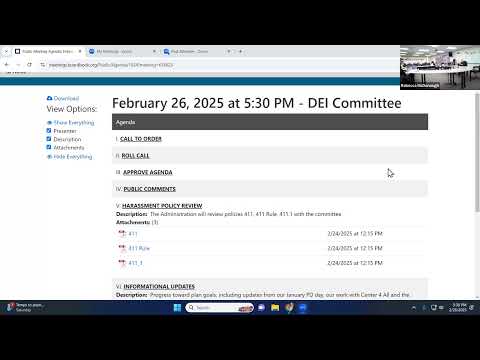
Waunakee DEI subcommittee advances revised harassment, nondiscrimination policies to policy committee
Summary
The Waunakee Community School District DEI subcommittee voted to advance revised student nondiscrimination and harassment policies (Policy 411, Rule 4-11 and Policy 411.1) to the district policy committee after discussion about accessibility of changes, reporting and follow-up procedures, and training plans.
Waunakee Community School District DEI subcommittee members voted to advance revisions to the district's student nondiscrimination and harassment policies (Policy 411, Rule 4-11 and Policy 411.1) to the policy committee for further consideration and eventual board review.
The revisions, presented to the subcommittee by district leadership and staff, were written to embed protections against hate speech and discrimination into the broader harassment policy, align with recent federal Title IX guidance, and clarify reporting and response processes for students, families and staff.
Gina Pagel, a district elementary teacher, spoke during the single public comment and said she supported the updated harassment policy while urging better public communication about the revision process. "I hope to gain some more understanding about the changes that I may or may not have noticed, tonight," Pagel said, and asked that the district provide clearer redlines and a brief, user-friendly summary of key changes.
The district's superintendent told the committee the policies were developed following January listening sessions in which students and families reported harassment and discrimination, and after review with legal counsel. The superintendent said staff consulted with legal counsel Barry Forbes and adjusted language to use terms such as "offensive" rather than older terminology in the prior draft. "All of our students deserve a school environment where they feel safe, valued, and respected every day," the superintendent said.
Committee members and staff walked through several substantive clarifications included in the proposed package: 1) explicit protections for students from harassment and discrimination based on legally protected characteristics; 2) integration of an anti-hate-speech approach within the harassment policy rather than as a standalone policy; 3) clearer complaint and follow-up procedures in Rule 4-11; and 4) an emphasis on education and prevention through staff professional development and student lessons.
On procedure, staff said that the complaint rule (4-11) contains a follow-up element that directs designated nondiscrimination coordinators and administrative officials to respond with the goal of preventing, identifying and preventing recurrence. Staff noted the rule clarifies that a single incident can trigger an investigation and response and is not limited to repeated behavior.
Committee members raised several process and clarity questions that staff agreed to address before the policy committee review: posting a redlined (strikethrough) version of the changes in board materials so the public can see edits; producing a short "CliffNotes" summary for parents and students explaining how to report incidents and what steps the district will take; confirming whether named staff listed in the rule must remain in the text or can be replaced by position titles if required by law; and ensuring the reporting tool and follow-up notifications are visible to families.
Staff described recent training tied to the policy work: January district professional development on microaggressions and interrupting biased remarks, middle-school lessons on "speak up" strategies that were delivered during advisory periods, and outside training provided by a consultant from McFarland. Staff said they have seen an increase in reports since those trainings, which they interpreted as students better understanding where and how to report concerns.
After discussion, a motion to approve advancement of the student nondiscrimination policy, the Rule 4-11 complaint procedures, and the harassment policy for protected classes (Policy 411.1) to the policy committee was made and seconded; the subcommittee conducted a voice vote and the motion passed. The transcript does not name the mover or seconder; the outcome was recorded as "motion passes." Staff said the next steps are policy committee review and, if approved there, full board consideration and implementation planning.
Committee members also discussed alignment with the district's three-year DEI plan: use of MSAN (Minority Student Achievement Network) resources, ongoing belonging-and-engagement data collection in each building, and coordination with the district's disproportionality reporting schedule to the Wisconsin DPI (midyear and end-of-year reporting). Staff said aggregate progress data will be shared, with the typical end-of-year reporting around June.
The subcommittee's vote to advance the policies does not itself adopt final policy language; it moves the proposed revisions to the policy committee for a subsequent formal review and possible recommendation to the full board.