Get Full Government Meeting Transcripts, Videos, & Alerts Forever!
Get email alerts on the School Budgeting topic
No spam. Unsubscribe anytime.
Waunakee committee advances preliminary 2025–26 budget plan; flags insurance, compensation, OPEB and transportation app
Summary
The Waunakee Community School District budget committee on March 5 moved the district’s preliminary 2025–26 budget planning document to the full board for approval next Monday after discussing a roughly 5% health‑insurance increase (about $250,000), compensation steps tied to the November 2022 referendum, declining OPEB liability and a proposed parent bus‑tracking app.
The Waunakee Community School District budget committee on March 5 moved the district’s preliminary 2025–26 budget planning document to the full school board for approval next Monday after discussion of health insurance renewal, compensation planning tied to the November 2022 referendum, post‑employment benefits (OPEB) and a proposed parent bus‑tracking app.
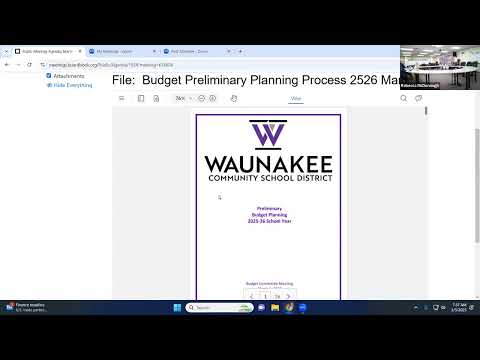
The committee’s motion to advance the planning document was approved during the meeting after staff presentations and discussion. Allie, district budget staff, told the committee, “Nothing has changed in the document from last month. So this month, we would just be looking for approval to take [it] in the full board next Monday.”
Why it matters: The preliminary plan sets priorities that the board and administration say they will align with outcomes from the HR and facilities committees, forthcoming health‑insurance proposals and state budget changes. Several items discussed—health‑insurance premium increases, multi‑year compensation steps from the referendum and shifting OPEB funding—could affect the district’s operating fund and staff pay decisions for 2025–26.
Health insurance and compensation
District staff said responses to the district’s insurance vendor requests were due to the district insurance committee and HR committee in the days after the meeting. Steve, district administrator, said the plan currently assumes an approximate 5% district investment increase in health insurance year over year — “roughly in the $250,000 range” — based on current responses. He said the district’s 2024–25 district share for insurance is about $5,000,000.
Compensation planning is proceeding in two prongs, staff said: implementing a referendum‑funded dollar amount targeted at raising hourly staff pay to the Dane County average and district discussions about CPI‑based increases and compensation systems. The November 2024 referendum set aside a $500,000 increment for hourly staff in 2025–26 and another $500,000 in 2026–27; staff confirmed those amounts as the planning baseline. The committee was told the planning documents currently assume a $325 per‑pupil number from state law in projections; the committee heard that CPI used in planning landed at 2.95%.
OPEB, HRA and fund balances
Administrators reported the district’s OPEB liability has fallen after a recent decision to pay earned pension/step‑point obligations now rather than defer them. Staff also said the district’s Health Reimbursement Arrangement (HRA) balance has grown since implementation, and that the district previously prefunded a secondary account (fund 73) that at its peak held close to $2,000,000 before funds were drawn down during the pandemic period.
Staff described a two‑part strategy for 2025–26 OPEB funding: monitor the state budget for additional special‑education aid that would reduce general fund pressure, and continue an internal review of current expenditures to reallocate dollars where feasible. Board members discussed using vested funds that become available when employees leave as a temporary source; administrators said such funds have ranged up to about $50,000 in a year and could be part of a short‑term strategy.
Maintenance, contingency and referendum debt plan
The committee reviewed priorities that staff are highlighting in the draft budget: post‑employment benefits, contingency, and maintenance. Administrators noted the district remains in a strong position on referendum‑funded maintenance because of interest earnings on the $175,000,000 November 2022 referendum proceeds and said maintenance can be de‑prioritized temporarily because of that cushion.
Staff reviewed the district’s borrowing plan tied to the referendum and told the committee S&P Global Ratings (Standard & Poor’s) has affirmed the district’s AA‑ rating with a stable outlook. Administrators said their long‑term debt service plan smooths the referendum debt so the annual debt service levy change averages about 2.1%—below historical local growth—by relying in part on interest earnings and careful timing of bond anticipation notes and future borrowings. The committee was told the district closed a $52,000,000 borrowing this cycle and is monitoring the market on roughly $96,000,000 in anticipated future borrowings to seek savings if interest rates fall.
Transportation: parent tracking app
The committee also discussed a lower‑cost option to give parents real‑time bus status without installing student‑level scanning hardware. Administrators said the district can connect bus GPS to a third‑party parent app (examples mentioned included “Here Comes the Bus”), allowing parents to see a bus’s location and estimated delay. Lamers Bus Lines was named as the current contractor the district has discussed with. Administrators said the parent app option would be a district purchase and could be funded by reallocating existing technology or other savings rather than asking the board for new money; they agreed to bring quotes and a funding plan back to the board. Board members described the app as most valuable to parents of students who ride buses, especially elementary parents.
Actions and next steps
The committee approved moving the preliminary 2025–26 budget planning document to the full board for action at the next board meeting. Staff said health insurance renewals will return to the board in April, and compensation recommendations are expected in May; administration continues building the draft budget and will present the first formal draft at the full board meeting.
The meeting ended after committee members closed discussion and adjourned.
Ending note: Administrators emphasized the budget is sensitive to two external variables—state special‑education aid and interest‑rate movement for bond timing—and said they will return to the board with updated insurance proposals, compensation recommendations and any market‑driven borrowing recommendations before final adoption.