Get Full Government Meeting Transcripts, Videos, & Alerts Forever!
Get email alerts on the Employee Benefits Insurance topic
No spam. Unsubscribe anytime.
Insurance review: district finds self‑funding not viable now; two insured options remain with tradeoffs
Summary
Waunakee Community School District staff reported results from a recent request for information on employee health insurance and laid out next steps for a recommendation to the board.
Waunakee Community School District staff reported results from a recent request for information on employee health insurance and laid out next steps for a recommendation to the board.
Brian, staff member, said the district solicited responses from local and national fully insured carriers as well as self‑funded third‑party administrators. He summarized: “The net result of this was that the best of these offers…would be an increase in district costs or plan costs…of 26.7%. So self funding was not a financial, viable alternative at this time.”
Staff received limited responses from national fully insured carriers; the realistic, immediate choices narrowed to two local carriers: Group Health Cooperative (GHC) and Dean Health. Brian said GHC’s initial offer showed a financial savings in year one but would cause “a total provider disruption” because employees would need to switch to GHC providers and a GHC clinic. Dean’s offer was higher in cost but would preserve most employees’ existing provider relationships.
The district explored offering both plans as a dual choice. Brian explained both carriers said a true dual option would require charging employees the same premium for each plan; that approach would force the district to raise the lower‑cost plan to match the higher rate and would increase the district’s contribution substantially. He said the district’s estimate showed the budget impact could approach a roughly 13% increase in district contribution under the dual‑choice scenario, a cost the current budget cannot sustain.
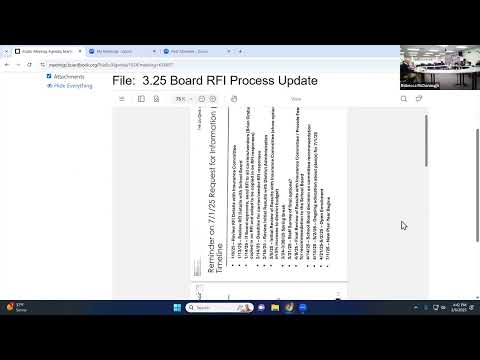
Committee members pressed staff on whether the detailed cost comparatives could be shared with the full board. Brian said the detailed vendor proposals contain negotiation details and that showing them publicly would likely require a closed session because they are part of an active negotiation. He also noted the insurance committee will meet in early April (second week) to craft a recommendation for the full board to consider at the April 14 regular meeting; employee education and open enrollment would follow depending on board action.
Staff will survey employees to weigh priorities — lower premiums versus maintaining provider relationships — and will present example employee cost comparisons that reflect different household/work schedules (for example, part‑time seasonal employees versus year‑round full‑time employees).
Why this matters: the district’s insurance choice affects employee out‑of‑pocket costs, continuity of care for employees and families, and district budget contributions.
Next steps: insurance committee recommendation in early April, full board consideration April 14, simultaneous employee education and open enrollment planning; staff will continue negotiations and may return to committee or closed session with detailed proposals.