Get Full Government Meeting Transcripts, Videos, & Alerts Forever!
Get email alerts on the Workforce Housing topic
No spam. Unsubscribe anytime.
Clallam County housing committee schedules workforce-housing forum, weighs RV rules and federal funding uncertainty
Summary
The Clallam County housing committee agreed to organize a workforce-housing forum and asked staff to bring proposals to the committee’s next meeting, while members discussed state bills on rent caps and RVs, local enforcement limits, and uncertainty around USDA and HUD funding for several projects.
The Clallam County Housing Committee voted to organize a workforce-housing forum and asked staff to return with recommended next steps at the committee's next meeting.
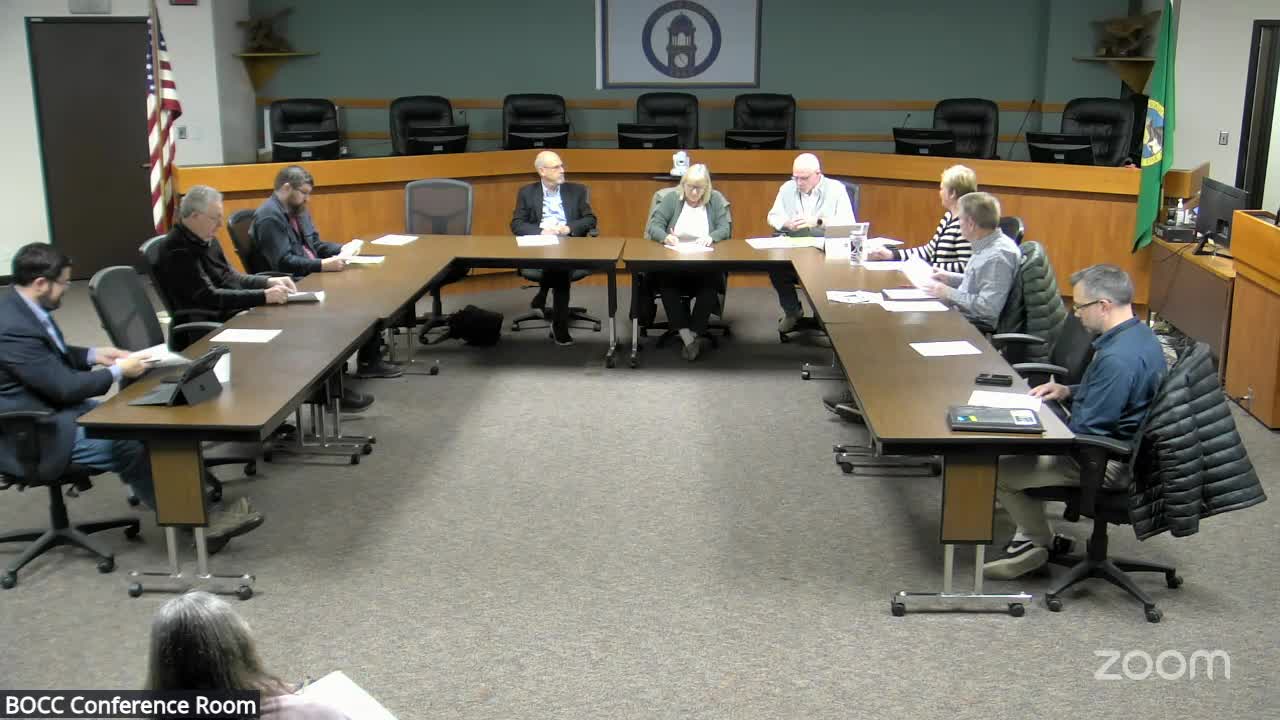
Committee members and staff met virtually to review a housing registry and ongoing projects, discuss pending state legislation that could change local housing options, and update the committee on federal funding prospects for local developments.
The forum is intended to bring together elected officials, private developers and employers to identify concrete actions to expand workforce housing. Committee members set an initial date for the forum on May 8 in the afternoon, and asked staff to present forum goals and invitees at the committee's April meeting.
Committee discussion and registry updates Colleen Robinson, a county staff member, reported progress on several local projects and openings for veteran applications, saying, “The roof's going on. ... We still have 2 units available.” Robinson noted construction delays from weather and staff turnover but said organizers are aiming for a late-summer dedication on at least one project. Staff also reported foundation pours at Northview Apartments and ongoing work on other developments listed in the county’s registry.
Peninsula Housing Authority matters Participants clarified that Peninsula Housing Authority does not yet own the Oxbow property; acquisition is still in process. Committee attendees discussed outreach from a Bellevue-based shelter operator that has sent letters about buying and rehabbing two senior developments in Sequim; county staff said they redirected that group to the housing authority.
Federal funding and project uncertainty Tim, deputy DCD director, told the committee that federal funding is uncertain and that the department is “waiting for next Friday when the continuing resolution expires to see what Congress is going to do.” He added that the NPR funding applied for the Oxbow “has been put on a pause.” Committee members said this uncertainty affects mortgage programs, USDA mortgage funding availability, and other project timelines.
State bills, rent caps and RVs Committee members discussed two state-level proposals named in the meeting packet. A bill the packet identifies as “12/17” would cap annual rent increases at 7 percent and limit late fees to 1.5 percent of rent; speakers warned landlords may raise rents annually to stay with market rates. A separate bill identified as “14/43” would allow at least one RV on each property in cities and counties; committee members said the bill’s implementation details and public-safety implications will matter locally.
On RVs and tiny homes, county planning and DCD staff described the difference between park-model/tiny-home units and RVs (park models and tiny homes are built to be placed; RVs are mobile and have onboard reservoirs). Staff said the county updated its park-model/tiny-home code last year and is now working with the planning commission to update RV rules to reduce public-health, solid-waste and fire-safety risks while recognizing that many people use RVs as long-term housing out of necessity. Staff described current enforcement as largely complaint driven and involving multiple departments — DCD (planning and code), environmental health (HHS), the prosecutor’s office and sometimes the sheriff — and said the county has a memorandum of agreement that includes guidance to consider poverty and mental health when enforcing code. A member of county staff summarized that approach: “We are really intentional about not creating homelessness through enforcement actions.” (county staff)
Enforcement limits and practical issues Staff told the committee enforcement tools are limited because some code thresholds (for example, the amount of visible solid waste or duration of occupancy) must be met before an enforcement action proceeds. For septic and sewage issues, environmental health has existing authorities, staff said. Committee members urged clearer, enforceable definitions in county code so that inspectors can determine when a recreational RV becomes long-term residential occupancy.
Workforce-housing forum goals and next steps Committee members described the forum as a practical, outcome-focused meeting to identify specific actions that local governments, employers and private developers could take. Attendees suggested inviting private-sector employers (hospital, schools, area businesses, and the Coast Guard housing liaisons) and developers working on smaller unit types (triplexes, zero-lot-line units) to explore barriers such as setbacks, parking rules and time-consuming permitting requirements. The committee asked staff to develop a short set of outcomes the forum should pursue and to report back at the April committee meeting.
Public comment and community concerns Public commenters reiterated concerns that workforce wages and housing costs are out of alignment and that some households are using RVs, park models or tiny homes as their only housing option. Steven Workman, the committee’s at-large member, urged state advocacy and local innovation and said, “I'm for making permanent living in RVs legal,” arguing for state or local policy options that could legalize and regulate longer-term use in controlled settings. Other commenters urged solutions that avoid trapping people in cycles of disposable, low-quality housing.
Meeting logistics and follow-ups Committee members asked staff to return with: a proposed forum agenda and invitee list (for the May forum), progress updates on the Oxbow acquisition and USDA/NPR funding, and draft language the planning commission is considering for RV code updates. The committee set its next regular meeting for April 4 and directed staff to present the forum plan and any draft code language at that meeting.
Why it matters Committee members framed the discussion around the county’s capacity to keep essential workers (medical, public safety, hospitality and construction) housed in Clallam County. Speakers linked workforce housing to local economic health and public safety, and repeatedly cautioned that state-level mandates (rent caps or blanket RV allowances) may have unintended local effects unless paired with funding and safety standards.
What the meeting did not decide No formal county ordinance or new regulatory standard was adopted at the meeting. Staff and the planning commission are continuing code work on RVs and tiny homes; the committee’s immediate decisions were procedural (to convene a forum, identify invitees, and request staff follow-up at the April meeting). State legislation discussed remains at the legislature and was not acted on by the committee.