Get Full Government Meeting Transcripts, Videos, & Alerts Forever!
Get email alerts on the Dungeness Trails Park Reservoir topic
No spam. Unsubscribe anytime.
Clallam County moves to formalize Dungeness Trails County Park as reservoir, trail projects advance
Summary
Dungeness Trails County Park appears poised to become a permanent county‑managed recreation and conservation site after Clallam County officials discussed multiple projects tied to the 400‑acre property and voted to memorialize the park name.
Dungeness Trails County Park appears poised to become a permanent county-managed recreation and conservation site after Clallam County officials discussed multiple projects tied to the 400‑acre property and voted to memorialize the park name.
The advisory board voted at the meeting to recommend that the newly acquired property — purchased for approximately $1,200,000 using a Washington State Department of Ecology streamflow restoration grant — be named and recorded as a county park under the working name Dungeness Trails. County staff said the property will be used for streamflow restoration, habitat and forest management, stormwater infiltration and public recreation, subject to deed restrictions tied to the grant.
Why this matters: the site is tied to a larger streamflow restoration effort that could restore late‑season flows for the Dungeness River by storing winter water in an off‑channel reservoir and releasing it in dry months. At the same time, county officials said the land presents near‑term trail and habitat work and that formal park designation will allow the county to apply park regulations, add signage, coordinate volunteer maintenance and plan parking and basic sanitary facilities.
What officials described: Public works deputy director Steve Curry and project staff presented design alternatives for an off‑channel reservoir and related projects. Consultants developed a set of options labelled E1 through E4; county staff recommended pursuing option E1 because it meets targeted benefits while avoiding costly work in a Bonneville Power Administration (BPA) utility easement. Curry told the board that a larger E4 footprint would add roughly $13,000,000 in construction cost and an estimated additional $2,000,000 tied to work in the BPA easement; staff said E1 could be built sooner and could be expanded later if funding and permitting allow.
Staff said the county has applied for federal hazard‑mitigation funding through FEMA for construction and has an outstanding FEMA application seeking up to $30,000,000. Public works said the county has roughly $800,000–$1,000,000 of remaining Ecology grant funds available to advance design toward 30–60% completion and that further subsurface borings and geotechnical work are needed to progress design.
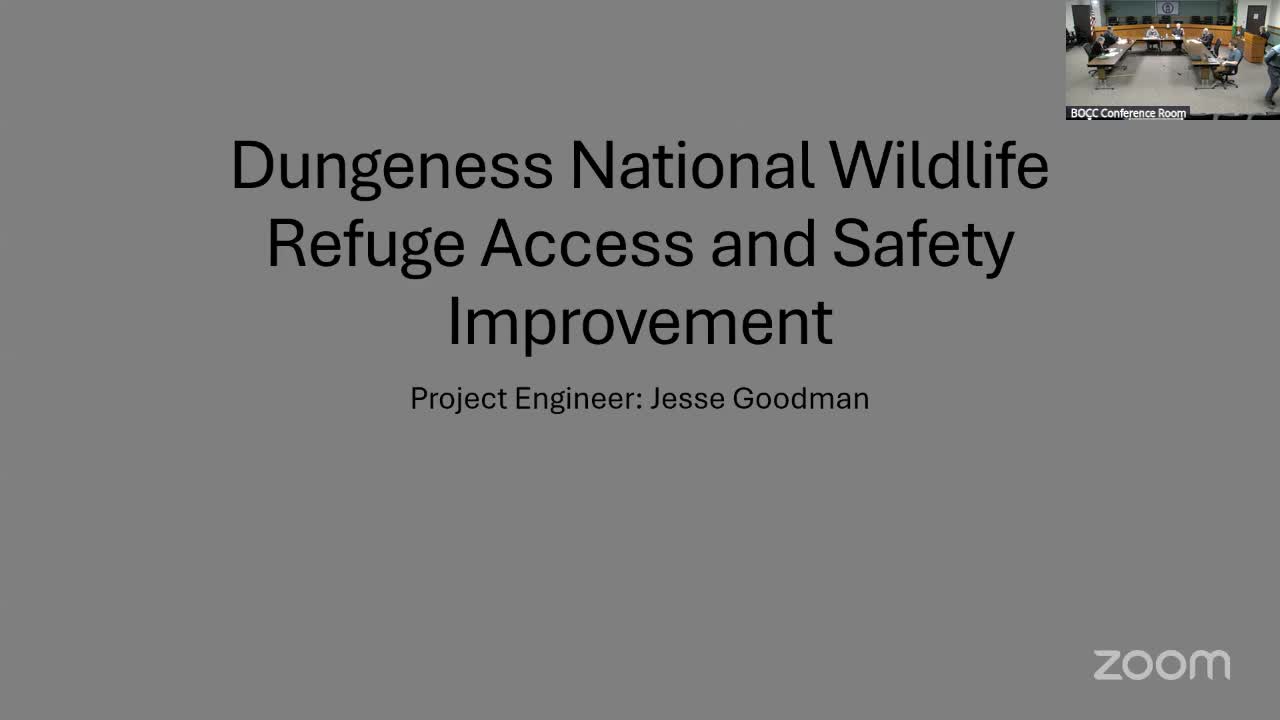
Trail, road and safety elements: Separate but related work includes trail maintenance and a potential new trail alignment and road realignment to maintain reliable public access to the Dungeness National Wildlife Refuge. Jesse Goodman, a project presenter, said erosion of the bluff and past delays in federal delivery prompted the county to reinitiate design. The county has solicited a wetland delineation and permitting quote from a marine survey firm for the portion within the park; staff indicated the cost figure was reported to the board during the meeting but did not provide a precise consolidated total in the public discussion summary.
Volunteers and local groups: The North Peninsula chapter of the Backcountry Horsemen of Washington volunteered to build a portion of a trail, offering labor and an estimated volunteer cost of about $40,000 to construct the volunteer segment under accepted trail‑building standards. Staff said volunteers could help with trail construction and initial maintenance while the county phases capital improvements.
Site cleanup and constraints: County staff said due diligence identified a former unauthorized dump area on the property; consultants located scattered surface debris and recommended a focused cleanup. The county reported that Ecology grant funding will cover most of the expected cleanup costs and that the cleanup should occur in spring–summer if bids and permitting proceed on schedule.
Deed conditions and permitted uses: Staff reiterated that because the acquisition was funded through an Ecology streamflow restoration grant, the recorded deed includes conservation‑oriented restrictions. Allowed activities listed by staff include streamflow restoration works, habitat restoration, forest management, stormwater infiltration, and parks and recreation facilities. The deed prohibits residential and most commercial or industrial uses and requires Ecology approval for activities not consistent with conservation values; staff said new wells would generally be disallowed unless needed for restoration and approved by Ecology. County staff advised that any more intensive improvements, such as full sanitary systems or campground developments, would require early consultation with Ecology.
Public outreach and next steps: Project staff said they will hold a public meeting focused on the proposed curve realignment and related road design within the next few weeks; staff emphasized they will not present a fixed design before gathering community feedback and warned that a contentious public response could require a formal project rescoping. The county's consultant interview team will complete provider interviews this month; the interview team may forward a recommendation to the parks advisory board by email, and the board agreed to accept and review the recommendation by email before the April agenda.
Park designation vote: During the meeting a board member moved and the board approved a motion to name the site officially “Dungeness Trails” and to memorialize it as a Clallam County park. The motion passed by voice vote; no roll‑call tally was recorded in the meeting transcript.
What remains unresolved: staff and board members highlighted several outstanding items, including (1) securing construction funding for the reservoir if FEMA or other large grants do not materialize, (2) finalizing design and geotechnical borings, (3) defining the relationship between reservoir infrastructure and park improvements (parking, restroom/sanitation, and access), and (4) getting Ecology concurrence on any uses that could intensify site impacts.
The park staff said they will prepare a development cost order‑of‑magnitude for board review at the April meeting and will coordinate volunteer groups on trail maintenance, parking improvements and signage in the near term.
Ending note: Board members and staff described the acquisition and linked projects as a multi‑year effort combining habitat and water‑supply goals with near‑term recreational benefits. County staff repeatedly emphasized the need to sequence design, outreach and permitting so that park improvements do not preclude potential reservoir or infiltration projects.