Get Full Government Meeting Transcripts, Videos, & Alerts Forever!
Get email alerts on the Legislation Votes topic
No spam. Unsubscribe anytime.
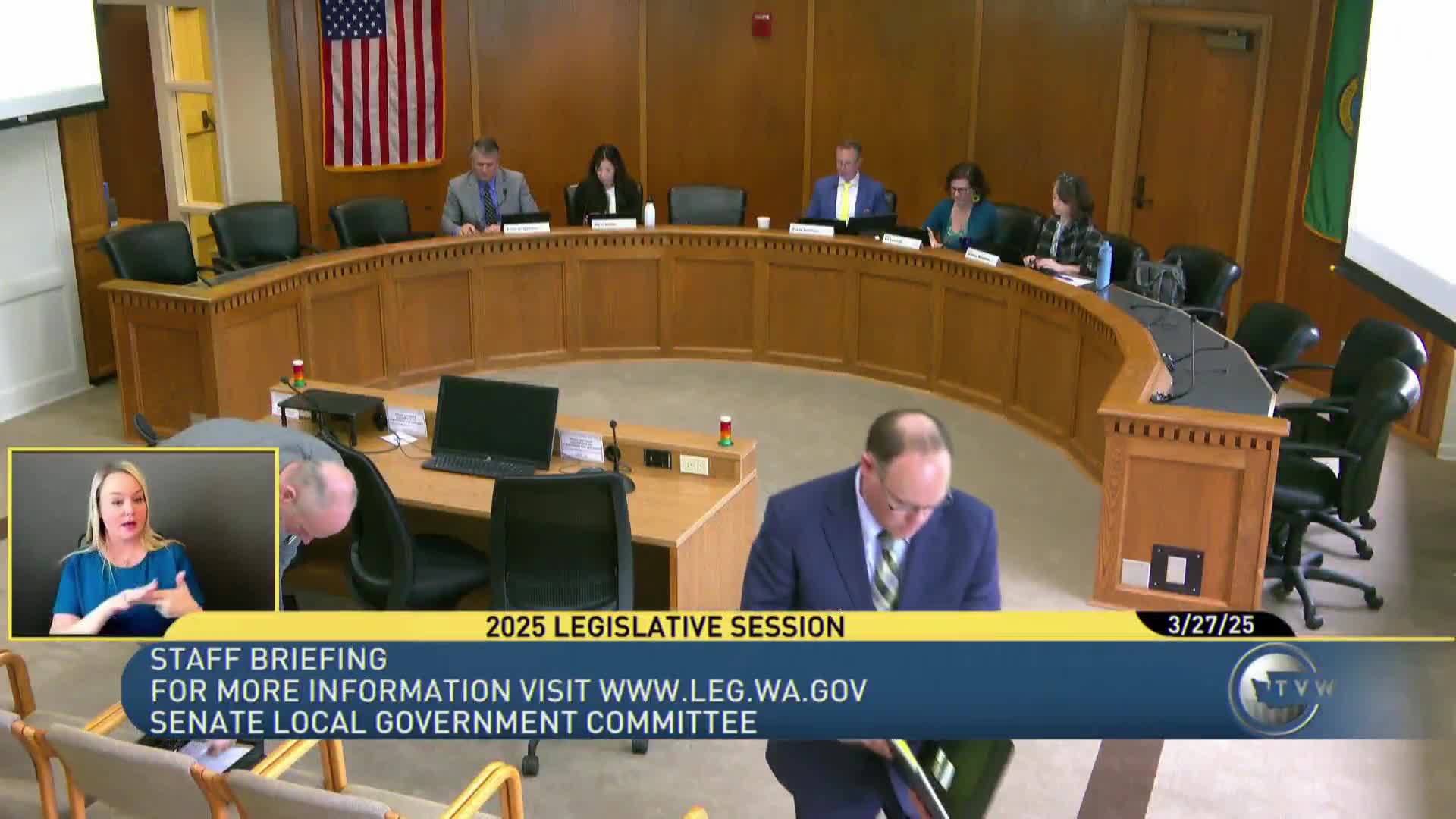
Senate Local Government Committee advances three bills on tribal representation, diaper changing stations and historic landmarks
Summary
In executive session the committee recommended "due pass" on three House bills to the Rules Committee: House Bill 1946 (tribal representatives on local boards of health), House Bill 1562 (baby diaper changing stations in public restrooms), and House Bill 1576 (limits on city historic landmark designations without owner consent).
The Senate Local Government Committee moved three House bills to the Rules Committee after staff briefings and short member discussion during executive session.
House Bill 1946: clarifying tribal membership on local boards of health Committee staff summary: Karen Epps summarized that the bill requires a local board of health or health district board to allow a tribal representative from each federally recognized Indian tribe that holds reservation or trust lands, or from an urban Indian organization (an IHS‑recognized 501(c)(3) serving American Indian or Alaska Native people) that provides services within the county. The bill requires the tribe or organization to select the representative, directs the State Board of Health to adopt timelines for membership modifications, and requires the county commissioners or legislative authority to update board membership. Epps said the bill passed the House 61–36 and that a fiscal note is available; a new fiscal note had been requested and not yet posted. The committee moved the bill forward with a due‑pass recommendation to Rules; the committee record notes the bill will be sent to Rules "subject to signatures."
House Bill 1562: baby diaper changing stations Committee staff summary: John Kim summarized HB 1562, which requires newly constructed buildings that must have a public restroom, or existing buildings undergoing a permitted restroom remodel of $15,000 or more, to provide baby diaper changing stations and signage, with specified exemptions and penalties. A striking amendment offered by the chair revised the exemption language to allow removal of a station if it is not used consistent with the manufacturer's standards rather than when it is no longer usable. Kim noted the House passed the bill 67–28; the Department of Commerce told staff the fiscal impact on local governments is indeterminate because of potential ordinance changes and enforcement. The committee adopted the striking amendment and moved the bill to Rules with a due‑pass recommendation.
House Bill 1576: designation of historic landmarks by cities Committee staff summary: Karen Epps briefed HB 1576, which (as presented) would prohibit a city or code city from designating a property as a historic landmark if the property is less than a stated age threshold or if designation would restrict use, alteration or demolition without the written consent of the owner. The bill contains exceptions for local historic districts and for older properties. The House passed the bill 95–0, and a striking amendment (labeled B and offered by Senator Solomon) revised the owner‑consent age threshold (transcript clarification: the amendment sets the threshold for designation without owner consent to 125 years). The committee adopted the striking amendment and voted to send the bill to Rules with a due‑pass recommendation.
Votes and motions - For each bill the committee record shows a motion to give the bill a “due pass” recommendation and that the motion carried; the oral record records “All those in favor say aye” followed by “Opposed, nay. The bill is passed subject to signatures.” The transcript does not include a roll‑call tally in committee; the bills were advanced to Rules.
Why it matters - HB 1946 alters local board composition to ensure tribal representation where tribes or qualifying urban Indian organizations operate locally; it will require state rulemaking timelines and local board membership updates if enacted. - HB 1562 would affect building and remodeling of public restrooms and could impose costs or ordinances on local governments; staff described an indeterminate fiscal impact. - HB 1576 changes local landmarking practice by requiring owner consent for most designations under the amended threshold, a change advocates and local governments have flagged as significant.
Speakers and staff at the executive session included committee Chair Senator Solomon and committee staff Karen Epps and John Kim. The committee adopted amendments where noted and advanced all three bills to the Rules Committee.