Get Full Government Meeting Transcripts, Videos, & Alerts Forever!
Get email alerts on the Child Support topic
No spam. Unsubscribe anytime.
Committee hears public testimony on child support schedule updates; bill would raise self-support reserve and expand income table
Summary
Engrossed House Bill 1014 would raise the self-support reserve to 180% of the federal poverty guideline, expand the child support economic table up to $50,000 monthly net income, and allow temporary reductions for parents in court-ordered behavioral-health treatment; proponents and advocates urged additional language on educational expenses.
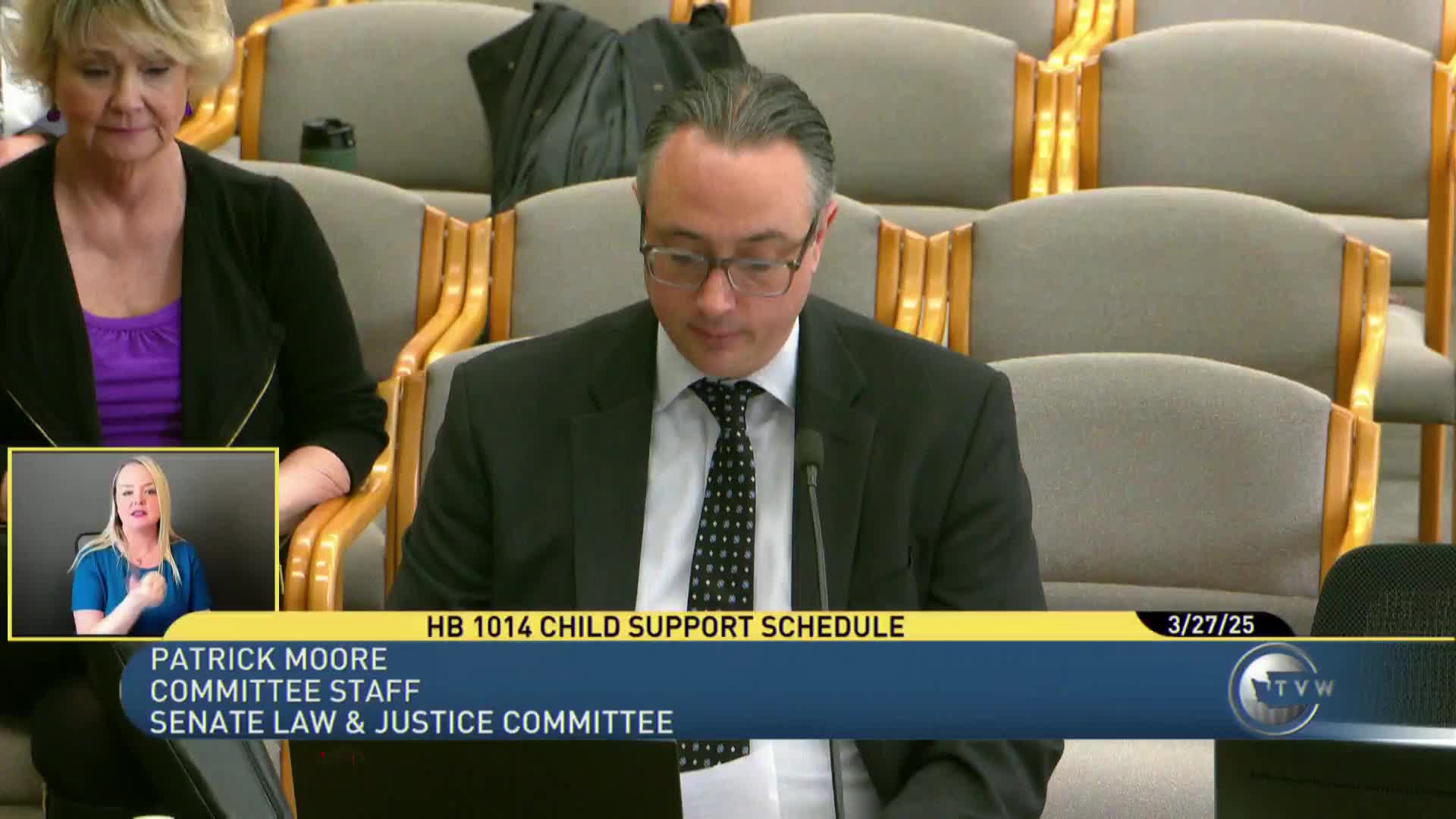
The Law & Justice Committee heard public testimony on Engrossed House Bill 1014, which implements the Child Support Schedule Work Group’s recommendations. Staff explained the measure would raise the self‑support reserve (the minimum net income a parent must be left with) from 125% to 180% of the federal poverty guideline for a one‑person household, expand the economic table to combined net monthly incomes up to $50,000, increase the minimum net income figure from $1,000 to $2,200 monthly, and add procedures to permit temporary reduction of child support for parents ordered into court‑ordered behavioral‑health treatment.
Proponent testimony
Jake Hughes (DSHS) told the committee the work group reached consensus after more than nine months of meetings and two public forums; he described the temporary abatement as a $50 per child minimum for up to six months in cases where a parent is involuntarily ordered into treatment under chapter 71.05 RCW and lacks assets to pay. Representative Schmidt, sponsor, said the changes reflect inflation and changes in wages and expenses since the last update and that the bill follows federally required periodic review.
Advocates’ concerns
Northwest Justice Project attorney Kaha Arte supported the bill but urged reinstating language (removed by a floor amendment) clarifying that educational expenses (school supplies, books) are not included in the basic child‑support economic table and should be apportioned between parents in the same proportion as the basic obligation, similar to current treatment of health-care and daycare costs. Other testifiers (James Clark, National Parents Organization; John Meyer, private citizen) expressed concerns about judicial discretion, the lack of residential‑time credit in some cases, and potential effects on lower‑ and middle‑income households.
Committee discussion
Staff explained judges retain discretion to deviate from the schedule if strict application is unjust, but must enter written findings. Several members asked about the specifics of the temporary abatement and discretion rules; staff and the sponsor said the work group’s process included judges, attorneys, an economist, and parents with lived experience.
Provenance
Staff briefing began with Patrick Moore and was followed by sponsor testimony and four public witnesses. No committee vote was recorded at the hearing.