Get Full Government Meeting Transcripts, Videos, & Alerts Forever!
Get email alerts on the Economic Development Redevelopment topic
No spam. Unsubscribe anytime.
Milford resident outlines how Franklin revived its downtown with housing, TIF and a whitewater park
Summary
At the March 12 EDAC meeting, Milford resident and developer Todd Workman described a multi-year public‑private strategy used in Franklin — land conservation, acquisition and rehab of mill buildings, tax‑increment financing, developer partnerships and a whitewater park — that he says helped revive the downtown and boost businesses and housing.
Todd Workman, a Milford resident and developer, told the Economic Development Advisory Council on March 12 that he helped lead a multi‑year effort in Franklin that combined land conservation, private real estate acquisitions, public‑private financing and the construction of a whitewater park to spur downtown revitalization.
The idea, Workman said, began after he conserved 231 acres adjacent to Webster Lake and then turned his attention to a walkable mill downtown. “I ended up putting my 231 acres into permanent conservation,” Workman said, describing how he sold development rights through the U.S. Natural Resources Conservation Service wetland reserve program and shifted his focus to rehabilitating mill buildings and the riverfront.
Workman said the effort used a variety of financing tools and partnerships to make projects viable. He described forming a New Hampshire nonprofit (Perma City Life) that acquired six mixed‑use mill buildings and worked with Franklin Savings Bank for acquisition and facade rehab loans, then combined Tax Increment Financing (TIF) proceeds, state historic tax credits, facade grants and loans from the New Hampshire Business Finance Authority, the Community Development Finance Authority and the New Hampshire Community Loan Fund. He said one TIF bond was about $1.2 million to clean up the mill infield and create parking and stormwater capacity; later phases attracted congressional funding and other grants.
Workman also described partnering with a nonprofit housing developer identified in the meeting as CATCH (Catch Housing) to convert a condemned mill building into workforce housing. He said a subsequent larger private conversion produced mixed‑income units, with a portion income‑restricted at 80 percent of area median income alongside market‑rate and upscale condominiums. “The Whitewater Park is free to everybody,” Workman said, noting that the park drew visitors, supported restaurants and breweries, and helped increase property values downtown.
Workman credited the project’s progress to concentrated property control, repeated planning efforts, and constant partnership among local government, banks, nonprofit fiscal sponsors and technical consultants. He said the whitewater design drew on examples from Colorado, engaged experienced engineers and required a multi‑phase permitting and engineering process; he told the council that the first phase from concept to ribbon cutting took roughly five and a half years.
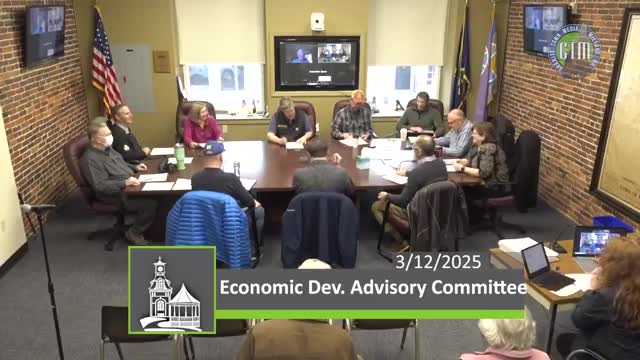
EDAC members asked about environmental and regulatory constraints for river modifications. Workman said the Franklin river reach had already been heavily altered by historic mills and that the initiative included cleanup of rebar, rubble and brownfield remediation; he said the group used engineers experienced in whitewater features and obtained regulatory approvals. Camille Patterson, Milford’s director of community development, was noted as staff at the meeting and helped facilitate Q&A.
Why it matters: several EDAC members raised the idea of applying similar placemaking and recreational investments to Milford’s Souhegan River corridor. Workman emphasized that projects of this scale require a clear local vision, concentrated property control (or coordinated owners), a dedicated project lead and a mix of financing tools so private investment becomes economically feasible.
Workman recommended starting with a single, achievable pilot project, building public‑private coalitions, preparing targeted grant applications and ensuring zoning and infrastructure alignment before pursuing larger river modifications or new river amenities. He repeatedly stressed that technical design and permitting — especially for river engineering — must be handled by firms with prior whitewater park experience.
Provenance: topicintro — excerpt from the meeting where Workman introduced his Franklin experience; topfinish — the later point where he closed Q&A and invited further questions.