Get Full Government Meeting Transcripts, Videos, & Alerts Forever!
Get email alerts on the Sidewalk Wetland Buffer Impact topic
No spam. Unsubscribe anytime.
Milford ZBA approves special exception for Mill Street sidewalk with minor wetland buffer impact
Summary
The Town of Milford Zoning Board of Adjustment granted a special exception permitting about 730 square feet of wetland buffer impact to construct a sidewalk along Mill Street serving a proposed 28-unit development at 30 Mill Street; the town will require easement dedication and final DPW/planning-board signoff. A 30-day appeal period applies.
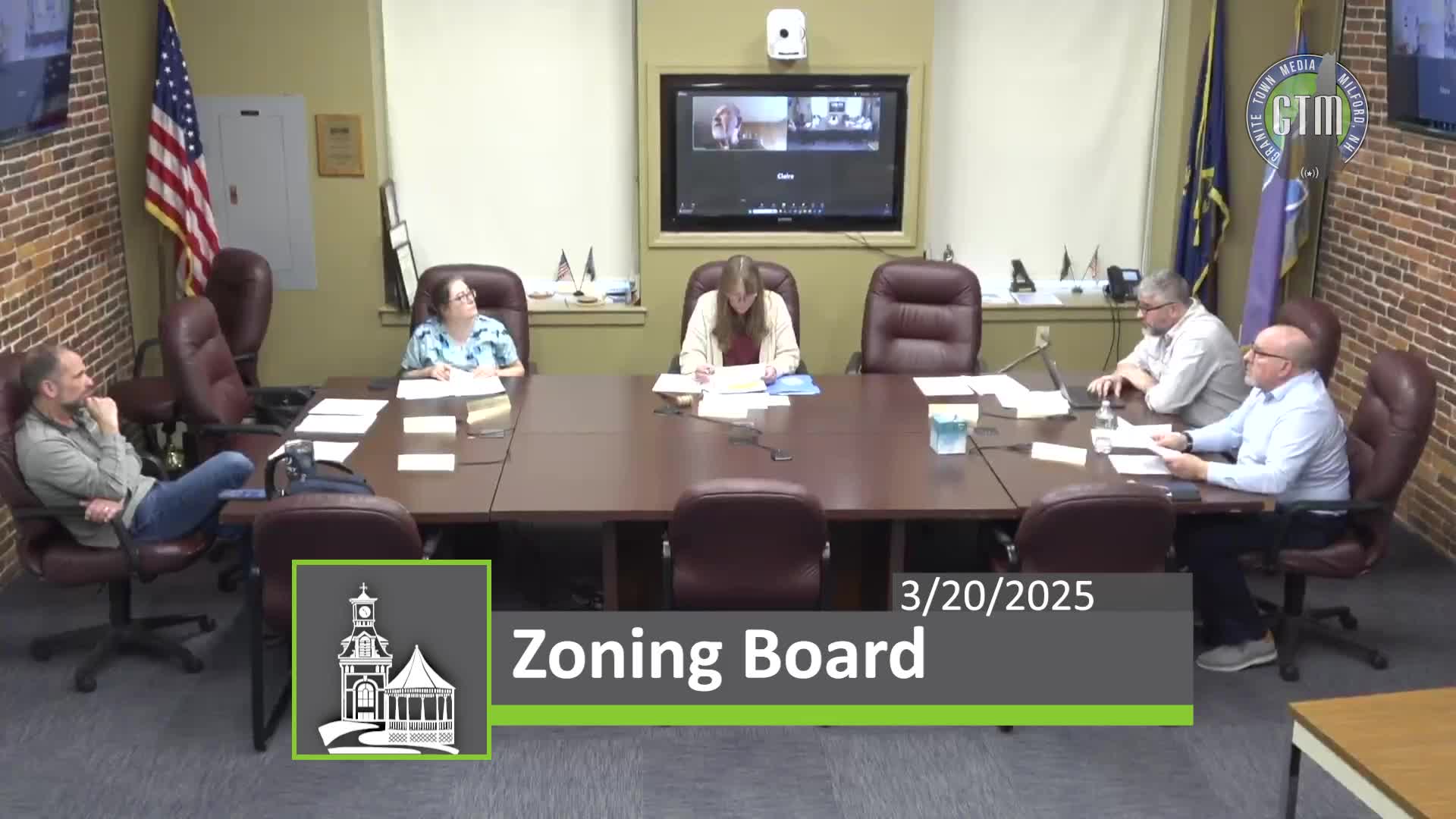
The Town of Milford Zoning Board of Adjustment on March 20 approved a special exception allowing a sidewalk along Mill Street that will affect the wetland buffer for a proposed 28-unit development at 30 Mill Street.
Board Chair Joan Darje opened the hearing and heard from Sam Ingram of Meridian Land Services, who said the application was "a straightforward, application" and described the impact on the wetland buffer as roughly 730 square feet associated with the sidewalk required as part of the planning-board review for the project. Ingram said the sidewalk will be placed directly adjacent to the roadway and that "the sidewalk will be protected with vertical granite curbing along Mill Street ensuring pedestrian safety." He also said the applicant will dedicate a sidewalk easement to the town for maintenance and operation by the Department of Public Works.
The board's nut graf: members said the sidewalk is consistent with local sidewalk placement and public-safety goals and that the proposed encroachment into the wetland buffer appeared minimal compared with the public benefit of a continuous pedestrian route. Several board members emphasized that final design and any easement language will be reviewed by the town's Department of Public Works (DPW) and the Planning Board before construction.
During the hearing, board members pressed the applicant on alternatives and stormwater treatment. Sam Ingram told the board the sidewalk alignment minimizes buffer disturbance by placing the walk adjacent to the existing roadway and that the overall site will include broader stormwater management measures as part of the development; he said no additional stormwater-treatment structures were proposed specifically for the sidewalk because such measures would cause additional buffer disturbance. Board members noted the Conservation Commission had provided comments (a March 14 communication was on file) suggesting the sidewalk could help channel runoff away from the buffer if properly drained and that designers should avoid creating ponding on the roadway.
Board members asked practical questions about the curb and grading; the applicant said the proposed granite curb would be about 7 inches tall and that the sidewalk grade should be sloped toward the street to reduce runoff into the buffer. The applicant also said some roadway alignment changes are planned to reduce a sharp corner near a stone wall and that those changes would not increase disturbance to the primary wetland edge behind the site.
After deliberation, the board reviewed the special-exception criteria aloud (similar permitted use, appropriate site, minimal adverse effect, no nuisance or hazard, adequate facilities, allowance under the ordinance, and specified conditions). The board voted by roll call on each criterion and on the request. The roll-call votes recorded the members present as voting yes and the board granted the special exception. Chair Darje announced the approval and reminded the applicant of the 30-day period for any appeal.
Ending: The board's approval allows the applicant to proceed to final Planning Board and DPW review, including preparation of easement documents and any required final design revisions to address drainage. The applicant was told to expect the 30-day waiting period for potential appeals before construction or permitting moves forward.