Get Full Government Meeting Transcripts, Videos, & Alerts Forever!
Get email alerts on the Border Security topic
No spam. Unsubscribe anytime.
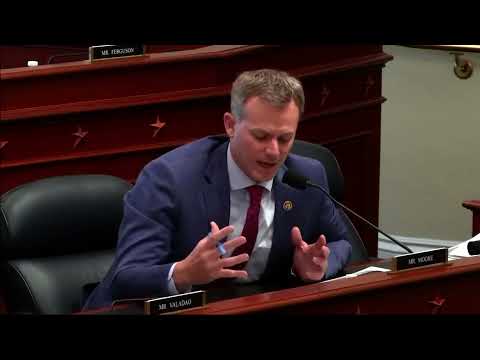
Congressman Blake Moore presses witnesses on cartel profits, intelligence sharing and border infrastructure at Utah town hall
Summary
Congressman Blake Moore, speaking at a town hall in Utah, pressed witnesses on recent changes in border policy, cartel profits and gaps in intelligence sharing, citing Homeland Security figures that he said show cartel human-smuggling and trafficking profits rising from about $500 million in 2019 to more than $13 billion in 2022.
Congressman Blake Moore, speaking at a town hall in Utah, pressed witnesses on recent changes in border policy, cartel profits and gaps in intelligence sharing, citing Homeland Security figures that he said show cartel human-smuggling and trafficking profits rising from about $500 million in 2019 to more than $13 billion in 2022.
Moore said the issue has appeared at “last 2 and a half, 3 years, numerous town halls” and described concern among his constituents about long-term implications for the state. He said he would support a legislative fix but noted Congress has not solved immigration reform in decades and urged the Biden administration to take executive steps in the meantime.
The central exchange involved Moore and a witness identified in the transcript as Mr. Webb, who described operational gaps at the southern border and proposed specific changes. Moore asked whether the Homeland Security figures were ‘‘directionally correct.’’ Mr. Webb replied, “That is directionally correct.”
Mr. Webb recommended several changes to improve law-enforcement ability to track cartel activity. He said “they need to be designated as foreign terrorist organizations in order to get the intelligence apparatus to completely understand, what Mexican cartels are actually doing.” He also urged changes to how cartel-related activity is logged, saying the current Uniform Crime Report and National Incident-Based Reporting System (NIBRS) do not capture much cartel activity and that agencies are “operating in silos.”
Mr. Webb described gaps in domain awareness and technology between ports of entry, and he cited the Secure Fence Act of 2006 as an example of legislation he said, in his view, would help deny illegal entries if its intent were applied to critical infrastructure between ports. He said Border Patrol agents sometimes lack the technology to understand ‘‘who, where, when, why, or how’’ people cross between ports of entry and compared the present conditions to an earlier era of limited equipment.
Both Moore and Mr. Webb pointed to two factors they said help explain the change in smuggling since 2019: the COVID-19 pandemic and policy reversals after the prior administration. Moore said policies such as the “remain in Mexico” arrangement under the prior administration were reversed by the Biden administration and that the reversals contributed to increased crossings. Mr. Webb and Moore repeatedly framed the issue as one requiring better interagency intelligence sharing; Mr. Webb said, “I I shutter whenever I hear the concept of not sharing intelligence and properly communicating with each other.”
The exchange included repeated caveats about measurement. Moore acknowledged it is difficult to track cartel finances precisely and said the $500 million-to-$13 billion figures are directional estimates from Homeland Security investigations. Mr. Webb likewise said reporting gaps mean officials are “running blind” unless reporting and data-sharing change.
No formal votes or directives were recorded in the transcript excerpt. Moore closed by thanking witnesses and saying he would continue to press for solutions.