Get Full Government Meeting Transcripts, Videos, & Alerts Forever!
Get email alerts on the Us Suriname Relations topic
No spam. Unsubscribe anytime.
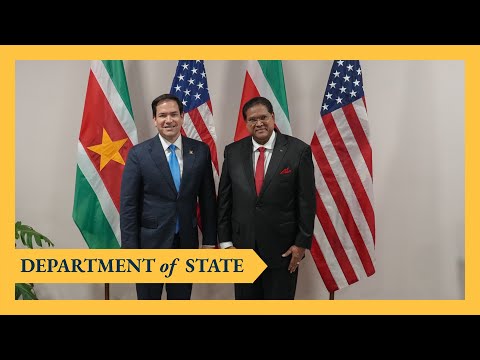
U.S. Secretary of State Marco Rubio visits Suriname, discusses investment, energy and security
Summary
U.S. Secretary of State Marco Rubio met with President Chandrikapersad Santokhi of the Republic of Suriname in Paramaribo on a visit aimed at expanding bilateral trade, investment and security cooperation, Rubio said during a joint press moment.
U.S. Secretary of State Marco Rubio met with President Chandrikapersad Santokhi of the Republic of Suriname in Paramaribo on a visit aimed at expanding bilateral trade, investment and security cooperation, Rubio said during a joint press moment.
The meeting highlighted plans to attract U.S. investors to Suriname's oil and gas and mining sectors, U.S. technical assistance on law‑enforcement capacity, and a pending maritime "shiprider" agreement that Surinamese officials said has been submitted to parliament for approval.
Why it matters: Suriname and neighboring Guyana are emerging energy producers in the Caribbean; U.S. officials framed deeper ties as a way to promote regional stability and provide alternatives to Chinese infrastructure projects that U.S. officials criticized for poor workmanship, opaque contracting and use of nonlocal labor.
President Chandrikapersad Santokhi said Suriname seeks expanded U.S. investment and noted longstanding commercial ties between the countries. "Suriname has a long standing and strategic partnership with The United States Of America," Santokhi said, and he invited U.S. participation in an upcoming energy summit in Paramaribo in June (described in the press remarks as an oil and gas summit and exhibition). He named U.S. oilfield service and energy companies he said are active or welcome in Suriname, including Apache, Halliburton and Schlumberger.
Rubio, introduced in the event as the U.S. secretary of state, said the visit came early in his tenure and that his office seeks to reorient U.S. foreign assistance toward the priorities host countries identify. "The best foreign aid programs are the ones that come to an end because they've achieved their purpose," Rubio said, adding that the intent is to build local capacity so partner countries can sustain law enforcement and stability without long‑term U.S. presence.
On counter‑drug cooperation, a Surinamese official said a renewed U.S. law‑enforcement presence (referred to in the press remarks as the "DA office") will be considered by the U.S. government. Santokhi said a new shiprider agreement has been approved by Suriname's government and "that agreement has been submitted to the parliament and we're waiting for the approval." He said the agreement would strengthen interdiction efforts and bring technical and material support to operations targeting transnational criminal groups.
Rubio said the United States wants to help prevent transnational criminal organizations and gangs from gaining a foothold in the region and described U.S. assistance as focusing on technology, personnel and best practices. "When these drug dealers look at the world, we want them to say, 'I don't wanna go through Suriname because their police departments and their law enforcement is so strong,'" Rubio said.
Both leaders addressed concerns about non‑U.S. foreign investment. Rubio criticized Chinese projects in parts of the region for poor construction quality, excessive debt and use of nonlocal labor, and argued the United States should offer alternative financing and contracting. "If you're gonna have a telecommunications system that is controlled by Chinese companies, you're gonna have trouble having American investors come in because they don't want all their stuff stolen," Rubio said. Santokhi said many foreign projects in Suriname were awarded through international bidding and financed by multilateral lenders such as the Inter-American Development Bank and the World Bank; he said local companies have often been excluded from participation and called for greater local content.
No new bilateral agreements were signed during the press moment. Surinamese officials presented the shiprider agreement as pending parliamentary approval, and U.S. officials said consideration will be given to reestablishing a U.S. law‑enforcement office in Suriname. Both sides described a shared interest in expanding private‑sector ties and U.S. investment in Suriname's energy and mining sectors.
The event included questions from international reporters; remarks and answers focused on investment opportunities, regional security cooperation and the competing presence of Chinese projects in the region.
Details that remain unspecified in the press remarks include a formal timeline for parliamentary action on the shiprider agreement, the precise U.S. agency or office referenced as the "DA office," and whether any specific U.S. financial commitments or project contracts will follow from the visit.