Get Full Government Meeting Transcripts, Videos, & Alerts Forever!
Get email alerts on the Energy Infrastructure topic
No spam. Unsubscribe anytime.
Painesville council hears legal concerns about amended Cuyahoga subgrant as staff outlines larger solar-plus-battery plan
Summary
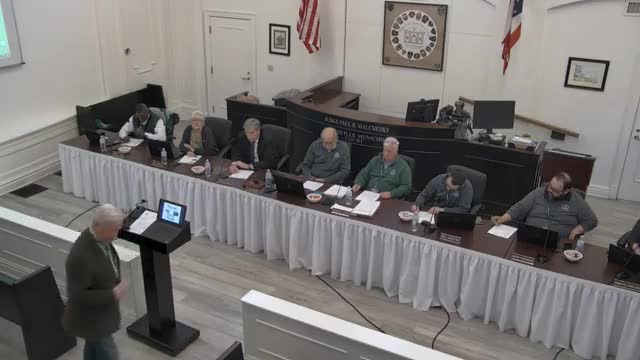
Painesville City Council on first reading considered a county-requested change to the city’s subrecipient agreement under an EPA CPRG grant and heard staff present consultant findings that favor more battery capacity for the city’s planned solar-plus-battery project.
Painesville City Council on first reading reviewed an amended subrecipient agreement from Cuyahoga County tied to the EPA CPRG grant and heard a detailed update on the city’s proposed solar and battery project, including a consultant recommendation to increase battery capacity.
Council members pressed staff and the law director on contract language that would make county payments contingent on the EPA’s continued funding, and asked what would happen to money the city already spent if federal payments were withheld. City staff said the city has submitted reimbursement requests (about $10,000 submitted to date) and has been told those submitted reimbursements will be paid, but acknowledged uncertainty about longer-term funding timelines and legal risk from recent federal actions. Law Director Doug described the change as a protective clause requested by Cuyahoga County legal counsel; county officials told the council they would not approve the subrecipient agreement without that language.
The discussion shifted to the scope and timing of the solar-plus-battery project funded through the same federal grant. Electric Superintendent Joe Price and other staff described a consultant (Courtney and Associates) analysis comparing configurations of solar and battery capacity. The consultant recommended a scenario with about 25 megawatts of solar and 20 megawatts of battery as the best technical balance; staff proposed proceeding first with the battery portion the grant currently approves (10 megawatts) and soliciting bids that include alternates for 15 and 20 megawatts to preserve options and pricing leverage. Councilmembers and staff discussed the need for engineering design, impact studies with the regional utility (FirstEnergy), and the timeline for purchasing and siting equipment at the Richmond Street substation, Northridge, or at the plant.
Council members repeatedly asked whether the agreement and project should be reviewed by the Utilities Commission before returning to council. Several members said they preferred the commission’s input because its members are end users of the utility; others said council has already reviewed earlier versions of the agreement and that the county and Cleveland had requested the specific language change. City staff and council agreed not to vote on the amendment at first reading and to schedule a second reading; staff said Cuyahoga County planned action on its side the following day, prompting council to consider a special meeting if needed to align approvals.
Council members asked staff to return with options that limit financial exposure absent a firm federal guarantee, and to coordinate next steps with county partners. No final approval of the amended subrecipient agreement occurred at this meeting; council took the item to second reading.
The discussion included multiple reminders that the grant is a federal reimbursement grant (the county is the prime recipient), that reimbursements are tied to invoice-by-invoice disbursements, and that larger project phases (for example, procuring tens of millions in equipment) would return to council for explicit approval. Staff described plans to spend under $50,000 on next-phase engineering work (which staff said would not require procurement under federal rules) and to issue solicitations for the first 10-MW battery with alternates for larger capacity.
Sources and speakers in the meeting included Law Director Doug, Joe Price (electric superintendent), Council President Mario, Councilmember Lori, Councilmember Jim Saas and other council members, and county/city staff working on the grant. The discussion merged legal and programmatic questions: contract language intended to protect Cuyahoga County as pass-through recipient, and technical recommendations to prioritize initial battery procurement while preserving the option to expand capacity later.
Council directed staff to continue coordination with Cuyahoga County, the Utilities Commission as appropriate, and to report back at second reading with options that clarify timing, reimbursement risk, and the scope of work for the immediate engineering phase.