Get Full Government Meeting Transcripts, Videos, & Alerts Forever!
Get email alerts on the Cannabis Regulation topic
No spam. Unsubscribe anytime.
Lake County planning commission denies Little High Valley cannabis permit amid road, safety and school setback concerns
Summary
The Lake County Planning Commission on March 27 denied a major use permit for a two‑acre outdoor cannabis cultivation and proposed processing facility at 17870 Little High Valley Road after sustained concerns about private road access, emergency response standards and proximity to a registered home‑based school.
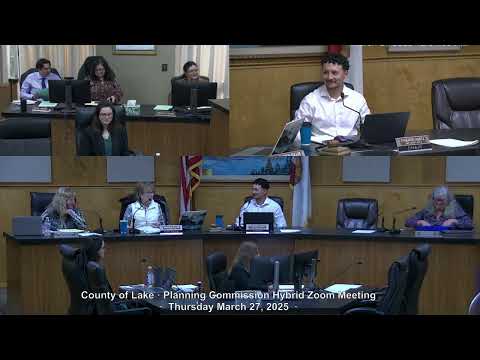
The Lake County Planning Commission on March 27 denied a major use permit for Little High Valley, a proposed outdoor cannabis cultivation operation and processing facility at 17870 Little High Valley Road in Lower Lake.
Staff had recommended approval after a change in legal precedent: on March 20 the California Department of Cannabis Control disclosed that the California Supreme Court had depublished the Court of Appeal decision in JC Crandall v. County of Santa Barbara, removing that decision as binding precedent. Senior planner Mary Claybon told commissioners the depublishing led staff to conclude the project now “meets the findings required for major use permit approval.”
Why it matters: Commissioners and dozens of nearby residents focused most of the hearing on road and emergency‑access standards set by state fire safety regulations (often cited as PRC 4290/4291 and implementing Title 14), the adequacy of private easements and associated maintenance agreements, and whether a nearby registered homeschool is protected by the county and state setback rules for cannabis cultivation.
Commissioners and the public described narrow, steep and partially eroded private road sections leading to the site, disputed whether routine maintenance would be sufficient to meet state fire‑safety expectations for commercial operations and questioned whether required road improvements would be feasible without additional permits or major grading. County staff told the commission that 42 90/42 91 rules can require roadway improvements to the nearest public road but that applicants can apply for an exception and demonstrate an “equivalent” standard.
Neighbors, including Joni Henderson and Bill Landers, told commissioners they live on the shared roads and described water shortages and erosion they attribute in part to recent work on the route. Henderson told the commission the issue was personal: she said her son is “severely immunocompromised” and urged the commission to prioritize his health when weighing setbacks for places where children gather. Henderson and others also questioned whether documentation submitted by the applicant and some site work had been permitted.
The applicant’s consultant, Trey Sherrill, and farm manager, Travis Lisenby, described the project details: two acres (87,120 square feet) of outdoor canopy, a proposed 3,500‑square‑foot processing building, water storage, and eight parking spaces including one ADA stall. Sherrill said the project’s hydrology study estimated 21.6 acre‑feet of groundwater recharge in a normal year and that projected cultivation water use would be about 4.2–5.8 acre‑feet per year (reduced by 10% under the project’s drought management plan). Lisenby said the operation would start smaller and scale up, noting they planned to plant roughly 1,500 plants per acre when fully built out.
To address commissioners’ primary concerns about road standards, the applicant said it was willing to remove the proposed processing building from the scope so the project would be treated as outdoor cultivation only — a change the applicant said would permit the county to treat the parcel under agricultural road standards per Board of Supervisors Resolution 2019‑124. County staff said such a modification could be noted and the permit description amended at the hearing if the commission chose to approve with that limitation.
Commissioners pressed legal counsel and staff about whether a home‑based homeschool qualifies as a “school” for state and county setback calculations. County counsel explained that both state and county cannabis setbacks reference the defined term “school” (covering kindergarten–grade 12) but that the county and state definitions exclude private schools “in which education is primarily conducted in private homes.” Counsel said that under current definitions a private home‑based homeschool is not treated as a school for the specific cannabis setback calculation, though commissioners may propose permit conditions based on project‑specific facts if those facts bear on the findings the commission must make.
After extended public comment and discussion, a motion to deny the permit carried. Chair Chavez announced that the motion to deny passed; the commission recorded the tally as three votes in favor of denial and one opposed. Chair Chavez reminded the applicant that the county’s zoning ordinance provides a seven‑calendar‑day appeal period to the Board of Supervisors.
Looking ahead: Staff advised that the applicant may apply for an exception to PRC 4290/4291 or amend the project to remove the processing facility and limit the action to outdoor cultivation only. The applicant stated on the record that they would accept removing the processing facility if that was required. The commission did not approve the project as presented.
Votes at a glance: Motion to deny major use permit UP21‑07 — motion passed (3 yes, 1 no). The applicant was notified of the seven‑calendar‑day appeal period.