Get Full Government Meeting Transcripts, Videos, & Alerts Forever!
Get email alerts on the Landscape Design topic
No spam. Unsubscribe anytime.
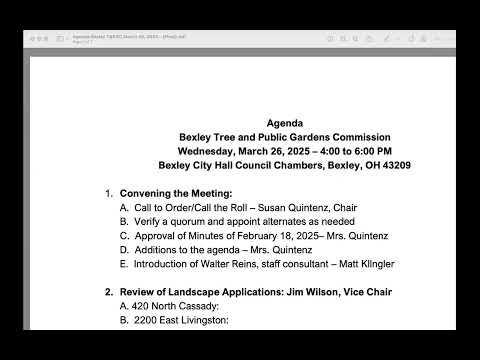
Commission approves landscape plan for 2300 E. Livingston with irrigation, plant substitutions and return review for furnishings
Summary
The Bexley Tree Commission conditionally approved the landscape plan for 2300 East Livingston (2300 E. Livingston), requiring substitution of Virginia creeper, replacement of a holly species with inkberry, irrigation for planting beds and tree lawns, and a return for approval of furnishings and ground‑cover selection.
The Bexley Tree Commission approved the landscape plan for 2300 East Livingston with conditions that address plant selection, irrigation and follow‑up review of ground cover and site furnishings.
Walter (staff consultant) said much of the existing plant material on the Livingston property was in poor condition and recommended a heavy replanting that would yield a net gain in canopy as the trees mature. He flagged a revision that listed a holly species (Ilex vomitoria 'Shillings') as unsuitable for Bexley’s climate and asked the applicant to replace it with a site‑appropriate shrub.
Applicant representative Bill Downing confirmed the design team will replace the holly with a compact inkberry and said the Virginia creeper originally shown on a trellis would likely be replaced with climbing hydrangea on that site. Pod Design added that the team had revised the planting palette to accommodate changes and supported irrigation across planting areas.
Why it matters: the Livingston site is the second parcel in the two‑site affordable housing project; landscaping choices will shape neighborhood character, buffer adjacent properties and determine initial maintenance needs during plant establishment.
Key facts and conditions
- Commission conditions for 2300 E. Livingston included: - Substitute climbing hydrangea or a noninvasive honeysuckle in place of Virginia creeper on the trellis. - Replace the holly species with a compact inkberry (Ilex glabra or similar inkberry cultivar). - Provide irrigation for planting beds and tree lawns, with attention to establishment needs for larger caliper trees (the commission noted regular supplemental watering for larger trees). - Return to the commission later with proposed bench and furnishings cut sheets and to revisit the ground cover selection for tree wells when furnishing plans are presented.
Discussion highlights
- Plant hardiness and provenance: Walter noted the dwarf yaupon holly was hardy to zones 7–9 and likely unsuitable for Bexley winters; the applicant agreed to substitute inkberry. - Amenity courtyard and safety: neighbors asked about sightlines and plant height near a fence on the north side; the developer agreed to protect existing arborvitae where possible and to replace any private plantings damaged during construction. - Street trees and sidewalk coordination: staff said street tree replacement on Livingston will align with the joint Livingston Avenue plan and that the exact street tree selection may be finalized later in coordination with the plan.
Action and vote
Commission member Jim Wilson moved to approve the plan with the conditions listed above; the motion was seconded and approved by voice vote. The chair called for ayes and declared the motion carried.
Next steps and context
- Staff said the project will coordinate with the joint Livingston Avenue plan for sidewalk width and street tree selection; the applicant must submit building permits and final planting/irrigation details for verification during permitting. - The broader two‑site project includes 27 units at the Livingston site (applicant statement).