Get Full Government Meeting Transcripts, Videos, & Alerts Forever!
Get email alerts on the Resource Center Relocation topic
No spam. Unsubscribe anytime.
Grand Junction Council to Consider Short Extension as Resource Center’s April 15 Closure Looms
Summary
Public comment at a March 17 special workshop focused on the downtown resource center’s April 15 closure; service providers urged more time to secure a replacement, downtown businesses pressed for a hard stop. Council agreed to agendize a formal discussion and tentatively schedule a special workshop to consider extension and interim plans.
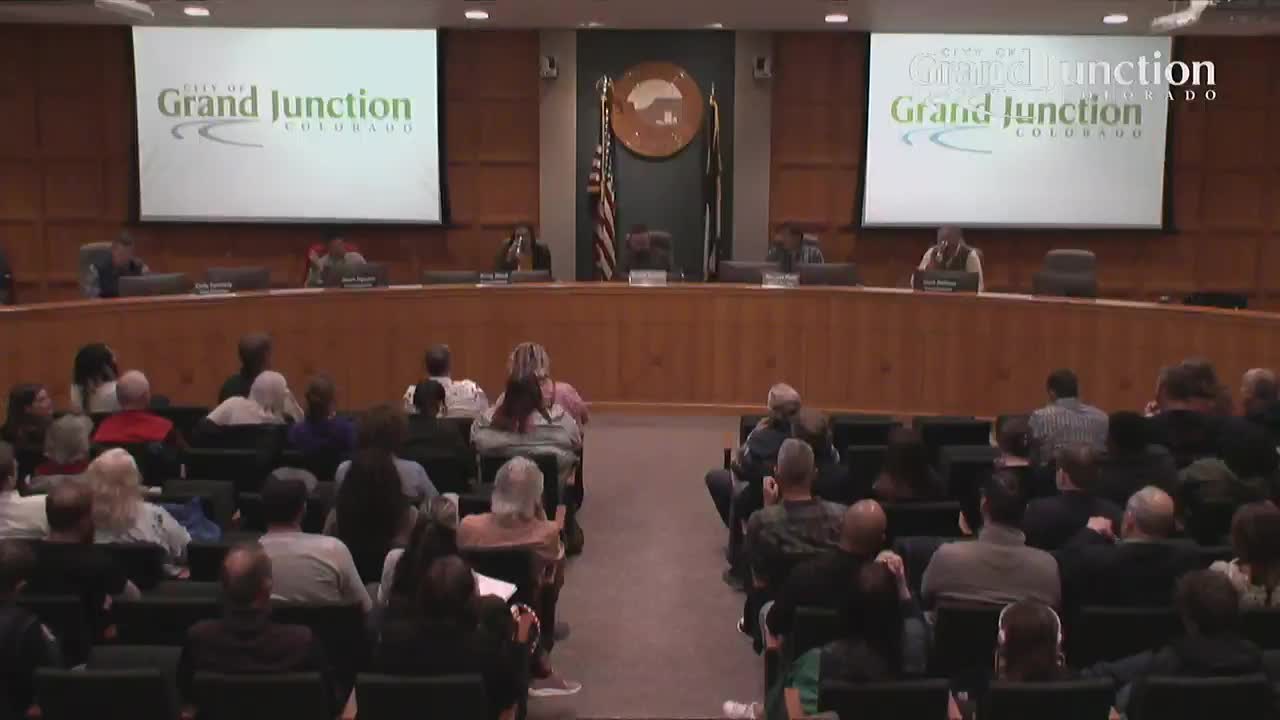
The Grand Junction City Council heard roughly four hours of public comment and provider discussion Monday about the city-run resource center downtown and whether it should close on April 15 as previously scheduled.
Advocates for keeping the center open, service providers and some collaborating nonprofits urged the council to delay closure until a permanent—or at least interim—replacement is ready; downtown business owners and nearby property managers said the center’s current location has driven safety and economic harms to the corridor and that the April 15 deadline should stand.
Why it matters: The center functions as a daily hub for dozens of service providers, offers showers and toilets used by hundreds of people, and hosts case management and health services staff the city and nonprofits say are central to linking people to housing. Closing without an alternative would shift where people in crisis spend daytime hours and could strain already stretched service networks.
Public comments and provider reports
Service providers and volunteers said the center has produced measurable service volume and long-term housing outcomes but acknowledged operational problems. "The resource center has provided over 83,000 collaborative services that include basic needs like meals, hygiene essentials, showers, 6 toilets, nursing services, transportation, and case management with currently over a hundred active case management," said Stephanie Avascones, executive director of Mutual Aid Partners and co-chair of the Resource Center Service Council.
Kristen Seidel, program and outreach coordinator with Mutual Aid Partners, read multiple first-person statements collected from people who use the center. One, attributed to “Bernadette,” said: "When you leave a shelter, you feel like you have nowhere else to go. The resource center is like my second home."
Nearby nonprofit leaders and business owners described a mix of safety and financial impacts. Jody Visconti Clow, director of Grand Valley Catholic Outreach Day Center, said cleanup and safety incidents have risen since December and recounted calls to law enforcement: "I made a total of 21 calls to 911 dispatch, 16 calls to non-emergency, and 8 calls to 911," she said, citing incidents including drug dealing and fires behind the day center.
Property owners and Main Street merchants reported lost tenants and extra costs. PJ McGovern, who manages several downtown properties, said he now pays for nightly security and weekly cleanups and estimated those expenses at about $30,000 a year: "We've had to hire a security guard service to walk through each of our buildings every night ... This is not free. I estimate $30,000 a year." The Grand Junction Chamber reported results of a flash poll of 34 downtown businesses: about 74% of respondents have been downtown more than 10 years and roughly two-thirds reported significant negative impacts since the resource center opened.
Provider proposals and concerns
Service organizations and coalition members said they remain committed to finding solutions but need time and coordinated logistics—transportation, storage, plumbing for showers/toilets and site readiness. United Way and other partners said they could reconfigure services and offer office space but underscored transportation and equipment needs for continuity.
Providers and coalition representatives urged a campus-style or distributed model rather than replicating a single large, open shelter tent. Scott Aker, chair of the Mesa County Collaboration for the Unhoused, said his group would support a short extension to avoid an abrupt shutdown: "We acknowledge that the location and what's going on there is untenable and cannot continue indefinitely. ... in the lack of Plan B being ready to go, we would be supportive of a 30 day — a 30 day extension to allow for just a little bit more time."
Council discussion and next steps
Council members did not make a final decision Monday. Instead they agreed to place the question on the council agenda for Wednesday to allow a public discussion and asked staff and providers to return with clearer, actionable proposals describing what would change during any extension (which services would continue, which would be relocated, and what measurable deliverables staff and providers could achieve within the requested time). Several council members said they would consider an extension only if it came with concrete, time‑bound deliverables. "For me to vote yes on an extension would have to have a really, really concrete deliverable," said Councilmember Stanley.
Councilmembers asked staff to continue real estate due diligence; staff reported they had evaluated roughly 30 potential properties and that a previously promising site at 2851 Avenue proved cost-prohibitive during city review. City staff also warned that equipment removal from the current site (pavilion, heat units, etc.) would take weeks and that securing assets would be necessary if the building were closed. Legal staff advised that any date change could be handled by a council resolution amending the prior action on the lease.
Council action at the meeting
Council directed staff to agendize a formal discussion for the next regular meeting (Wednesday) about whether to extend the resource center lease and operations; members also agreed to attempt scheduling a special workshop in the week that follows to consider any amendment or extension, with the caveat that any extension should include explicit deliverables and a clear end date. No formal vote to extend or to change the lease occurred at the March 17 workshop.
Context and outstanding questions
City-commissioned and provider data cited in the meeting highlighted both service volume and downtown impacts: providers reported more than 100 active case-management files tied to the center and staff said the center accounts for a majority of public toilet capacity downtown. Nonprofits warned that closing toilets and showers would have immediate public‑health and logistical consequences; one provider said pumping/operating the shower trailer cost about $4,000 per month. Business leaders and some residents maintained that the center’s current model and location have concentrated problems downtown and urged a hard stop on April 15.
The council asked providers to meet with staff, consolidate proposals about which services must continue and how they would be delivered during any extension, and return with draft language council could consider. Council also instructed staff to keep searching for suitable properties; city staff said they had already evaluated several dozen sites and would continue that work.
What’s next
Council will take up a formal discussion on Wednesday, March 19, and may schedule a special workshop the following week to consider whether to amend the lease or adopt a short extension and, if so, what conditions will attach. If council approves an extension, members said they expect a clear, measurable plan from providers and staff about how services will be delivered during the interim and what the finishing steps are toward a permanent location.