Get Full Government Meeting Transcripts, Videos, & Alerts Forever!
Get email alerts on the Housing Conversions topic
No spam. Unsubscribe anytime.
Planning commission backs drafting findings for code changes to allow commercial-to-residential conversions under HB 1042
Summary
At its March 24 meeting, the Monroe Planning Commission voted to direct staff to draft findings recommending City Council adopt code amendments required by Washington House Bill 1042 to ease conversion of existing commercial buildings into residential units, citing a June 30, 2025 compliance deadline.
The Monroe Planning Commission on March 24, 2025 voted to direct staff to draft findings of fact and conclusions of law recommending the City Council adopt amendments to Monroe Municipal Code Title 22 to implement Washington House Bill 1042, which encourages interior conversion of existing commercial and mixed‑use buildings into housing.
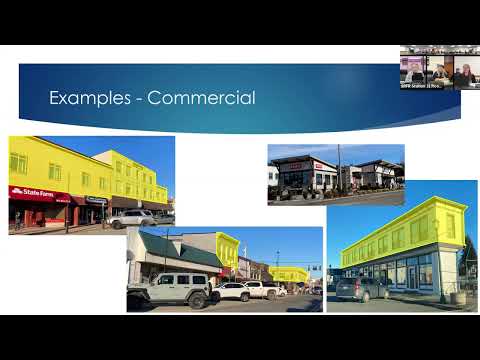
The measure matters because state law requires municipalities to update local development regulations to allow conversions and specifies limits on what cities may require. Leanne Barr, a staff member presenting the proposal, said House Bill 1042 "defines existing buildings as anything that has been completed at least 3 years ago" and requires cities to allow up to 50% greater residential density within an existing building envelope for qualifying conversions.
Under the proposed local amendments described by Barr, the city would: allow a 50% increase in residential density for conversions entirely within an existing building envelope; not require additional parking for those conversions (while retaining existing on‑site parking when proposed); not impose extra exterior design or architectural standards for converted projects; and not require additional permitting beyond typical new‑building requirements, including prohibiting a separate environmental review or CEPA process for the conversion itself. Barr also told the commission that the city "cannot deny a project based on any existing nonconformities," giving the example of setback nonconformities that predate current code.
Barr cautioned that while converted spaces must meet current energy‑code requirements, the law does not require bringing the entire building to current energy code. She also flagged common conversion costs—insulation, windows, HVAC and mechanical systems, water and sewer work and possible structural or seismic upgrades—as potential barriers for property owners. The presentation cited examples from Seattle and Bellevue to show conversions are expected to be uncommon: Seattle projects estimate about a dozen conversions over seven years; Bellevue fewer than five.
During public testimony, one resident asked general questions about growth and green space; staff and commissioners noted those matters were more directly related to the separate comprehensive rezone item on the agenda. After closing public testimony, the commission approved a motion to direct staff to draft the required findings and conclusions recommending City Council approval. The motion passed on a voice vote; no roll‑call tally was recorded in the transcript.
The planning staff said the next steps are for the commission to review drafted findings at its April 14 meeting before the packet moves to the City Council P3 committee and then a council public hearing, with the aim of meeting the June 30, 2025 deadline for compliance with the city’s recently adopted comprehensive plan.