Get Full Government Meeting Transcripts, Videos, & Alerts Forever!
Get email alerts on the Transportation topic
No spam. Unsubscribe anytime.
Brookline residents press Select Board to change Chestnut Hill Avenue bike‑lane plan
Summary
Multiple Chestnut Hill Avenue residents told the Select Board they oppose the town’s proposed redesign, saying it would remove curbside parking, hamper emergency access and worsen traffic on a heavily used arterial. Neighbors urged slower, broader community engagement and suggested nearby quieter streets as alternatives.
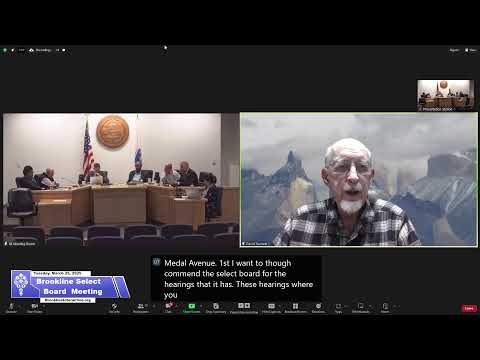
Brookline Select Board members heard more than a dozen residents from Chestnut Hill Avenue object to a proposed renovation that would change curbside parking and add protected bicycle facilities.
Neighbors said the plan, as presented so far, would remove or narrow curb parking used by visitors, service providers and people with mobility needs, and would create bottlenecks for buses, truck traffic and emergency vehicles. Several speakers asked the town to pause and broaden outreach before the Transportation Board advances a final design.
The board chair introduced the speakers by saying earlier work on the plan and quick timeline had prompted neighbors to sign up and ask for changes before a final Transportation Board decision. That set the context for a string of public comments from residents who live along or near the avenue.
David Eisenberg, a town meeting member and cyclist, said the proposed design ‘‘may be an attempt at solving a problem that might not exist’’ and warned the new treatment could increase risk on a roadway used by buses and tractor‑trailers. Brenda Hefter, who identified her address as 653 Chestnut Hill Avenue, said curbside spaces are essential for visitors, medical appointments and delivery vehicles and said she was not aware of any bike‑vehicle collisions on the corridor. She told the board the road carries ‘‘over 15,000 vehicles daily,’’ and said losing parking would create equity and safety problems for elderly and disabled residents.
Other speakers, including members of the neighborhood and of the Pedestrian Advisory Committee, said they had limited notice about the Bicycle Advisory Committee meeting where initial designs were shown and pressed for more neighborhood meetings and time to review alternative concepts. Jesse Hefter, a member of the Brookline School Committee and the Pedestrian Advisory Committee, said the first public hearing he saw was listed only shortly before that committee’s meeting and that subsequent iterations again lacked broad neighborhood outreach.
Speakers suggested quieter parallel streets such as Elliott Street or Fisher Avenue as alternatives for bike routing, and several asked the town to consider on‑street geometry that would preserve parking and evacuation/access for emergency vehicles. At least one resident said the plan ‘‘feels rushed, driven by very narrow interests rather than thoughtful planning that considers the entire community.’’
Select Board members did not take a formal vote on the Chestnut Hill Avenue designs during the meeting. Board members repeatedly urged staff to ensure a clearer, documented outreach schedule and to bring updated designs back in a way that makes neighborhood input visible to decision makers.
The Transportation Board and town engineering staff are handling detailed design and public process steps; residents and Select Board members asked staff to return with revised plans or an explicit explanation of the remaining review schedule so neighbors can judge whether to pursue an administrative appeal later in the process.
The Chestnut Hill Avenue remarks were part of a longer public‑comment period that the Select Board closed near the end of its meeting; some members said they expected additional neighborhood engagement before the town executes major changes to this arterial.