Get Full Government Meeting Transcripts, Videos, & Alerts Forever!
Get email alerts on the Alternative Education Community Schools topic
No spam. Unsubscribe anytime.
Paradise Creek staff describe intensive nine‑week courses, community partnerships and $780,000 grant for expanded supports
Summary
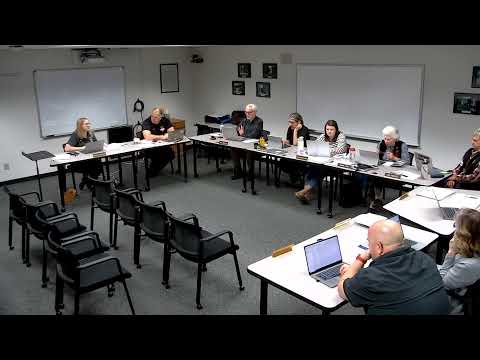
Paradise Creek (PCR), the district's alternative high school, runs compressed, 9‑week courses and relies on a small teaching staff and community partnerships to get at‑risk students to graduation, PCR and district staff told the Moscow School District Board of Trustees on March 26.
Paradise Creek (PCR), the district's alternative high school, runs compressed, 9‑week courses and relies on a small teaching staff and community partnerships to get at‑risk students to graduation, PCR and district staff told the Moscow School District Board of Trustees on March 26.
Bridal Smith, PCR high school lead and district CareerTech coordinator, told trustees PCR operates with three teachers and two classrooms and schedules four 110‑minute classes per student every nine weeks to deliver full course standards in a shortened format. "It's 110 minutes of go, go, go with high rigor expectations," Smith said.
Smith said the school accepts students who are sophomores and older so they can enter the school's accelerated, integrated math sequence; she described large variation in incoming skill levels, saying a single PCR class may contain students performing near fifth‑grade levels alongside students at 11th‑ or 12th‑grade levels. To address that range PCR uses differentiated instruction, co‑teaching with a Title I teacher and paraprofessional support, and a beginning/mid/end screener to track growth.
"Seventy‑four percent of our students this January were at the '60 first percentile' or higher for that integrated 1A math course," Smith said, adding that the school measures growth between fall and spring. She credited teachers Matt Pollard (math/science) and Paul (English/history) and Ruby Jackson (Title I and culinary programming) for delivering hands‑on courses and individualized supports.
Smith outlined a broad set of vocational and enrichment offerings: chemistry, biology, physics, forensics, entomology, forestry, environmental science, computer science, culinary skills (partnering with University of Idaho Family & Consumer Sciences), CNA certification, forklift training with LCSC, and guest speakers from local employers. She said many courses are lab‑ or project‑based and that students also take dual‑credit classes on the U of I campus when ready.
Smith reported that 82 percent of PCR graduates last year earned dual credit, career training, or military enlistment, and described the senior project as a required, community‑connected capstone that places students with local partners such as Gritman Hospital, LCSC, Net Architecture and the Leighton Historical Society.
On districtwide supports, Smith described the district's community schools work, which aims to tie industry partners to classroom and family supports. She said the district has developed expanded after‑school/adventure club sites and plans a 5‑to‑9 summer program targeted at students leaving fifth grade through entering ninth grade. Smith described a recent STEAM night with more than 300 attendees and multiple university and industry partners showcasing K‑12 to career pathways.
Smith told trustees the district has been awarded a four‑year grant through the Idaho Coalition of Community Schools and United Way of Treasure Valley totaling $780,000. "This includes $40,000 per year for programming at Moscow Middle School and Moscow High School along with two school coordinator roles," she said, and asked the board to support sustaining and expanding hub services and a family resource hub.
Smith cautioned the board about a proposed state change to high‑school humanities graduation requirements that would narrow acceptable humanities credits to only visual arts, foreign language, music or theater. PCR can offer literature and history but cannot provide visual or performing arts; Smith said that change could force PCR students toward remote learning options such as IDLA and away from in‑person supports.
Smith closed by stressing the limited staffing load: three teachers deliver roughly 39 distinct course offerings on a rotating nine‑week schedule and typically teach at‑risk students in classes up to 18 students each.
The board did not take action on the presentation but discussed how the community schools grant and PCR programming might connect to district staffing and facilities planning.
Ending: Smith invited trustees to visit PCR's labs and senior projects; board members praised the partnerships and asked to be kept informed about capacity, funding and any state rule changes that could affect PCR course eligibility.