Get Full Government Meeting Transcripts, Videos, & Alerts Forever!
Get email alerts on the Fire Rebuild Land Use topic
No spam. Unsubscribe anytime.
Malibu Planning Commission backs draft planning-code changes to speed fire rebuilds, asks council to resolve seawalls, FEMA issues
Summary
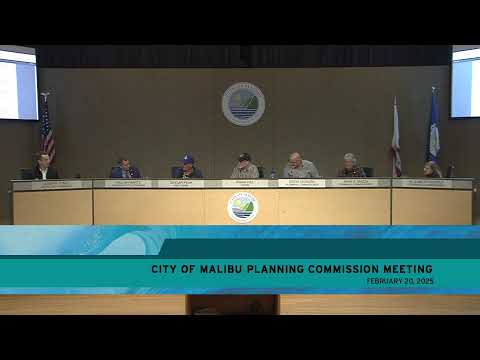
Malibu Planning Commission members voted unanimously Feb. 20 to recommend draft Local Coastal Program and Municipal Code changes to speed rebuilding after recent wildfires, endorsing temporary‑housing limits, a universal 1,000‑square‑foot ADU cap and a new “rebuild development permit” while asking the City Council to resolve seawall and FEMA elevation issues with state and county partners.
Malibu Planning Commission members voted unanimously Feb. 20 to forward a package of proposed changes to the city’s Local Coastal Program (LCP) and Municipal Code (MMC) designed to speed rebuilding for properties damaged or destroyed in recent wildfires, especially those affected by the Palisades Fire.
The commission’s recommendation follows a lengthy staff presentation and more than four hours of public comment in council chambers and online. The draft amendments largely implement Governor Gavin Newsom’s Feb. 13 executive order N-20-25 for Palisades Fire rebuilds (which suspends selected Coastal Act and CEQA requirements for eligible repairs and replacements), while proposing additional local rules—temporary housing limits, ADU adjustments, and a new rebuild-development-permit process—to reduce processing time for fire victims.
The package matters because it changes what approvals Malibu homeowners must seek after a disaster. “Under the governor’s order, CEQA and parts of the Coastal Act are suspended for Palisades Fire rebuilds where structures are in substantially the same location and do not exceed 110% of their footprint or height,” said Tyler Eaton, principal planner for the City of Malibu. Eaton presented the draft LCP and MMC changes and explained how the city proposes to interpret “primary development area / footprint” and to handle temporary housing, accessory dwelling units and storm/flood‑related FEMA elevation issues.
The commission’s action: it voted to recommend the draft amendments — including the edits discussed at the meeting — to the City Council, and recorded a unanimous roll‑call vote in favor (Vice Chair Peake: yes; Commissioner Leonard: yes; Commissioner Mazza: yes; Commissioner Riddick: yes; Chair Hill: yes).
Why this matters: The governor’s executive order limits required coastal and environmental review for eligible Palisades Fire rebuilds, but it applies only to Palisades Fire properties and addresses footprint and height (not every local code topic). The planning staff’s draft tries to translate the executive order into local code language, identify gaps (for example where local permitting or FEMA elevation rules remain applicable) and create a city‑level process — the proposed rebuild development permit — to cover supportive structures and infrastructure needed during reconstruction (temporary foundations, access work, septic replacements, water tanks, driveway widenings and limited mechanized work on beaches).
Key provisions the commission recommended be forwarded to City Council
- Temporary housing: staff proposed lowering the city’s maximum temporary dwelling size from 1,200 to 1,000 square feet to align with ADU rules and to allow some temporary units to convert later to permanent ADUs where permitted. Staff also proposed increasing enforcement/removal penalties to $500 per day for unauthorized use and requiring a limited geotechnical review for temporary homes in geologically hazardous areas. Eaton told the commission the geotechnical requirement is limited in scope — to check debris‑flow or landslide risk for temporary occupancy — and that wheeled/movable units would have a lighter requirement than foundation‑based structures.
- ADUs: staff proposed a universal 1,000‑square‑foot ADU threshold (replace the existing bedroom‑count rule) and clarified that ADU approvals in Palisades rebuild areas would follow state ADU law where applicable, but the city must resolve a remaining HCD certification issue for its local ADU ordinance.
- Local Coastal Program (LCP) interpretation: to reflect the governor’s order, staff wrote a local definition of “primary development area/footprint” that includes building pads and attached decks present before the fire. The draft limits seaward expansion: rebuilding seaward of the pre‑fire footprint is not allowed under the executive order for Palisades properties.
- FEMA height/elevation issue: staff explained the draft initially used a 24‑foot (flat roof) / 28‑foot (pitched roof) street‑side measurement to cap height increases; after public comment staff proposed removing the fixed cap and instead recommending the minimum increase necessary to meet FEMA base‑flood‑elevation requirements, while preserving the ability for existing nonconforming heights to be restored. The commission asked staff and council to clarify how FEMA elevational changes interact with existing primary view determinations and neighbor impacts.
- Rebuild development permit: the draft creates a new permit class for new accessory/support structures (seawalls, water tanks, driveway and retaining‑wall work, temporary shore access, on‑site wastewater replacements) needed to implement a replacement dwelling. These permits were proposed to be administratively processed (with a three‑year baseline approval and extensions by the planning director), rather than requiring full public site‑plan review for every item.
What the public said and what commissioners noted: More than 60 speakers attended in person or online. Common themes were requests that the City: (1) convert de minimis waiver categories to exemptions where the governor’s order applies, (2) allow temporary housing and ADU occupancy quickly and without burdensome extra reports, (3) minimize added geotechnical/topographic burdens where a system already worked before the fire, (4) provide a staffed “rebuild” coordinator/team to speed reviews, and (5) coordinate urgently with Los Angeles County Fire, Caltrans and the Coastal Commission on seawall, roadway and flood‑elevation issues. “The septic system and the driveway access should be classified under exemptions, regardless whether [they fall] within a primary development area,” said Don Schmitz (commenter). Norm Haney, chair of the city’s Wastewater Advisory Committee, urged that functioning septic systems be allowed to remain where a qualified specialist can certify performance: “If it worked before, … you should be able to keep it without having to move forward with an advanced wastewater treatment system.”
Commission direction and outstanding questions: Commissioners pressed staff to (a) make the LCP and MMC definitions consistent, especially how “substantially the same location/footprint” will be measured; (b) seek Coastal Commission and state staff guidance about whether items now listed as de minimis waivers should instead be exempt in a certified LCP; (c) work with LA County Fire on defensible‑space, irrigation and house‑hardening standards so the city’s proposed landscape/fire‑protection rules reflect fire‑behavior science; (d) bring Caltrans, state lands/Sea Grant and Coastal staff together with city staff to assess PCH/shoreline protection sequencing and whether larger, coordinated seawall or coastal engineering work is needed (rather than piecemeal single‑lot walls); and (e) clarify how FEMA base‑flood elevation changes will be accommodated without stripping existing property rights such as previously‑granted primary view determinations.
The formal action and next steps: The Planning Commission voted to forward the staff draft as amended in the meeting and described above to the City Council with the commission’s comments and requested follow‑up studies and interagency coordination. The commission recorded a unanimous roll‑call vote in favor of recommending the draft amendments to council.
What to watch next
- City Council special meetings: staff noted the Council special meeting on March 4 to hear the amendments, and a March 10 regular Council meeting for potential adoption. Staff also scheduled design‑professionals and technical workshops on March 5 and a debris‑removal town hall in late February.
- Interagency coordination: the commission asked staff to prioritize meetings with Coastal Commission staff, LA County Fire, Caltrans and the state agencies responsible for FEMA flood determinations so the city can return to council with clearer paths for seawalls, PCH impacts and FEMA elevation consequences.
- Implementation items the commission asked the City Council to consider: expedited review/fee‑waiver options for current fire victims (staff noted policy and legal constraints), a staffed rebuild coordinator/team, standard construction/traffic management plan requirements tied to planning/verifications, and a public process to resolve primary view determinations affected by FEMA‑driven elevation changes.
Ending: The Planning Commission’s recommendation moves a substantial package of draft changes to the City Council and signals strong public demand for speedier, clearer rebuilding rules. The commission and staff emphasized the next step is less about rewriting the draft and more about fast, practical interagency work — especially on seawalls, FEMA elevations and fire‑protection standards — so the council can adopt an implementable ordinance for Malibu residents already rebuilding.
Votes at a glance: Planning Commission recommendation to City Council on LCP/MMC amendments: motion approved (Peake — yes; Leonard — yes; Mazza — yes; Riddick — yes; Hill — yes).