Get Full Government Meeting Transcripts, Videos, & Alerts Forever!
Get email alerts on the Disaster Recovery topic
No spam. Unsubscribe anytime.
Residents Urge Sewers, Water Tanks and Compassion in Rebuild Process; Chair Apologizes for Prior Meeting
Summary
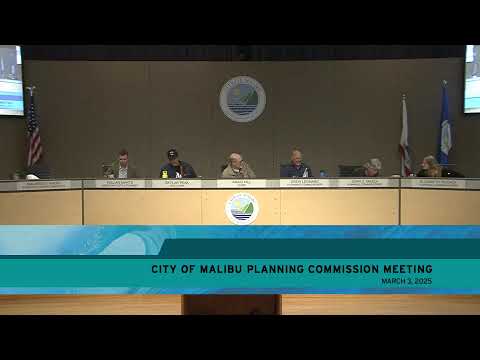
Design professionals and residents told the Malibu Planning Commission on March 3 that the city should consider centralized sewer options for Big Rock and clarify how private water tanks will be permitted during the post‑fire rebuild; commissioners apologized for how a resident was treated at a prior meeting.
Several residents, design professionals and commissioners used the Planning Commission’s public‑comment period on March 3 to press for broader options in the city’s post‑fire rebuild — including a discussion of sewer systems for Big Rock and clearer paths for private water‑tank approvals — and to raise concerns about the treatment of a resident who had been cut off at the commission’s previous meeting.
“Not putting septic systems back in those areas” was the central pitch from Christopher Ryan Sorensen, a local design professional, who told the commission a sewer system could avoid reinstallation of hundreds of septic systems along PCH and Big Rock and reduce groundwater infiltration into a landslide‑prone area. Sorensen estimated that replacing individual septic systems for many lots could reach “tens of millions” of dollars and described vacuum sewer systems that firms said could be sited along a 3–5 mile stretch in a 6–12 month construction window.
“Sea‑side septic even as good as tertiary systems is right up against the ocean polluting the Santa Monica Bay,” Sorensen said, arguing that a centralized sewer could be technically feasible and could reduce future environmental risks.
Norm Haney, a resident, urged the city and county to maintain infrastructure rather than require private property owners to pay for it. He also suggested the city approve on‑site tanks as a valid source of fire‑suppression water, saying privately stored water (pools or tanks) can protect multiple houses in an immediate area during wildfires. Haney argued the county’s current approach discourages property owners from deploying larger on‑site tanks.
Dina Moore, a physical therapist and resident, and others criticized how the commission handled a public commenter, identified in public remarks as Heather, who lost homes in both the Woolsey and Palisades fires and was not permitted to speak at a prior meeting. Moore described the incident as traumatic and said commission conduct had “seriously shaken” trust among some residents. Chair Hill opened the meeting by apologizing for the prior proceeding and several commissioners echoed apologies and said they had learned from the experience.
Staff responses clarified procedural and jurisdictional limits. Planning staff said adding a new on‑site water tank as part of a rebuild currently qualifies as new development under the local code and therefore requires a coastal development permit (CDP) under the Local Coastal Program (LCP). Staff also said some aspects of water infrastructure are controlled by county or state agencies and ultimately outside the city’s sole authority.
Rebecca (planning staff) and other staff noted the city opened a rebuild center and has published a fire‑rebuild newsletter at maliburebuilds.org; Los Angeles County Fire will participate in the one‑stop shop to help evaluate water tanks and related fire‑safety components per state fire marshal standards. Staff encouraged residents and design professionals to bring sewer or system proposals to the City Council, which has jurisdiction over citywide infrastructure and assessments.
Commissioners and staff also reminded the public that the City Council planned a special council meeting the next day (town‑hall/workshop format) focused on code paths for permitting rebuilds, and that a design‑professionals meeting on zoning text and LCP amendments was scheduled for March 12.
The public‑comment period covered a range of technical, policy and procedural issues — sewer feasibility and financing, responsibility for county infrastructure, the permit path for on‑site tanks, debris clearance timing and administrative handling of public speakers — and commissioners urged staff and the council to pursue practical next steps.