Get Full Government Meeting Transcripts, Videos, & Alerts Forever!
Get email alerts on the Utilities Water Energy topic
No spam. Unsubscribe anytime.
PUD updates Sedro-Woolley council on water transfers, micro-hydro projects and plant upgrades
Summary
George Sidhu, a representative of the Public Utility District (PUD), gave the Sedro‑Woolley City Council an annual update on the utility’s recent projects and near‑term work, including a water‑transfer pilot for irrigators, micro‑hydro generation installations and upgrades at the water treatment plant.
George Sidhu, a representative of the Public Utility District (PUD), gave the Sedro‑Woolley City Council an annual update on the utility’s recent projects and near‑term work, including a water‑transfer pilot for irrigators, micro‑hydro generation installations and upgrades at the water treatment plant.
Sidhu said the PUD is continuing a transfer program that makes PUD water available to irrigators when river diversions are restricted. “We’re gonna set that up again this year,” he said, describing transfers that let irrigators pump at specified downstream diversion points when river levels fall. The transfers require irrigators to have existing permitted diversions and the arrangement is intended as a backstop for local farming operations.
The PUD also reported progress on small hydropower projects that generate electricity from pressure‑reducing sites. Sidhu described an earlier micro‑hydro unit installed at Division Street that offsets that site’s electric use under a net‑metering agreement with Puget Sound Energy. He said a second site at the Ninth and Highland tank — adjacent to Mount Vernon High School — is in construction and will allow the PUD to provide some generated power to the neighboring Mount Vernon School District. He said the school district has 14 meters that will receive offsets and that the arrangement should produce roughly $26,000 in yearly savings for the district.
Sidhu said most project funding comes from federal and state grants, and that vendors have offered to bridge shortfalls so the project proceeds as planned. He noted that PSE contributed funding on the first project and that net‑metering arrangements may allow additional customer discounts under PSE rules.
On water supply and infrastructure, Sidhu said the PUD holds senior water rights on the Skagit River and that those rights give the utility reliability during low flows. “Our water rights are senior to that,” he said, adding that Judy Reservoir is managed to provide storage and that, when topped up in spring, it holds about five months of supply under normal operations.
Sidhu addressed a condition assessment of the transmission pipeline from Judy Reservoir into Sedro‑Woolley. He said operational testing indicates the concrete‑cylinder pipeline “holds pressure very well” and that the PUD expects capacity to be adequate for the near term; the PUD has moved replacement of that line later in its capital plan and currently estimates the pipe will perform for at least the next 20 years.
Sidhu also described two treatment‑plant projects: a plan to reduce the amount of chlorine gas stored on site to improve safety for operators and the community, and a program to replace an aging, undersized diesel generator. On chlorine, he emphasized that chlorine gas “is not something you want to be around” and said changes to disinfection systems will reduce on‑site storage. On the generator, he said the current unit cannot run the full plant and will be upsized; the PUD will continue to use diesel for that backup unit because other fuel options are not currently feasible at the plant location.
Council members asked about program details: which diversion points would receive transferred water; whether PSE contributed to the new school district‑linked project; and whether similar pressure‑recovery generation could be applied inside Sedro‑Woolley. Sidhu said net‑metering rules currently limit generated power to immediate neighbors and that broader “wheeling” to other local public users would require legislative or rule changes. He said PUD staff have discussed the change with PSE and have support for pursuing rule adjustments.
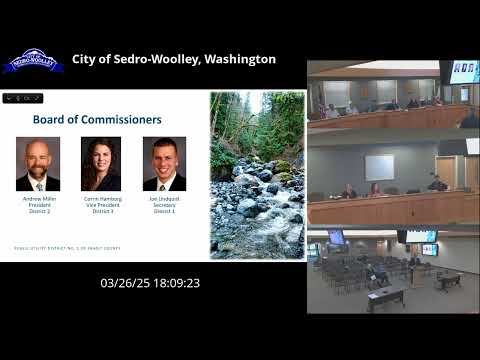
Sidhu closed by noting the PUD’s near‑completion of a new administrative building and by thanking the council for the opportunity to present. Commissioner Corinne Hamburg attended the meeting as a PUD commissioner and was acknowledged by the mayor.
The presentation covered operational items that affect local water reliability, school district energy costs and public‑safety work at the treatment plant; Sidhu said several projects rely on state or federal funding and on agreements with neighboring agencies.