Get Full Government Meeting Transcripts, Videos, & Alerts Forever!
Get email alerts on the Homeowner Associations Ombudsman Registration topic
No spam. Unsubscribe anytime.
Minnesota bill would create ombudsman and registry for homeowner associations
Summary
The Minnesota Senate Commerce and Consumer Protection Committee on March 27 recommended passage of Senate File 1063, as amended, creating an ombudsman office for common‑interest communities and a registry of homeowner associations to be housed at the Department of Commerce.
The Minnesota Senate Commerce and Consumer Protection Committee on March 27 recommended passage of Senate File 1063, as amended, creating an ombudsman office for common‑interest communities and a registry of homeowner associations (HOAs) to be housed at the Department of Commerce.
The bill would establish an ombudsperson ‘‘to assist unit owners in enforcing their rights and to facilitate resolution of disputes between unit owners and associations,’’ and would require registration of common‑interest communities so basic information about associations is available to the state and, in part, to the public.
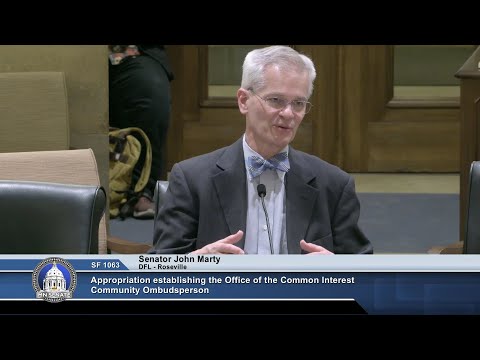
Senator Marty, an author of the bill, told the committee the measure is designed to ‘‘assist unit owners in enforcing their rights and to facilitate resolution of disputes between unit owners and associations.’’ Marty said the proposal is intended as a partner to a larger package (Senate File 1750) produced by an HOA task force and to fill gaps that the companion bill does not address.
Senator Pa, the committee’s designated chief author for the registration portion, described the scale the bill aims to cover: she said Minnesota has ‘‘approximately 7,950 common interest community associations, impacting over 1,500,000 homeowners.’’ Pa and other supporters told the committee that many homeowners lack clear, accessible information about who manages an HOA and how to resolve disputes without going to court.
Under the bill’s text and as discussed at the hearing, the ombudsperson would perform three primary roles: provide education and plain‑language explanations of the law and association governing documents; offer information and referrals; and provide third‑party mediation. Committee testimony emphasized that the role is mediation, not arbitration: the bill ‘‘clearly spells out that in dispute resolution, they…cannot make rulings, cannot make determinations’’ and that courts would retain authority to issue binding decisions, Marty said.
The registration component (referred to in testimony as Article 2) would require associations to provide basic identifying information to the Department of Commerce. Patrick Hynes, representing the Community Associations Institute Minnesota chapter, said the bill protects volunteer board members’ personal contact information from public disclosure while still allowing the ombudsperson’s office to contact boards when necessary. Hynes told the committee the registry route differs from prior proposals to add fields to Secretary of State annual filings and that the legislature will need to decide the best host agency and funding approach.
Testimony included homeowner accounts of alleged harms. Becky Cole, an HOA homeowner, described multiple examples she and others have reported to her, including one case she said resulted in a total assessment and related charges of $55,481.45 (with roughly $4,268 in collection costs and $24,213.16 in legal fees) and another involving a disabled homeowner in Eagan who she said continued to be harassed over a shed that had city approval. Cole also said some associations’ funds are controlled by out‑of‑state management companies and cited one account she said held about $1,800,000.
Ron Ellwood of Legal Aid testified in strong support, saying the working group that drafted recommendations ‘‘heard over and over…there’s nowhere to turn when people feel that they’ve been unjustly aggrieved by a decision of the board’’ and that an ombuds office would ‘‘take the temperature down in many cases and avoid unnecessary escalation of complaints and disputes.’’
Committee members questioned scope and implementation. Senators raised concerns about the potential workload for an ombuds office given the scale of homeowners affected and about municipalities that require HOA formation as part of development approvals. Authors and testifiers said the ombudsperson would not handle every individual case and that education, referrals and complaint data collection were essential functions; they also said Senator Lucero’s companion bill (SF1750) addresses other enforcement and structural issues raised during the working group’s process. The authors acknowledged the bill currently lacks a final fiscal note; the text contemplates both a modest per‑association fee and a general‑fund appropriation to start the program.
A technical reviser amendment (A4) was offered and adopted without recorded opposition. The committee then approved the motion, offered by Senator Wicklund, to recommend the bill as amended and refer it to the Committee on State and Local Government. The committee voice vote recorded the motion as passing; no roll‑call tally was provided in the transcript.
Supporters urged the committee to continue work on the related package and on city‑mandated HOA formation; some senators asked for further refinement of fee tiers and exemptions for very small associations. The bill’s authors said the legislation and its companion remain under development and that further committee stops would allow addition of a fiscal note and more detailed cost estimates.
Next steps: Senate File 1063, as amended, will go to the Committee on State and Local Government for further consideration. The authors and testifiers said a final fiscal note and staffing model (number of ombuds staff) are expected to be developed in subsequent committee review.