Get Full Government Meeting Transcripts, Videos, & Alerts Forever!
Get email alerts on the Electronics Recycling Epr topic
No spam. Unsubscribe anytime.
Senate hears manufacturer‑funded electronics recycling proposal to remove e‑waste from rural landfills
Summary
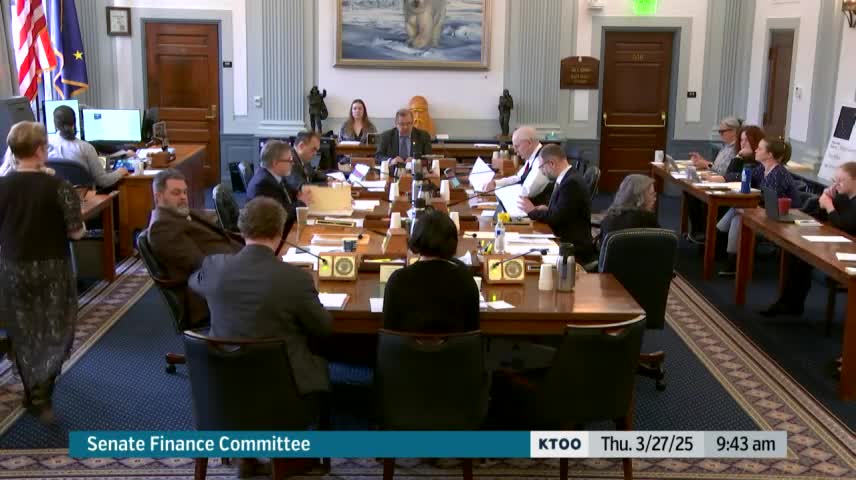
Senate Finance on March 27, 2025, took testimony on Senate Bill 61, sponsored by Senator Lukey Tobin, to require manufacturers to fund a statewide electronics product stewardship program administered through DEC.
Senate Finance on March 27, 2025, took testimony on Senate Bill 61, sponsored by Senator Lukey Tobin, to create a manufacturer‑funded electronics product stewardship program. The bill would require manufacturers selling covered electronic devices in Alaska to register with the Department of Environmental Conservation (DEC), pay an annual fee, and operate or join an approved producer responsibility organization (PRO) to fund collection, transport and recycling.
Sponsor overview and purpose: Senator Lukey Tobin described the bill’s purpose as addressing hazardous electronic waste in unlined rural landfills and stabilizing funding for existing local collection efforts. “Instead of having Alaskans pay for it, like all these other states and Canadian provinces and European countries, we will have the manufacturers foot the bill,” Tobin said. The bill would establish a 13‑member advisory council to review stewardship plans and allow DEC to approve plans submitted by manufacturers or PROs.
Nut Graf: Supporters — including regional nonprofits, tribal entities and statewide backhaul programs — said the bill creates predictable, long‑term funding to remove hazardous electronics from rural dumps and reduce health risks associated with burning or landfilling electronics. Industry groups raised concerns about the bill’s convenience requirements, the cost to manufacturers (and potentially consumers), and gaps in statewide e‑waste quantity and infrastructure data.
Key details and testimony: The bill’s scope was narrowed in committee to remove certain items (microwaves, batteries containing electronics, and FDA devices) and to reduce the number of required collection sites; the advisory council may meet virtually. Louis Flora (staff to Senator Tobin) and multiple invited witnesses said existing statewide efforts cover many communities and the bill aims to formalize and fund them.
Invited testimony included: - Riley Kosinski (Backhaul Alaska/Zender Environmental) — described existing backhaul and hub‑and‑spoke collection infrastructure and said roughly 70% of Alaska communities have some level of e‑waste recycling or access to collection events. - Scott Clague (Product Stewardship Institute) — noted that two dozen states have electronics EPR laws, praised the bill’s stakeholder process, and said an effective law must build on existing infrastructure. - Dr. Lynn Zender (civil engineer, SWAT) — emphasized health risks from electronics in rural landfills and burning and estimated many villages cannot afford incineration or advanced landfill upgrades.
Public testimony: Rural tribal representatives, nonprofit coordinators and regional program managers urged passage, saying local efforts currently rely on volatile grants. Phelan (Saunde) Gleeson, an environmental health specialist, said EPR would free federal grant funds for other uses. Opponents included Katie Capozzi, CEO of the Alaska Chamber of Commerce, who argued the bill would create one of the most expensive programs in the nation and shift cost to consumers, and Katie Riley of the Consumer Technology Association, who raised concerns about the bill’s convenience standards, lack of statewide e‑waste quantity data, and certain structural provisions such as requiring a single PRO.
Fiscal note and procedure: Senator Kiel summarized DEC’s fiscal note: DEC estimated an FY26 unrestricted general fund need of $499,600 and two full‑time positions; the estimate adjusts and stabilizes in FY28 (about $420,700), and in FY29 the funding source shifts to program receipts (manufacturer fees). The committee set the bill aside for further consideration. The chair announced the amendment deadline for the bills heard that day as Tuesday, April 8, 2025, 5 p.m.
Ending: SB 61 was set aside pending further work; stakeholders were encouraged to continue engagement with the sponsor and DEC on program details and implementation timing.