Get Full Government Meeting Transcripts, Videos, & Alerts Forever!
Get email alerts on the Alaska Native Governance topic
No spam. Unsubscribe anytime.
Presenter outlines Alaska Native governance complexity, urges stronger government-to-government ties
Summary
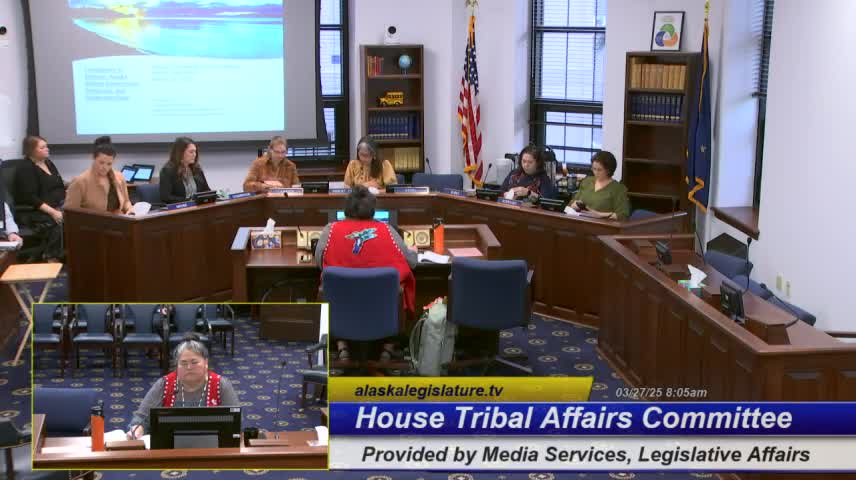
Loganae Cheech Gitne, co-founder of Ginga and Ignin Collective, told the Alaska Legislative Tribal Affairs Committee on March 20 that Alaska Native governance is complex and underappreciated, and she urged the Legislature to strengthen long-term, government-to-government relationships with tribes and other Native entities.
Loganae Cheech Gitne, co-founder of Ginga and Ignin Collective, told the Alaska Legislative Tribal Affairs Committee on March 20 that Alaska Native governance is complex and underappreciated, and she urged the Legislature to strengthen long-term, government-to-government relationships with tribes and other Native entities.
Cheech Gitne framed the presentation around three practical points: the distinct authorities of tribal governments, the role of tribally delegated entities (including health organizations and regional nonprofits), and the separate legal status of Alaska Native Corporations created under ANCSA. She asked lawmakers to recognize those differences when they consult, compact, contract or otherwise partner with Native entities.
"We were hashtag ‘it's complicated’ long before Facebook ever came around," Cheech Gitne said, illustrating how multiple governance systems and cultural protocols can be missed when decision-makers lack local context. She explained that tribes exercise inherent sovereignty that predates the United States, that many tribes have authorized tribally designated organizations to carry out programs, and that ANCSA corporations are constructs of federal law with different authorities.
The presentation listed federal statutes and processes that shape the current landscape: the Indian Reorganization Act template used for some tribal constitutions; the Indian Self-Determination and Education Assistance Act (P.L. 93-638) under which tribes can compact and assume program responsibilities; the Indian Child Welfare Act (ICWA); NAHASDA for tribally designated housing authorities; ANCSA (the Alaska Native Claims Settlement Act); and Public Law 280 (PL 280), which affects state criminal and civil jurisdiction in some contexts. Cheech Gitne noted litigation and definitional questions raised by recent federal program distributions (for example, disputes over CARES Act definitions) and said those legal lines can complicate who the state should consult and how.
Cheech Gitne described how tribes may delegate authority to regional nonprofits or health organizations and how that delegation allows those entities to stand in a government-to-government role for program negotiations with the federal government. She contrasted that with Alaska Native Corporations (created under ANCSA), which derive from a different federal settlement and have different legal bases and obligations. "To talk to an Alaska Native corporation is not the same thing as talking to an Alaska Native tribe," she said.
Committee members asked for practical resources. Representative Kerrick asked whether a state inventory exists of tribal courts that the state currently refers matters to; Cheech Gitne said a tribal court assessment report had been produced following the Tribal Law and Order Act and offered to provide resource links. Representative Story recommended a full presentation from the Department of Public Safety and tribal partners on Village Public Safety Officers (VPSOs); Cheech Gitne and committee members noted an upcoming VPSO presentation is planned with Commissioner Cockrell.
Cheech Gitne also stressed cultural and procedural protocols for working with Native communities: treat tribes as co-equal governments; build enduring (not transactional) relationships; discuss difficult issues in the room together; and operationalize government-to-government relationships at legislative and administrative levels. She used several local examples — from tribal peacemaking courts to VPSO responses in lifesaving operations — to show how blending tribal and state systems can reduce recidivism and save lives.
On factual points she raised: Cheech Gitne said Alaska has 229 federally recognized tribes and that the average village population is about 300 people; she also discussed differing population figures for Alaska Natives cited during the talk (she referenced a 2020 Census figure and a different figure produced by a personal AI assistant). She urged legislators to consult multiple local sources and offered to provide region-by-region organizational charts, maps, and other reference materials after the hearing.
The committee indicated next steps: staff will distribute resource links and the committee plans a VPSO update and further briefings to help lawmakers better understand regional differences across the state. No formal votes or motions were taken during the presentation.
Cheech Gitne closed by reminding the committee that long-term presence and relationship-building are central: "When we just focus on ourselves, we fall. Working together, we can actually do better for Alaska as a whole," she said.