Get Full Government Meeting Transcripts, Videos, & Alerts Forever!
Get email alerts on the Mariculture Marketing topic
No spam. Unsubscribe anytime.
House fisheries panel weighs allowing ASMI to market mariculture; shellfish growers oppose
Summary
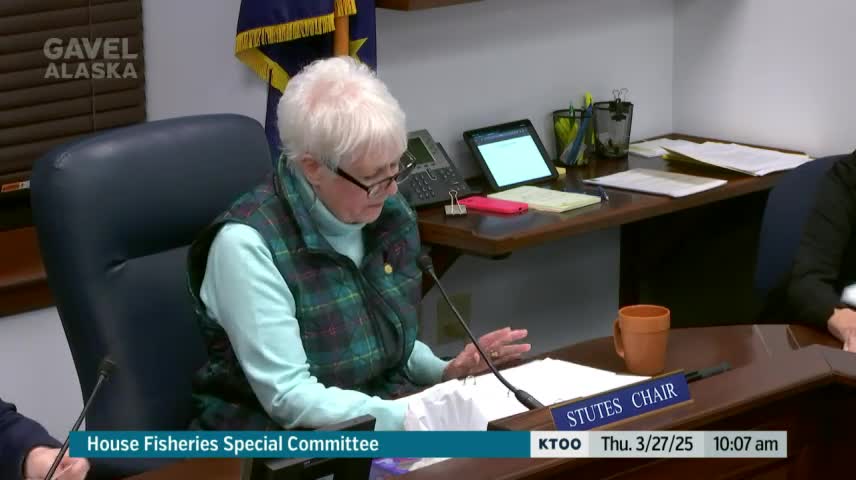
House Bill 135, sponsored by the governor, cleared an initial committee hurdle March 27 as the House Special Committee on Fisheries adopted a committee substitute to expand the Alaska Seafood Marketing Institute's statutory duties to include marketing of aquatic farm products such as shellfish and seaweed.
House Bill 135, sponsored by the governor, cleared an initial committee hurdle March 27 as the House Special Committee on Fisheries adopted a committee substitute to expand the Alaska Seafood Marketing Institute's (ASMI) statutory duties to include marketing of aquatic farm products such as shellfish and seaweed.
The substitute, adopted as the committee's working draft with no objection, revises the ASMI definition of "seafood" (AS 16.51.180) and makes a technical change to AS 16.51.100 to add the word "harvest" in places that previously referenced only wild capture. "This bill'd would allow the Alaska Seafood Marketing Institute to market aquatic farm products," DCCED Deputy Commissioner Anna Latham said in opening remarks. "Alaska already produces more than 50% of the seafood in The United States, and it's a natural progression for Alaskans to expand mariculture as a renewable resource that Alaska can add to its economic portfolio."
Jeremy Woodrow, executive director of ASMI, said the bill "gives the ASMI board the powers to market mariculture products produced in the state of Alaska," and that section 2 of the bill points to AS 16.41.099 (Fish and Game's definition of aquatic farm products). He told the committee the bill, as drafted, covers shellfish and seaweed ("aquatic farm products") and does not include farmed finfish.
Supporters told the committee they expect ASMI's brand and grant access could help nascent sectors. Robert Venables, executive director of Southeast Conference, said ASMI is "the gold standard for marketing" and noted a $49,000,000 Alaska Mariculture Cluster Initiative that aims to build mariculture capacity. Jason Lessard, executive director of the Alaska Mariculture Alliance, said 87% of his group's voting membership recently approved a measure to support ASMI marketing mariculture products provided each sector can decide whether to participate; the alliance supports the bill "as it is currently written" while acknowledging assessment questions remain.
However, a large group of shellfish farmers and industry representatives testified in opposition, saying shellfish farming is agricultural, not a fishery, and warning the bill could open growers to assessments, additional regulation and costs. Katie Bode, an oyster farmer with Kamaso Shellfish, said the seafood marketing assessment "would be an additional cost to our farm. The amount is unknown, but treating farming as a fishery opens the door for additional taxes, assessments, and regulations." Weatherly Bates, president of the Alaska Shellfish Growers Association, said her family's farm has reinvested millions in production and that "public funds should not be used to market private farm products." Multiple small-family growers, including James Greeley of the Alaska Oyster Cooperative, Dewan Delbosch of Simpson Bay Oyster Company, and Margo Revey of Jackalof Bay Oyster Company, testified similarly, urging the committee to keep aquatic farm products exempt from fisheries assessments and from the same statutory treatment as wild-capture fisheries.
Committee members pressed ASMI on capacity and funding. Woodrow said ASMI could pursue mariculture-specific grants it currently cannot access and that marketing under the ASMI umbrella would be directed by participating industries: "ASMI listens to the industry and then reacts to where the industry needs its help most for marketing initiatives." Committee discussion raised the possibility of statutory exemptions or thresholds to exclude very small producers from assessment if an assessment mechanism is later proposed.
The committee did not take a final floor vote on policy; the committee substitute for HB 135 was adopted as the working draft and the bill was set aside later in the agenda for further work. The transcript records that the ASMI board met Feb. 21 and "unanimously approved a motion to support any type of action to change ASMI statutes to allow for the marketing of mariculture products," a point Woodrow placed on the record. "Please oppose 135," one oyster farmer concluded in public comment.
Next steps: HB 135 will require additional drafting and negotiation if it is to proceed. Committee members suggested possible carve-outs for small producers and further discussion of assessment mechanisms and regulatory implications before any assessment or enforcement provisions are added.