Get Full Government Meeting Transcripts, Videos, & Alerts Forever!
Get email alerts on the Transmission Infrastructure topic
No spam. Unsubscribe anytime.
Committee advances transmission bill creating an authority, SEPA processes and county permitting requirements amid debate over eminent domain
Summary
Substitute Senate Bill 5,466, which would create a Washington Electric Transmission Authority, add county permitting deadlines, and revise SEPA review for certain transmission projects, was reported out of the Environment & Energy Committee with a due-pass as amended recommendation after extended debate and divided roll-call votes.
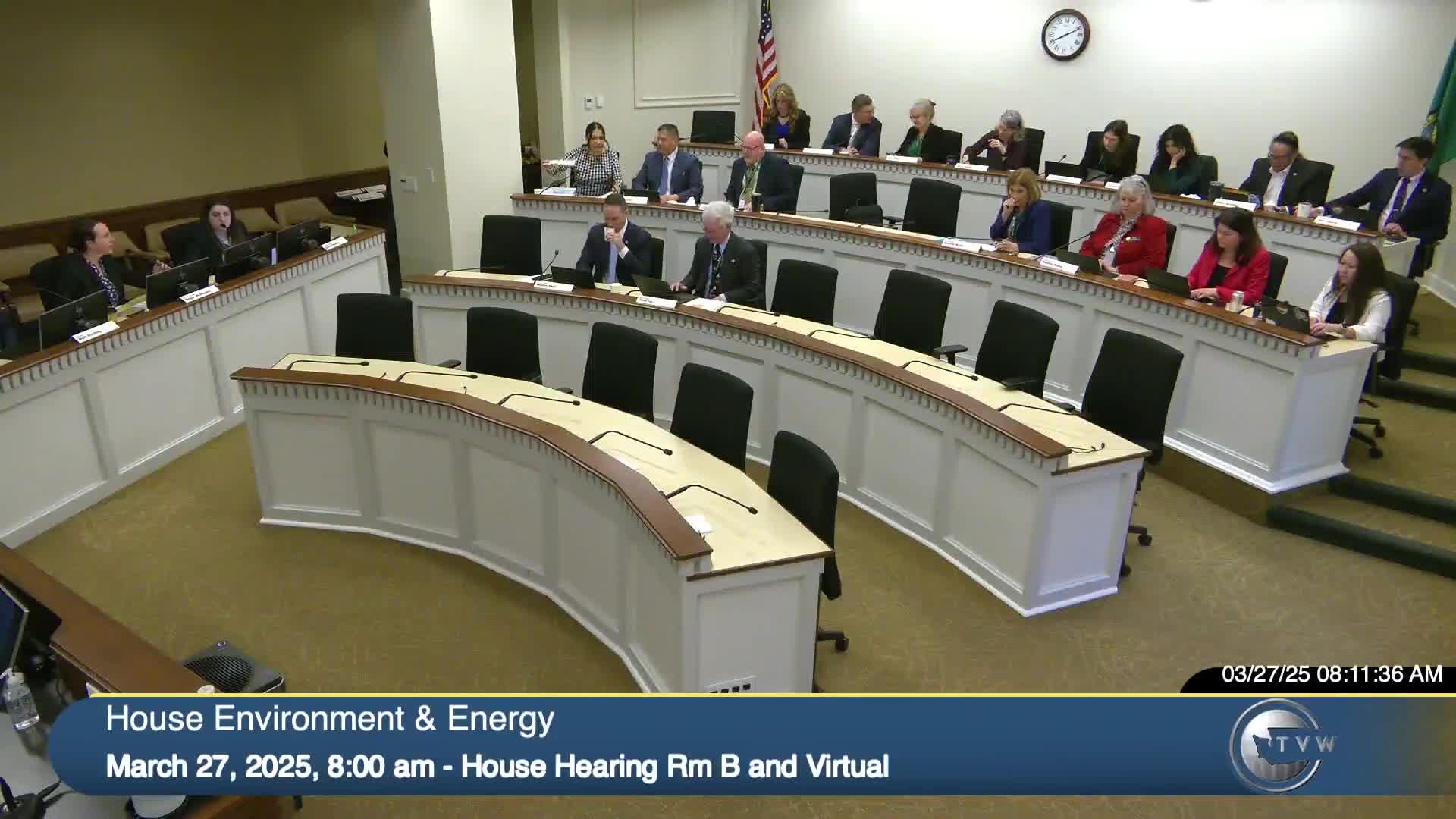
March 27 — The House Environment & Energy Committee voted to report substitute Senate Bill 5,466 out of committee with amendments after detailed staff briefings and a roll-call vote that split the committee.
Committee staff Meg Grit Fadden summarized the striking amendment and broader provisions of the bill, saying it “establishes the Washington Electric Transmission Authority,” directs the Department of Commerce to conduct needs assessments and provide support for local and tribal governments, provides a categorical SEPA exemption for certain transmission projects, and (in prior versions) included an incentive rate of return for utility transmission investments that was later removed in the striking amendment.
The striking amendment (H2048.1) and several subsequent amendments revised the authority’s stated purposes (adding a priority to connect renewable and nonemitting resources across multiple utility territories), altered board composition to require utility-experienced members (one from a consumer-owned utility and one from an investor-owned utility), and limited the authority’s rulemaking so it may not adopt rules to direct transmission cost allocation.
On SEPA exemptions the amendment added definitions (for previously disturbed or developed lands and for upgrading/rebuilding) and changed the scope of exemptions to exclude activities undertaken wholly or partly on lands covered by water. It also replaced an earlier DAHP-led review process with a new process that sets roles and timelines for permitting jurisdictions, the Department of Archaeology and Historic Preservation (DAHP), federally recognized tribes, and project applicants to avoid, minimize or mitigate harm to tribal, archaeological, historic, sacred or cultural resources. The amendment also requires all counties to adopt permitting processes for certain transmission-line activities by specified dates and makes counties without a process eligible for a $4,000 Department of Commerce grant to help create one.
A significant portion of committee debate focused on whether the proposed authority should have the power of eminent domain. One amendment would have eliminated eminent-domain authority for the new authority; another required a wildfire-claims fund of at least $200 million before eminent-domain power could be exercised. Members who supported eminent-domain authority said the bill extends to the authority the same eminent-domain powers and statutory guardrails that utilities and public entities already possess. Members opposing eminent domain or seeking limitations said the power could harm property owners and tribal interests and urged more safeguards.
Other amendments on liability, corridor widening and restoration of existing corridors were offered and many were not adopted. Representative Ramel and others emphasized the bill’s aim to both improve efficiency on existing corridors and enable development of new long-range transmission to meet future load and clean-energy goals.
Because the committee did not reach consensus, it proceeded to a roll-call final report-out vote. Committee staff recorded 11 ayes and 10 nays on the motion to report Substitute Senate Bill 5,466 out of committee with a due-pass as amended recommendation. The bill will move forward to the next legislative steps with the committee’s recommendation.