Get Full Government Meeting Transcripts, Videos, & Alerts Forever!
Get email alerts on the Distributed Energy topic
No spam. Unsubscribe anytime.
Committee advances bill easing siting rules for small solar arrays, agrivoltaics and counting some conservation toward clean-energy targets
Summary
The Washington State House Environment & Energy Committee advanced substitute Senate Bill 5,445 on March 27 with amendments that clarify a limited SEPA exemption for small solar arrays, allow certain agrivoltaics on enrolled farmland without back taxes so long as agricultural production continues, and limit how long accelerated conservation measures count toward Energy Independence Act obligations.
March 27 — The Washington State House Environment & Energy Committee on March 27 advanced substitute Senate Bill 5,445, which creates new exemptions and incentives for certain distributed solar projects, clarifies how agrivoltaics can be sited on farmland enrolled in open-space tax programs, and changes how accelerated conservation measures are counted toward the Energy Independence Act.
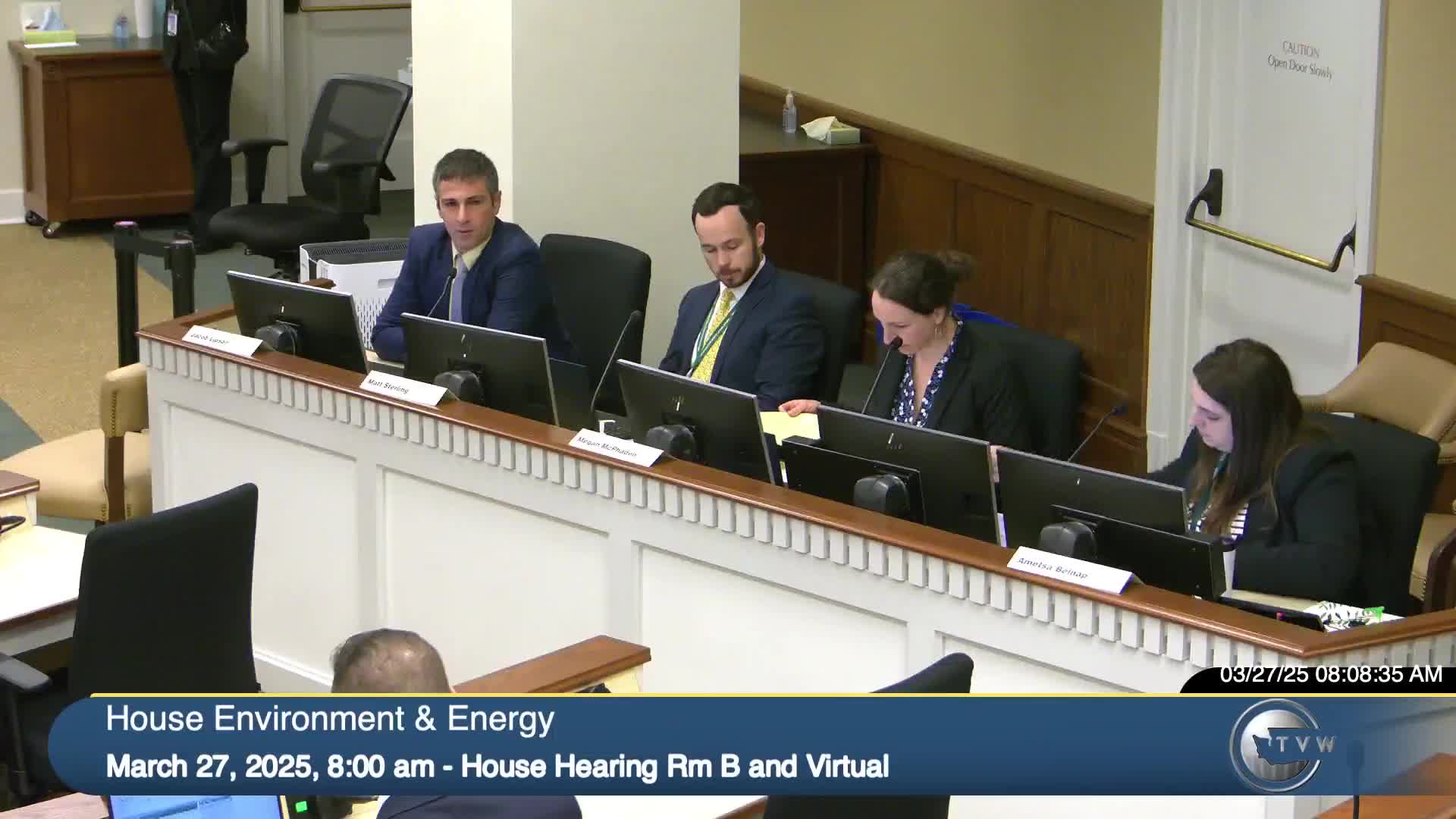
Committee staff Jacob (staff) summarized the amended measure, saying, “Senate Bill 5,445 deals with distributed energy generation. It amends the State Environmental Policy Act to create a categorical exemption for certain new solar energy generation. It amends the Open Space Land Use Taxation Act to provide for the siting of agrivoltaics on farm and agricultural land without back taxes and penalties, so long as there's continued agricultural production on that property.”
The striking amendment adopted in committee (H2041.1) clarifies the SEPA exemption language so that the exemption can apply either to a supporting structure with a footprint of 1,000 square feet or less or to an array of solar panels with that footprint. The amendment also changes how the Open Space Land Use Taxation Act treats new tax preferences created under the bill, including language related to the statute’s performance statement and the typical 10-year automatic expiration for newly established tax preferences.
Under the amended bill, the Energy Independence Act (EIA) provisions were adjusted so that credit for accelerated conservation and demand-response measures is limited to expected savings through Feb. 2030 rather than the full lifetime of those measures. Committee staff explained the change was intended to align the crediting window with when EIA and Clean Energy Transformation Act compliance obligations shift.
Supporters said the bill creates alternative compliance pathways for public utility districts to meet EIA targets while promoting distributed energy in places that are already disturbed — rooftops, landfills, highway rights-of-way — preserving agricultural production while enabling solar deployment. Representative DeLeo, chairing the committee, and other supporters framed the measure as a way to prioritize distributed generation and resilience in PUD service territories.
Opponents expressed concern about putting too much emphasis on particular technologies and potential cost impacts on ratepayers; some members said they preferred an “all-of-the-above” approach to resource planning. Those concerns were heard during discussion but did not stop committee passage.
The committee adopted the striking amendment and then voted to report Substitute Senate Bill 5,445 out of committee with a “do pass as amended” recommendation. Committee staff announced 21 ayes on the final report-out vote.
What’s next: The bill will move from the committee to the next House floor or calendar step named in legislative procedure for further consideration.