Get Full Government Meeting Transcripts, Videos, & Alerts Forever!
Get email alerts on the Education topic
No spam. Unsubscribe anytime.
House committee advances bill expanding protected classes in public schools after lengthy debate
Summary
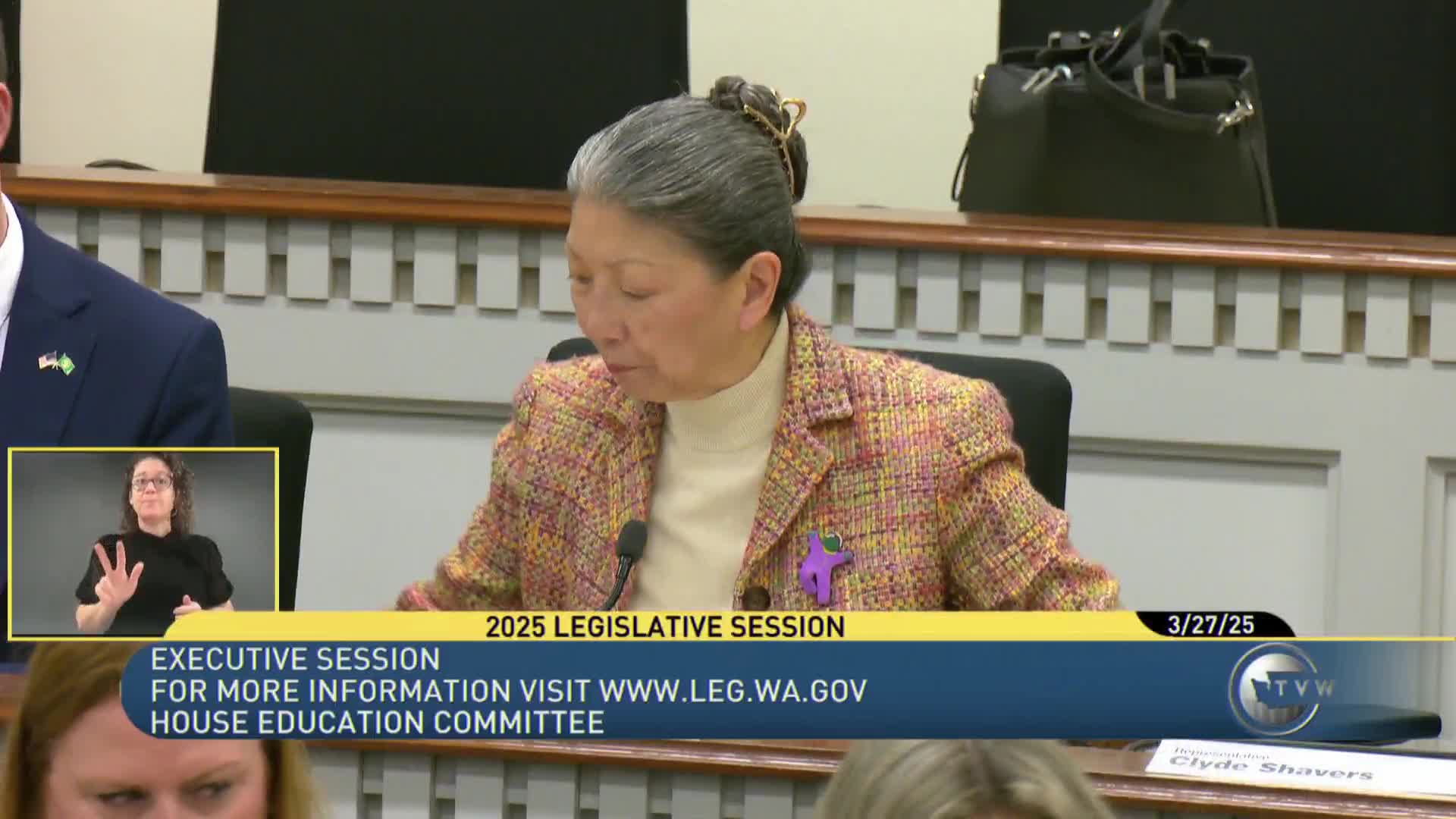
The House Education Committee voted 11-8 to report substitute Senate Bill 5,123 out of committee with a due‑pass recommendation. The bill would add several protected classes and definitions to the law prohibiting discrimination in public schools; multiple amendments were proposed and rejected after substantial debate.
The House Education Committee reported substitute Senate Bill 5,123 out of committee with a due‑pass recommendation after an extended debate over definitions and proposed amendments.
The bill, as briefed by staffer Ethan, “adds the following protected classes to the nondiscrimination provisions that apply to public schools: ethnicity, homelessness, immigration or citizenship status, and neurodivergence. It also separates sexual orientation, gender expression, and gender identity into three separate protected classes” and “provides definitions for these protected classes that apply to public schools.”
Committee members debated eight proposed amendments that would have changed those definitions or added additional protected classes. Representative John McIntyre urged adoption of one amendment to tighten the definition of gender identity, saying the change would “relieve us of having to continue to entangle ourselves further in this” and allow lawmakers to “be objective.” Representative Monica Scott opposed that amendment, saying it “seeks to define gender identity as something that does not provide a meaningful basis for identification” and urging a no vote. The amendment failed on voice vote.
Other failed amendment proposals included limiting the homelessness protection to students, adding religious expression and identity, adding political affiliation, exempting sex‑segregated athletic activities from gender‑identity protections, adding parent/legal guardian status, adding pregnancy as a protected class, and a provision stating nondiscrimination would not require districts to discontinue sex‑segregated bathrooms and locker rooms. Supporters and opponents exchanged views on whether the changes duplicated existing law, whether they properly belonged in a student‑centered nondiscrimination section, and whether specifying certain protections might reduce clarity for schools and staff.
Representative Kallen, speaking in favor of the bill on final passage, said the measure “is fundamentally” intended to give school districts “the direction and the ability to define discrimination and have the state statute that is behind the work that school board directors are trying to do every day.” Representative Mike Marshall said he would vote no on final passage, arguing existing model policies and state law already provide protections and that enforcement of current rules was the priority.
On the roll call, the committee recorded 11 ayes and 8 nays. By that vote, the committee reported substitute Senate Bill 5,123 with a due‑pass recommendation.
The bill will move to the House calendar for consideration by the full chamber or further floor action; the committee did not adopt any of the eight standalone amendments during its executive session.