Get email alerts on the Long Term Care Behavioral Health topic
No spam. Unsubscribe anytime.
Senate panel hears proposal for $2M behavioral‑health program to support nursing homes and basic care settings
Summary
Long-term care advocates and Behavioral Health Solutions recommended a $2 million program to embed behavioral-health specialists and offer staff training, crisis consultation and direct interventions in nursing and basic care facilities to reduce hospital stays and emergency visits.
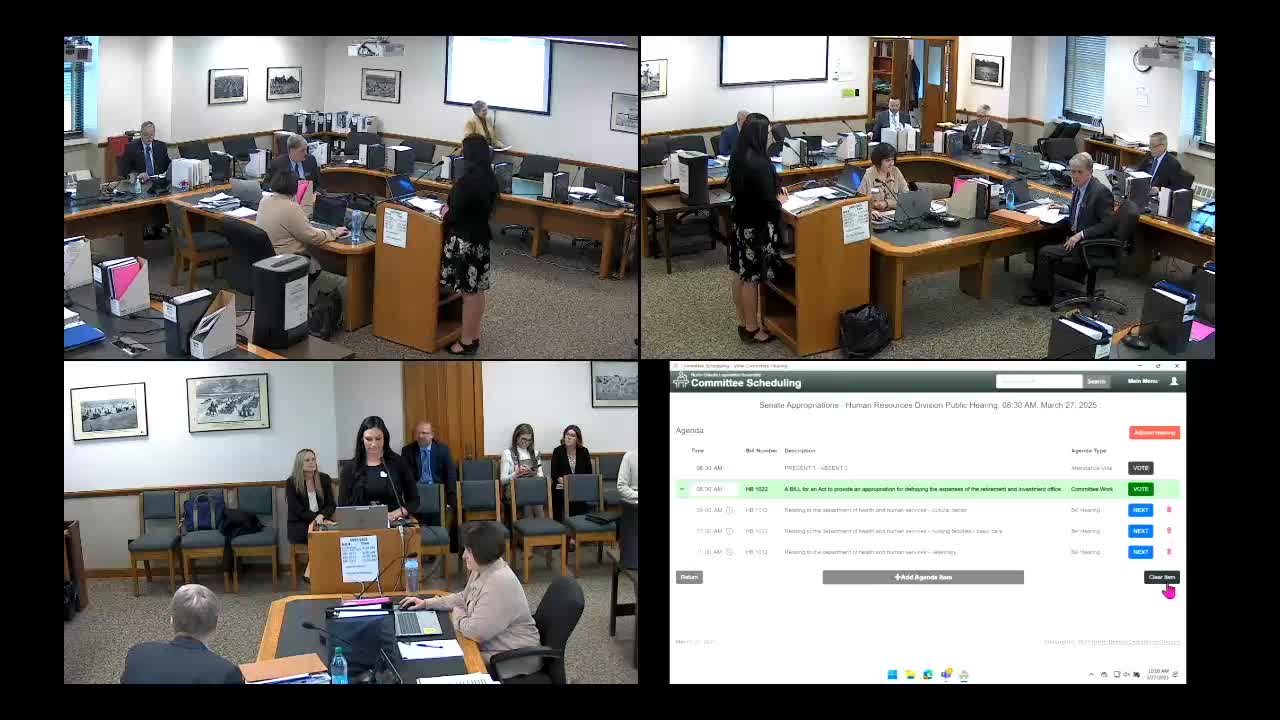
The North Dakota Long Term Care Association and Behavioral Health Solutions presented a model to the Senate Appropriations — Human Resources Division that would use $2 million to implement specialized behavioral‑health supports in nursing homes and basic care settings.
Nikki Wagner, president of the North Dakota Long Term Care Association, said caring for residents with complex behavioral symptoms (for example aggression or severe agitation often tied to dementia or co‑occurring psychiatric diagnoses) has increased and many nursing and basic care providers lack the capacity to manage those individuals on site. Wagner said patients with complex behaviors often end up in emergency departments or have extended hospital stays because nursing homes lack crisis-response resources and staff training.
Doctor Kristi Kovacs, chief clinical officer and co‑founder of Behavioral Health Solutions, described a model used in other states that offers a capitated payment to a behavioral-health provider to deliver training, consultation, urgent/crisis planning and direct one‑on‑one psychosocial interventions by behavioral-tech staff. Kovacs said programs that deliver onsite training, psychiatric consults, medication-management support and dedicated behavioral‑health technicians have reduced emergency room visits and hospital readmissions in other states; she cited Nevada’s program outcomes, including reductions in ER visits and shorter hospital stays for participants.
Kovacs described the program components as three buckets: staff training and technical assistance; consultative access for urgent concerns and care planning; and direct services (psychiatric evaluation, psychotherapy where appropriate, behavioral‑tech support and psychosocial activities). Staffing for a state program would include at least one psychologist, one psychiatrist or psychiatric nurse practitioner, a licensed clinical social worker to act as hospital liaison, behavioral health technicians and activity staff. Kovacs said the model can be layered over existing providers and tailored to facilities with the greatest need.
Senators questioned whether the state already had some capacity and whether reimbursement rates needed broader revision; Wagner and Kovacs said expanding capacity through targeted funding and training would allow more residents to be cared for in-place and reduce expensive hospital or state‑hospital placements. The witnesses asked that the $2 million amendment the House added to HB 10-12 be supported and that the committee consider program metrics and reporting to document return on investment.
AI generated
The text on this page is AI generated. Summaries, highlights, analysis, and video transcripts are all produced from the original source material.
AI can make mistakes, so if you spot one, and we will fix it for everyone.
Note: the source content is unaltered by us. Any content source we link to, be it a video, an audio recording, or a document, is presented exactly as its publisher released it. That publisher is usually a government body, sometimes an individual official or another organisation.