Get Full Government Meeting Transcripts, Videos, & Alerts Forever!
Get email alerts on the Cultural Center Funding topic
No spam. Unsubscribe anytime.
Native Inc. seeks modification to HB 10-12 funding language and requests $900,000 for cultural programming in Bismarck
Summary
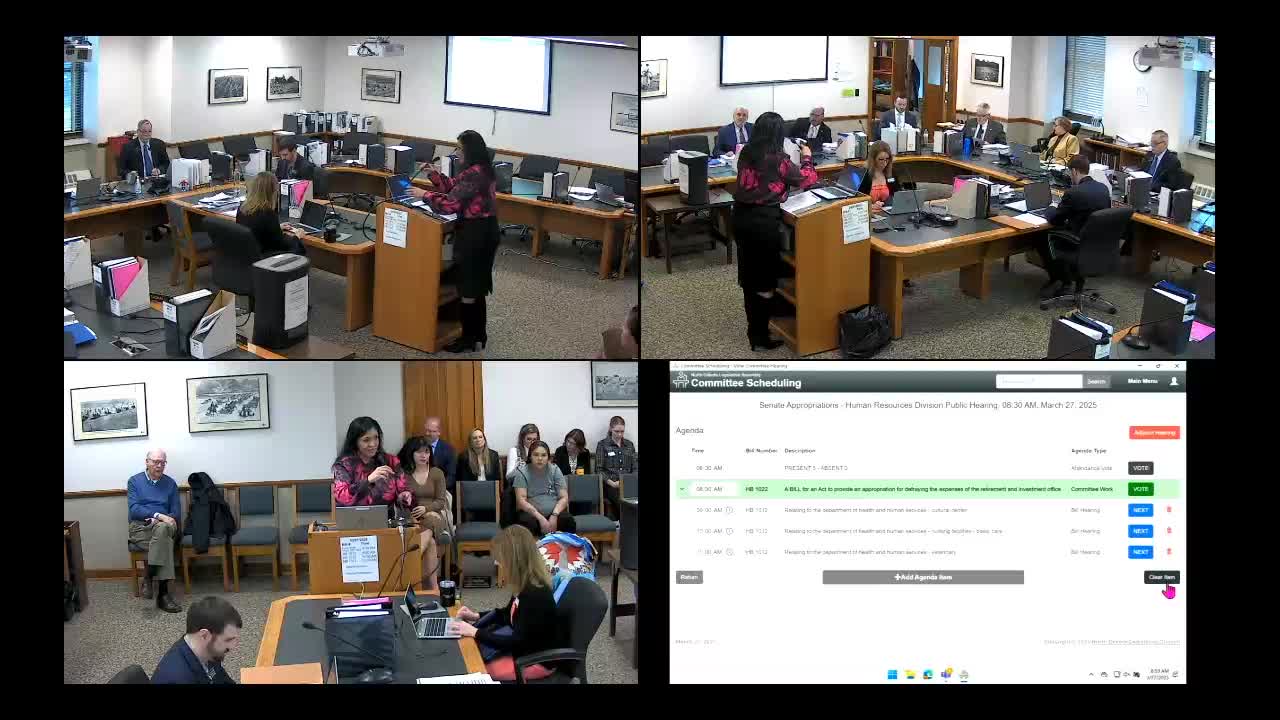
Native Inc. testified in support of House Bill 10-12 and asked the Senate Appropriations — Human Resources Division to change a land‑purchase trigger in section 7, and to add $900,000 for cultural programming in Bismarck to sustain services when federal grant funding ends.
Lorraine Davis, founder and CEO of Native Inc., asked the Senate Appropriations — Human Resources Division to amend House Bill 10-12’s cultural center language to release the bill’s $1 million line item when at least half of the funds needed to purchase the land are raised, rather than when half of the total project cost is raised.
Davis told the committee the cultural center is a roughly $40 million project; the land alone has an estimated cost of about $5 million and the organization expects to raise a large portion of the land cost through private and tribal donations and philanthropy. Davis described program elements that would be housed in the center — a gymnasium available for public use, auditorium space, community kitchen, storefronts for Native artisans, office space for human-services programming, art gallery and a healing room designed without windows for cultural ceremonies — and said an architect and development team had offered services pro bono.
Davis also asked the committee to add $900,000 to support cultural programming in Bismarck. She said Native Inc. received a federal culturally specific grant in prior years that covered programming in Fargo and Grand Forks but the same geography rules prevented funding for Bismarck in a subsequent award. That federal grant supported cultural-services staff and activities she called critical to behavioral-health and prevention supports; she described the programming as a bridge to build trust and reduce emergency-room utilization and long-term costs by addressing underlying trauma and behavioral-health needs.
During questions, senators asked about governance (Davis said Native Inc. has a seven-member board that would operate the cultural center), fundraising progress (Davis said the capital campaign was starting and pledges from tribes were in process but no cash had been collected yet), and location (she identified a site north of Legacy High School where the group plans to acquire 11–14 acres). A committee member asked whether the $1 million line item in the bill — currently conditioned on 50 percent of total project funds being raised — should be changed to relate to land acquisition; Davis responded that tying release to 50 percent of the land cost would allow land purchase sooner and allow the project to proceed in stages.
Several public witnesses also described program impacts. Sherilyn Reese, a Native Inc. program participant, told the committee she had used Native Inc.’s cultural and healing programs and linked participation to sobriety, improved family stability and increased ability to remain housed.
Davis said Native Inc. intends to continue pursuing federal funding and philanthropic support for the cultural center but asked for the state change to the bill so land acquisition can proceed earlier in the campaign. Committee members did not adopt the change on the record during the session's testimony period; staff and legislators asked questions and said they would continue to consider the request as House Bill 10-12 moved through committee processes.