Get Full Government Meeting Transcripts, Videos, & Alerts Forever!
Get email alerts on the Veterans Claims Accreditation topic
No spam. Unsubscribe anytime.
Committee reconsiders veterans-assistance bill; debate centers on accreditation and private preparer services
Summary
The committee voted to take HB 1169 back up and advanced it to the Senate floor after hearing from the state veterans commissioner, private veteran-claim preparers and the Attorney General's office about whether state law should require people who assist veterans to follow federal VA accreditation rules.
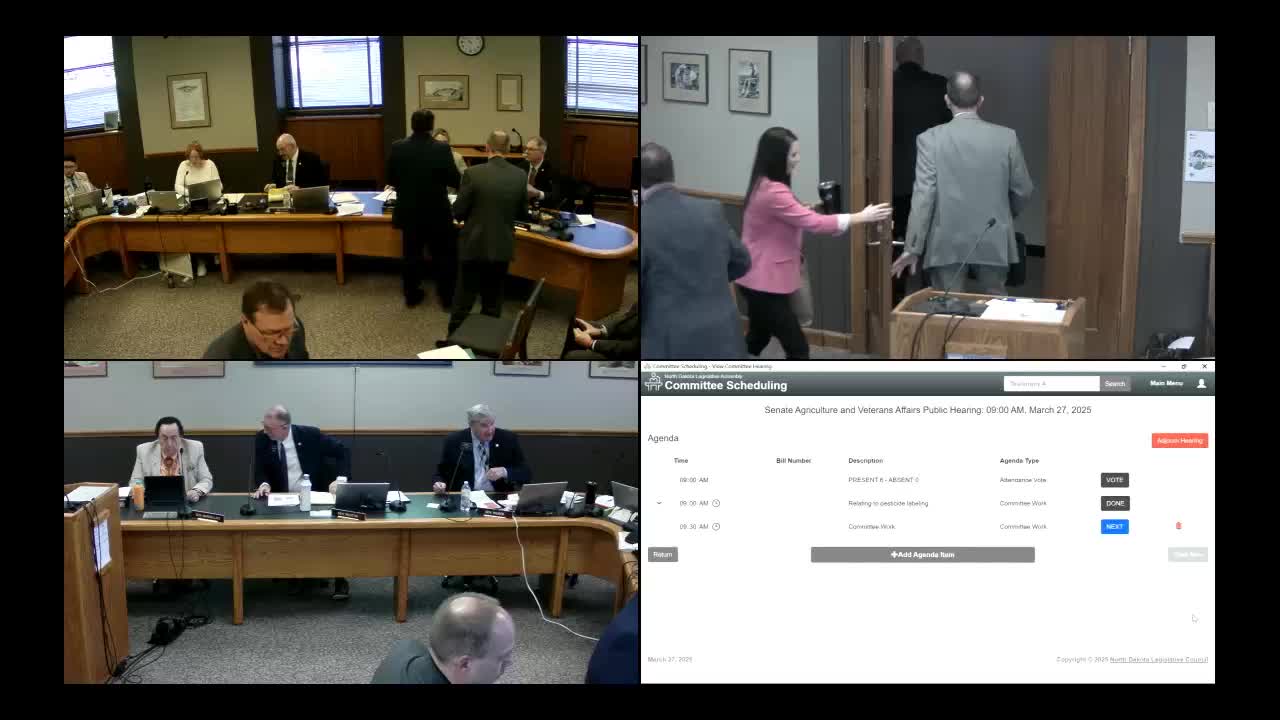
The Senate Agriculture and Veterans Affairs Committee reopened and advanced House Bill 1169 after hearing testimony about whether individuals or businesses that assist veterans in preparing claims must be accredited under federal Veterans Affairs rules.
The bill as discussed would require that persons who assist veterans in compiling or filing VA benefit claims follow federal law on accreditation and would prohibit receiving compensation for unaccredited assistance in certain circumstances. Lonnie Wangen, Commissioner of Veterans Affairs for North Dakota, said the amendment’s intent is to require those who assist veterans to follow federal rules and to provide a state enforcement mechanism where none exists now.
“By federal law you need to be accredited to prepare, assist and present claims to the VA,” Commissioner Wangen told the committee, describing cases where veterans later discovered they owed fees or had duplicate assistance because unaccredited preparers were involved.
Private companies that provide preparatory services told the committee their business model is lawful under current federal guidance when the preparer does not “assist in preparation, presentation or prosecution” before the VA. Amy Cleary of the GA Group, representing Veteran Benefits Guide, said private preparers provide a choice for veterans who want non‑accredited help assembling their paperwork and that adding a state requirement to force accreditation would make those private services untenable. “The adoption of that amendment would render the bill nullified,” Cleary told the committee, saying the firms comply with federal limits on representation and charge for work that is allowed.
The Attorney General’s office and the VA Office of General Counsel were cited by multiple witnesses. Assistant Attorney General Mark Openshaw said the VA’s Office of General Counsel guidance distinguishes between preparatory, nonrepresentational services and activities that constitute practice before the VA and therefore require accreditation. Openshaw and other witnesses also told the committee that the VA’s guidance is not the product of extensive federal case law, producing some legal uncertainty about how a court would treat borderline activities.
Committee action: after procedural votes to reconsider the bill, the committee moved to advance HB 1169 as the committee had previously amended it; Senator Meerdal was identified to carry the bill to the floor. Committee members said they would consult further with the Attorney General’s office and congressional activity (bills pending in Congress) before final action on related statutory language.
Why it matters: the bill seeks to protect veterans from fee charges by unaccredited preparers and to codify enforcement under state law; opponents say state requirements should not block private, lawful preparers from offering services veterans want.
Next steps: the committee advanced the bill to the Senate floor. Committee members indicated interest in monitoring pending federal legislation that would modify accreditation rules and possible state–federal interactions.
(Reporting note: testimony and quoted material in this article come from the committee hearing transcript of March 21, 2025.)