Get Full Government Meeting Transcripts, Videos, & Alerts Forever!
Get email alerts on the Time Zone Policy topic
No spam. Unsubscribe anytime.
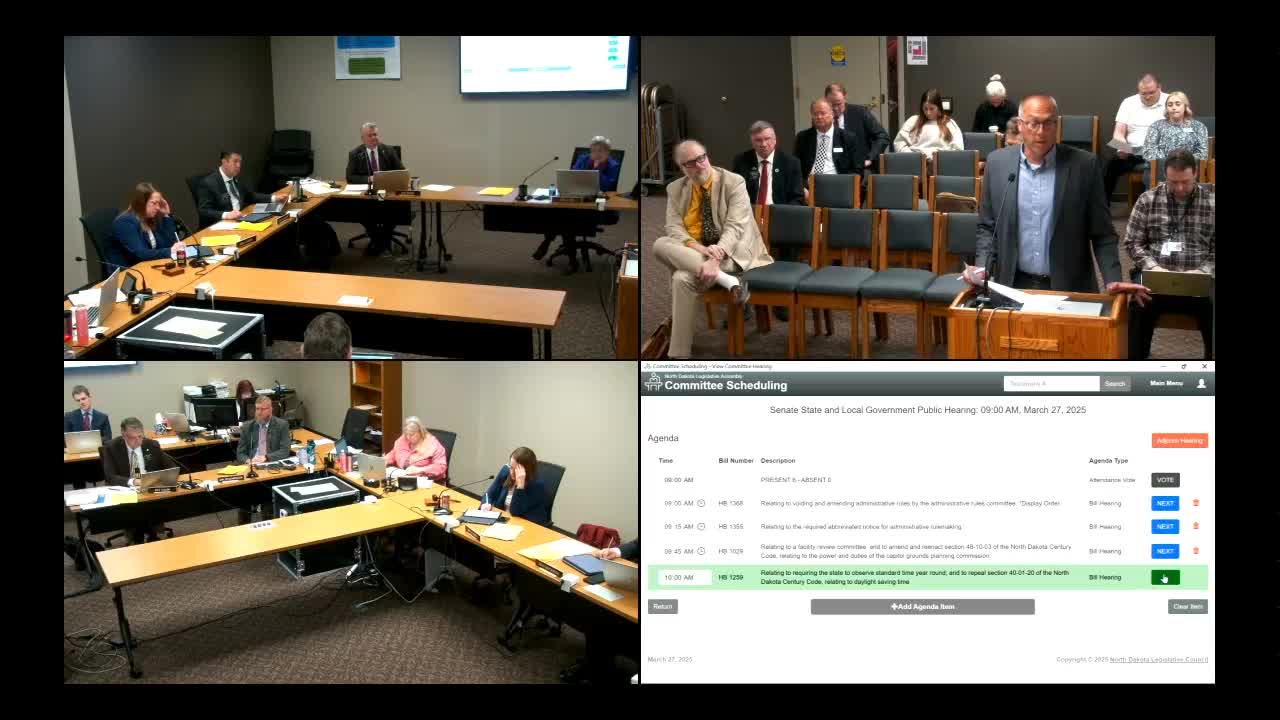
Mixed testimony as committee hears bill to end clock changes and adopt permanent standard time
Summary
Representative Roger Mackey opened a hearing on House Bill 1259, which would stop twice‑yearly clock changes and move North Dakota to permanent standard time with contingent triggers tied to neighboring states and federal action.
Representative Roger Mackey, prime sponsor of House Bill 1259, told the State and Local Government Committee the bill’s aim is simple: “stop changing the clock.” Mackey said he amended the bill to add triggers so North Dakota would move to year‑round standard time only when neighboring states (he referenced South Dakota and Montana) coordinated and federal law allowed later change to permanent daylight time if desired.
Supporters framed the measure as a public‑health policy. JP (Mr. P), president of the nonprofit Safe Standard Time and co‑chair of the Coalition for Permanent Standard Time, said, “Daylight saving time does not create daylight. It is a mandate to wake early and to sleep less.” Doctor Seema Khosla, a sleep medicine physician in Fargo, told the committee permanent standard time most closely matches human circadian biology and warned permanent daylight time would shift sunrises later into the morning months when children and commuters need early daylight.
Opponents included business, recreation and border‑community groups who argued the change would create disruptive cross‑border time differences that harm commerce, transit operations and recreation. Eric Spencer of the Greater North Dakota Chamber said eliminating daylight saving time “does have significant economic implications … disruptions to interstate commerce,” and cited impacts on seasonal workforces, construction, tourism, and border towns where residents and businesses operate across state lines. The Fargo‑Moorhead Chamber and Grand Forks Chamber submitted similar opposition letters. Sports and youth organizations and recreation providers warned earlier sunsets would reduce usable evening hours for practices and events and could raise costs for lighting.
Transportation and logistics concerns also featured: witnesses described complications for rail dispatching, trucker logbooks and airline scheduling if North Dakota’s clock diverged seasonally from neighboring states.
Committee process: testimony ran through a broad set of stakeholders—medical professionals, advocacy groups for sleep health, chambers of commerce, parks and recreation associations, and construction industry representatives. The committee closed the hearing after extensive public comment; no committee vote on the bill was recorded in the transcript.
Ending note: The hearing showed deep division between sleep‑health advocates, who favor permanent standard time for safety and biological reasons, and business and border‑community groups, who emphasized economic, operational and logistical harms if the state diverges seasonally from neighboring states.